
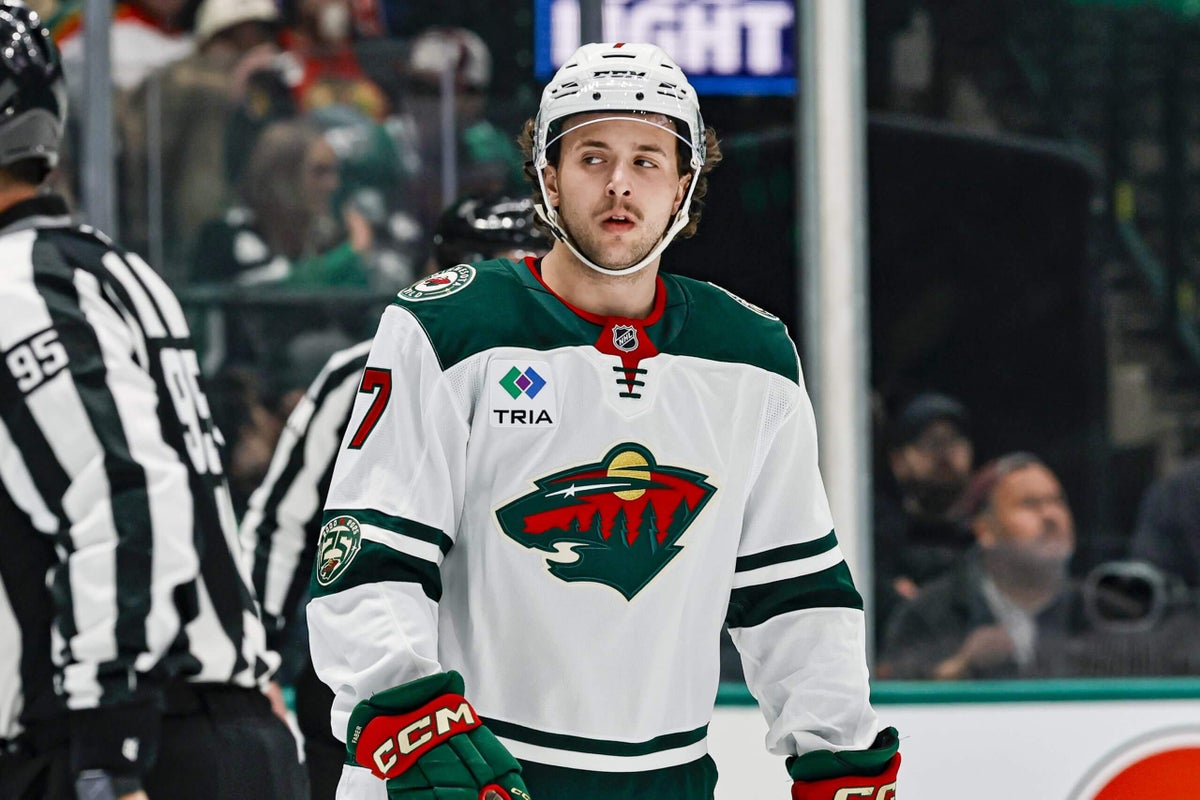
DALLAS — One of the biggest advantages the Minnesota Wild had on Saturday against the Dallas Stars was rest.
The Wild strategically sat almost every one of their top players for the last two games of the regular season. The Stars did not — and had to play on the road Wednesday in Buffalo. The Wild were done on Tuesday with a home game and got to take Wednesday off.
The Wild’s top players looked fast, fresh and full of vigor in Game 1 of the rivals’ first-round series. The Stars’ top players looked slow, tired and low on energy.
Case in point: Brock Faber.
The Wild defenseman played 82 games in his rookie season and only missed four last season. He wanted to play a full 82-game season again in 2025-26.
But after heavy minutes playing mostly with Quinn Hughes since the former Vancouver Canucks captain came over in a trade Dec. 12, and travel to and from Milan for the Olympics — plus all the hoopla that came after winning an Olympic gold medal — Faber was forced by the Wild to sit the final two games of the season, much to his chagrin.
“Hughesy, even though he was sick, in hindsight, he was going to be another one,” coach John Hynes said Sunday, a day after the Wild’s stunning 6-1 clinic over the Stars. “(Faber) was fighting us tooth and nail about playing and wanting to play the last few games and all of them, for the most part, but that’s what you love about them. They want to play. They’re competitors.
“The situation worked out, I think, for the better and even for them, experiencing that and going through that, maybe they see some benefits down the road in their careers that it might be beneficial.”
Faber really wanted to play and made his case.
Hynes had to explain to him why he was getting a forced rest and, in no uncertain terms, made clear to Faber that he wasn’t being talked out of it.
Faber relented. One week ago in St. Louis, Faber made clear to The Athletic that he didn’t want to come out of the lineup but ultimately conceded that he and Hughes were starting to bleed chances and “the breather” could be good for them.
“Obviously, it’s been a long few weeks with the stretch of the few losses in there and not playing our best,” he said last Monday.
Faber gets it now, especially after playing arguably the best playoff game of his career in Game 1.
“I think everyone was kind of in the same boat there, where you hate to watch the game from the stands but when you get told that’s what you’re doing, I think you can kind of look at it one of two ways,” he said Sunday, when he tied a team playoff record with a plus-4. “We did take advantage of the rest. Obviously, it’s been a long year for us and we just needed to do everything we could to prepare for this series and hopefully a long run here. So I think that’s what we did, and it was definitely beneficial.”
Faber recorded his first point in 13 playoff games, setting up Ryan Hartman’s goal after an impressive shift that former NHL defenseman Jason Demers broke down on X — and also led the breakout that triggered Kirill Kaprizov’s eventual game-winner. He also logged 4 minutes, 43 seconds shorthanded, while suppressing scoring chances against.
According to MoneyPuck, in 13:32 of five-on-five ice time, the Hughes-Faber pair was on the ice for three goals for and zero against, 19 shot attempts for and 11 against and had a 57.7 percent expected goals rate.
“He and Hughes were a machine on the breakout,” said ESPN color analyst Erik Johnson, who was between the benches and interviewed Faber during the first period. “Faber’s ability to check with his legs is so impressive. He didn’t allow Dallas to get their rush going at all. He was on top of those guys all night. He had his fingerprints all over that game. He only had an assist but may have been their best player.”
And that’s saying something considering Kaprizov scored a goal and two assists, Matt Boldy scored two goals and an assist and Joel Eriksson Ek scored two power-play goals.
In 2023, Faber played the final two regular-season games after losing in the NCAA championship game in Tampa, Fla. The then-University of Minnesota captain was not supposed to play any playoff games, but he was so impressive in those final two games that he played all six playoff games against Dallas instead of veteran Alex Goligoski. He wasn’t on the ice for a single goal against.
Still, Faber played sheltered, limited minutes on the third pair. Not anymore.
Not when you’ve developed into one of the top two-way, top-pair defensemen in the league. Not when you play with Hughes.
That’s also why he felt so much more at ease Saturday than he did in Game 1 three postseasons ago.
“I think we all just played the game the right way,” Faber said. “We played simple when we needed to play simple, and we pushed when we needed to push. And obviously, there’s a comfort level when you have a few (playoff games) under your belt and you obviously have a few bad ones under your belt. You kind of get used to the noise and the lights and the nerves.
“So just a lot more excitement (Saturday). It was hard to play a bad game when we all played with the mindset that we did.”
Faber played to his identity, Hynes said, defending hard, being physical, playing fast and moving the puck efficiently.
“I’ve been playing with Brock for 45 games, maybe a little more now, and like I’ve been saying, the more we play together, the more we’re going to grow together and he can pick my brain,” Hughes said. “Like he knows where I want the puck, and I know where he wants the puck. Just kind of be able to read off each other without having to say anything. He’s obviously a really gifted player — can skate, really skate, competitive, defends, can chip in offensively — and is a great guy.
“So, it’s a massive piece for us, and as we go forward, we’re just going to have to continue to elevate, but I thought he was excellent tonight.”
Hughes logged 24 ½ minutes — more than three minutes below his league-leading average ice time during the regular season. Part of the reason was that the Wild didn’t need to push him, considering they played with such a large lead. Part of it was that he was coming off an illness that kept him off the ice for seven days.
“Obviously, he had a tough week there, and he stepped right back and could have played 30 minutes and not even been fazed by it, and that’s what makes him so special,” Faber said.
Ditto for Faber, though, who was a 30-minute-a-night machine during his Calder Trophy runner-up season. But he’s a better, more mature and more physically developed now, especially compared to the one who debuted in that 2023 series against the Stars.
For one, he’s a mainstay now and feels much more part of it, compared to then.
“Obviously, coming from college, you don’t go through the whole ups and downs that all the guys went through to get to the playoffs,” Faber said last week. “It’s definitely a feeling of more, like, pride, to want to win and want to be at your best and get past Dallas. So definitely a lot more goes into it when you go through the whole year of working toward one goal, and that’s to make the playoffs. Definitely, you realize how much work that comes from doing this.”
The Wild have never led a series 2-0 in their 25-year history. Faber wants that to end, heading back to Minnesota for Game 3.
“We took it to them (Saturday) night, but that’s in the past now,” Faber said. “They’re going to have a response, and we need to continue to get better in all aspects.”