
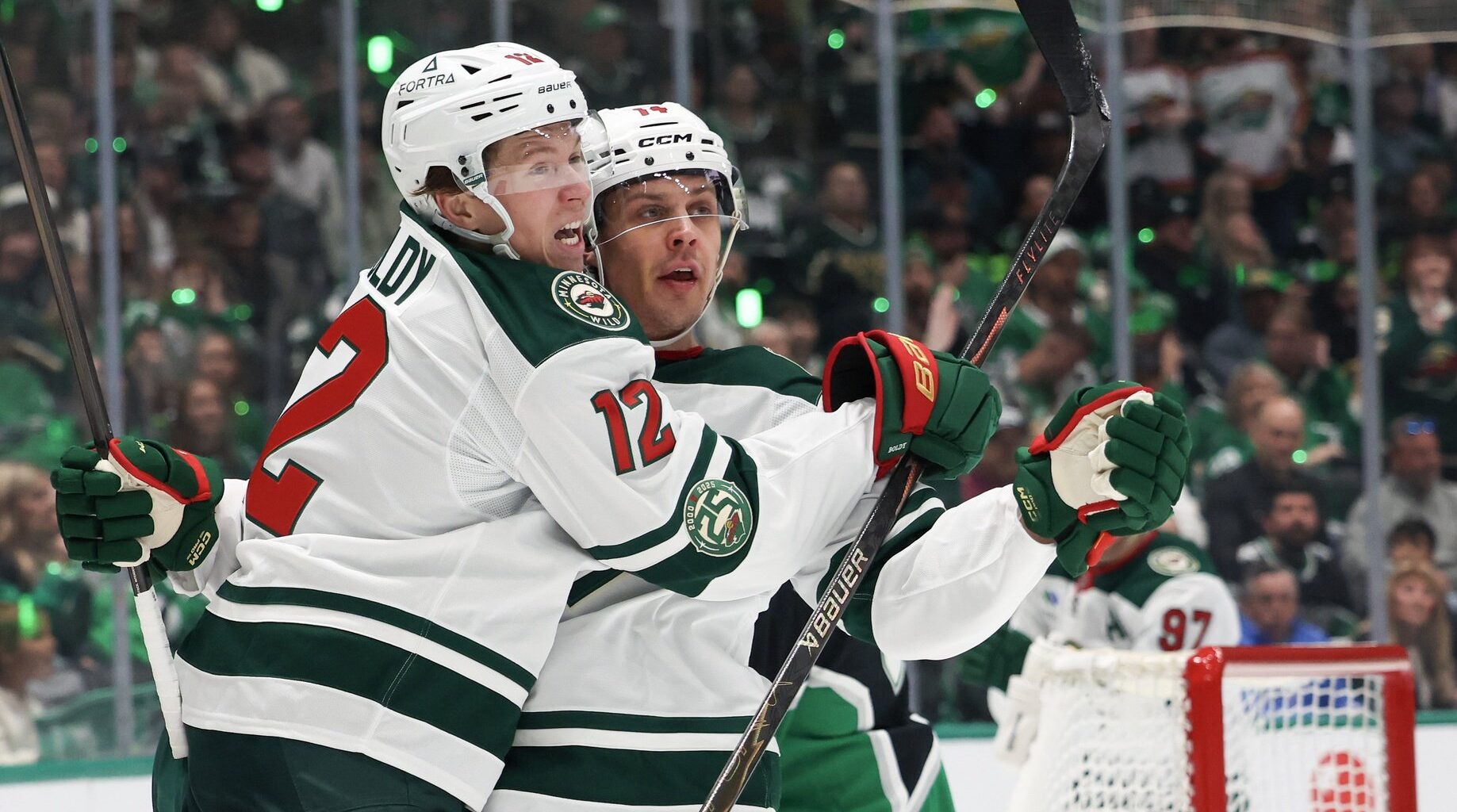
Saturday afternoon was a major victory for fans of old-time hockey.
The playoffs kicked off, and bodies started hitting the boards. Pucks were in deep, if not at the net. And leading the Wild in power play goals was none other than hard-nosed, no-nonsense, two-way forward Joel Eriksson Ek.
The nerds told you that it couldn’t be done, but a man with meat hooks for hands was instrumental for the Wild’s man-advantage unit, including the crucial First Goal Of The Game.
Those familiar with the Wild know that this guy is more famous for his punchable face than his scoring touch. He’s arguably only on the power play because he’s decent at faceoffs and attracts attention at the net.
All that tees up the burning question — how did he do it?
It all comes down to Dallas’s penalty kill game plan. In Game 1, their shorthanded unit came out in an aggressive 2-2 box shape. The box is a popular shape because it allows defensemen to cover the net while forwards cover the high slot. Neither position group has to change its reads very much. Jack Han diagrams this nicely in his book, Hockey Tactics 2026.

There are two different styles for the defending team to play from this formation — aggressive (the “Large Box”) or passive (the “Small Box”). While the small box allows the forwards to provide support in the slot, Dallas opted to deploy the large box instead.
For a Wild team that has struggled to maintain power play possession in the past, the large box is a sensible choice. The Stars give their penalty-killing forwards free rein to pressure the puck carrier and take away passing lanes. This often leads to broken entries by the power play and easy clearances for the killers. It can even lead to shorthanded breakaways.
Enter Quinn Hughes and, suddenly, the Wild don’t have as much trouble holding the zone.
Quick passes are the death of the Large Box system. When the opposing power play can work through the two pressuring forwards, it usually leads to a three-on-two chance near the net. If the passes connect in a short period of time, there’s no chance for either shorthanded forward to help at the net.
That’s precisely what happened on Eriksson Ek’s first goal. After the kill shrinks into Matt Boldy’s entry, he makes a slick kickout pass to Kirill Kaprizov. The large box immediately fans out to contest the new puck carrier. However, Kaprizov, Hughes, and Mats Zuccarello quickly work the puck away from pressure and down low to Boldy.
Kaprizov beats his check to the back door because the initial pressure pulls Dallas’s forward group out of position. The two defensemen can’t cover all three of Boldy, Kaprizov, and Eriksson Ek. While Dallas gets good pressure on the entry and defends Minnesota’s two most dangerous scoring threats (a Boldy drive to the net or a Kaprizov one-timer), it leaves a void in the middle of the ice, where Eriksson Ek’s stick blade waits for a gorgeous opportunity.
Later in the game, Dallas devoted more attention to the net-front. Open one-timers in the slot tend to have that effect on a penalty kill. But, since the defender nearest the puck was at the front of the net, he wasn’t available to gather a rebound in the corner.
This time, Kaprizov and Zuccarello relieve the pressure by working together behind the net, passing around the pressuring defenseman. Eriksson Ek scores from nearly the same spot as his last goal. If that wasn’t open, Kaprizov could likely have also skated behind the net and fed Hughes a one-timer at the right circle.

On the one hand, Dallas’s plan was successful. The Stars limited Kaprizov, Boldy, Hughes, and Zuccarello to a combined zero goals. However, Eriksson Ek proved he’s a threat whom they must respect. They’ll likely shape-shift in Game 2.
Han notes that Dallas deploys two shapes on the penalty kill. Instead of the box, Dallas sometimes deploys a 1-2-1 diamond shape.

The main benefit of the diamond is that it won’t leave a passing lane open to the net-front. The strong-side defenseman skates to attack the puck carrier, and the strong-side forward covers the passing lanes to the point and to the far-side flank. The weak-side defenseman and weak-side forward work together to cover the slot and the crease. In theory, it should neutralize the opposing power-play’s net-front player. For the Wild, that player is Eriksson Ek.
Minnesota also has built-in answers to attack the diamond. While the penalty-killing forwards should theoretically limit cross-ice passes, it’s difficult in practice. It’s risky business for shorthanded skaters to take their eyes off the puck, but that takes attention away from the back-door one-timer.
If Dallas decides to shift to the diamond, there will be chances for Zuccarello to thread passes through to Matt Boldy on the right circle for a one-timer. If Boldy is covered, there’s a good chance that Kaprizov will be open in the high slot.
The diamond has answers to all of these threats, but they are usually shared responsibilities, which require the penalty killers to execute perfectly. And, if Dallas wants to cover Matt Boldy with a forward rather than a defenseman, John Hynes is likely elated at that idea.
The real answer here is for the Stars to stay out of the box. But, for a team that struggles to generate five-on-five scoring opportunities, that’s a tall order. Dallas has thrived under a defensive identity all season, and made their nut on the power play. Facing perhaps the best even-strength team in Wild history, they’ll need some fortunate bounces to get a lead.
If Dallas can’t get a lead five-on-five, it’s hard to imagine this Minnesota team on a parade to the penalty box.
For once, the Wild seem to have a special teams advantage in the playoffs. The man who proved it: Joel Eriksson Ek.