
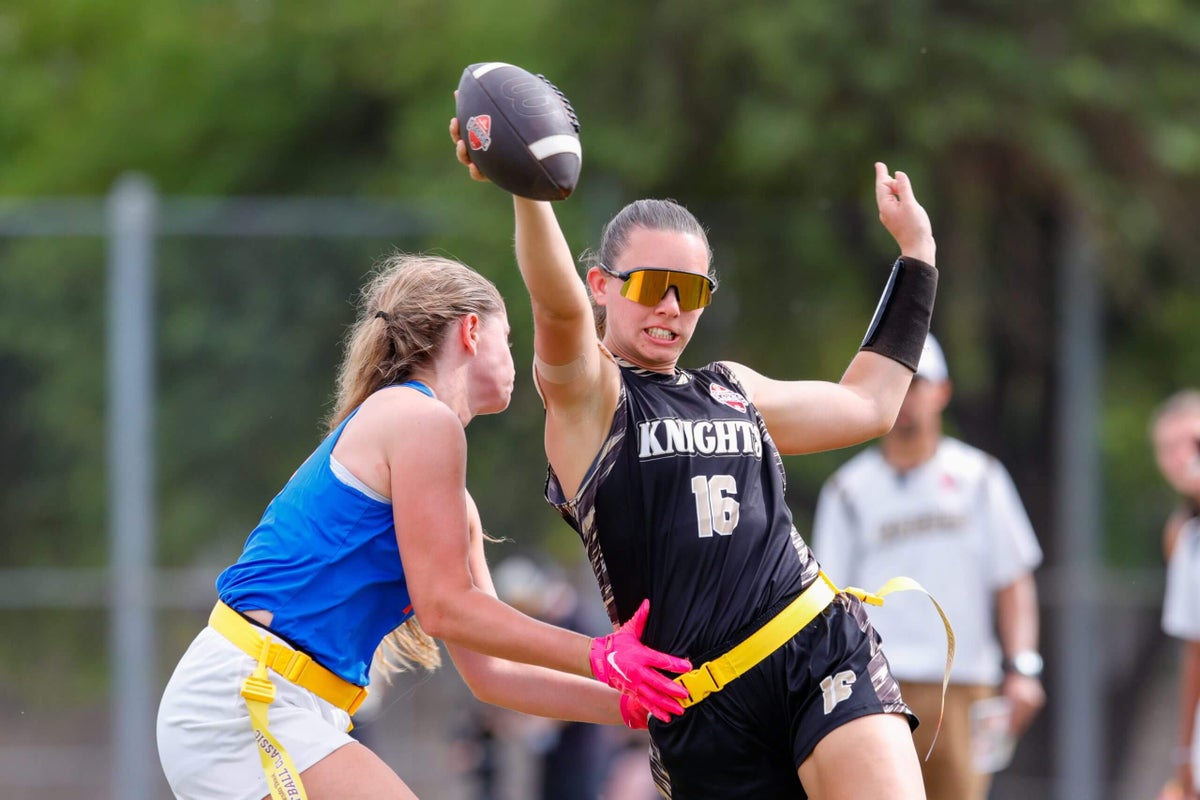
TEMPE, Ariz. — They stood tall, looking to the west end of the stadium toward the Stars and Stripes whipping in the desert breeze as the National Anthem echoed. Some shook their heads, awestruck by the stage they’d long believed could become a reality.
All those seasons scrounging for practice fields, all those long car rides to youth tournaments, all those busted fingers suffered going to grab a flag — it all meant that much more Sunday afternoon as this championship game was being broadcast live on ESPN.
As with all momentous championship football games, there was the sudden engrossing sound of an aircraft flying overhead during the anthem. Unlike the Super Bowl or College Football Playoff, however, they weren’t F-16s streaming low over thousands in attendance. They were Southwest Airlines flights ascending after takeoff from Phoenix’s Sky Harbor International Airport.
Nobody was arguing the semantics of ambiance. Like everything else, the University of Central Florida Knights and Florida Gators leaned into the weight of the moment and let the reality sink in. The in-state rivals were facing off with a hefty trophy on the line, but they believed the results were already solidified regardless of who won.
“This is just the start,” said UCF’s Elian Higbie-Long, “and this is a big start.”
The inaugural Fiesta Bowl Flag Football Classic featured eight teams from around the country in a two-day tournament on Arizona State’s campus. Sponsors transformed intramural fields into a sprawling event that featured 18 games in less than 48 hours. Over those two days, 140 athletes from UCF, Florida, Georgia, ASU, Charlotte, Grand Canyon, Alabama State and USC faced off in the first Division I women’s flag football tournament.
More than 2,000 tickets were sold for the event. The semifinal and final games aired live on ESPNU on Sunday afternoon. Fans brought cowbells and rang them at will. Florida had an inflatable alligator on its sideline to commemorate highlights. While players escaped the heat between games, they performed TikTok dances together. Fans questioned offensive play calls and hollered about timeout usage. It was a weekend of, well, football.
Flag football was known as a niche offshoot of football and primarily an intramural collegiate sport, but over the last several years, its reach has overtaken the youth sports realm. In the last year, 2.5 million girls played organized youth and high school flag football.
According to USA Football, the number of girls aged 6 to 12 playing flag football increased by 283 percent from 2015 to 2024. A sliver of that number was represented this past weekend in Tempe. On Sunday afternoon, UCF defeated in-state rival Florida 19-7 in the championship game held inside Sun Devil Soccer Stadium.
“This event itself is a pivotal moment in women’s flag football,” said UCF junior quarterback Kayla Ludwig, whose 44-yard touchdown run late in the fourth quarter sealed the victory for the Knights.
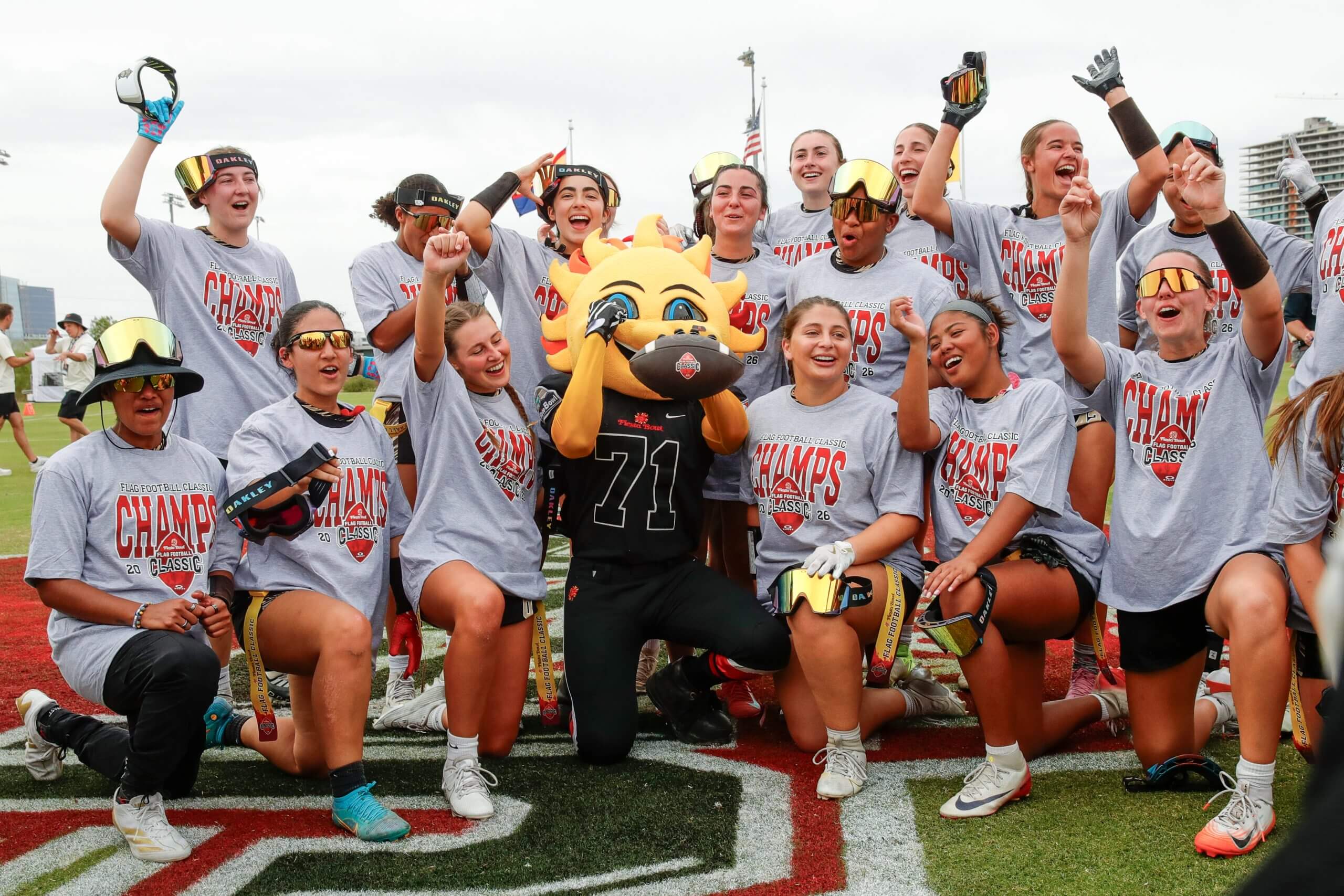
UCF won the Fiesta Bowl Classic championship 19-7 in a “pivotal moment” for the sport. (Patty Kennedy / Fiesta Sports Foundation)
The sport’s explosion onto the national scene has yet to earn it official NCAA scholarship-level status. Women’s flag football is currently one of four sports on the NCAA’s Emerging Sports for Women program alongside rugby, equestrian and triathlon.
Gretchen Miron, director of education and external engagement with the NCAA, is part of the emerging sports program. Miron said the significant uptick in investment in women’s sports in the last decade will only help flag football’s popularity continue to soar.
Miron said sports in the emerging women’s program need at least 40 Division I teams nationwide to move on to the next phase of the process. It’s estimated that more than 60 Division I programs will compete this spring. Anything above 40 in Year 1, Miron said, shows significant staying power.
Of the eight teams that competed at the Fiesta Bowl Classic, only one, Alabama State, is a varsity-level program recognized by its athletic department. The rest are either well-established or newly established club teams. UCF’s women’s team started in 2013, Baroody said, but didn’t start officially competing at the national level until 2021.
One of the programs competing in Tempe didn’t even exist in December. USC’s club team came together all of three months ago, when 19-year-old freshman Alia Pasternak took it upon herself to get a team off the ground. Pasternak started playing at the high school level in 2023 when it became an official CIF varsity sport her junior year at Huntington Beach High. She posted about tryouts on social media, and within days had over 100 interested players.
The USC program officially started on January 12 and now has two teams: a competitive team like the one that came to Tempe and a developmental team that is learning to play. Pasternak was named to the all-tournament team over the weekend and proudly clutched her diamond-encrusted Fiesta Bowl emblem gold necklace.
“It’s an opportunity to show our athletic department that this needs to be a varsity sport,” she said. “That’s my goal with our program, to create a statement powerful enough to show them that it is flag football’s time, and there’s interest to back it.”
Once the spring season ends, Miron said a committee on access, opportunity and impact would aim to vote and recommend that the Division I, II and III levels establish a nationwide championship allowing all participating schools to compete.
“They’re on track,” Miron said.
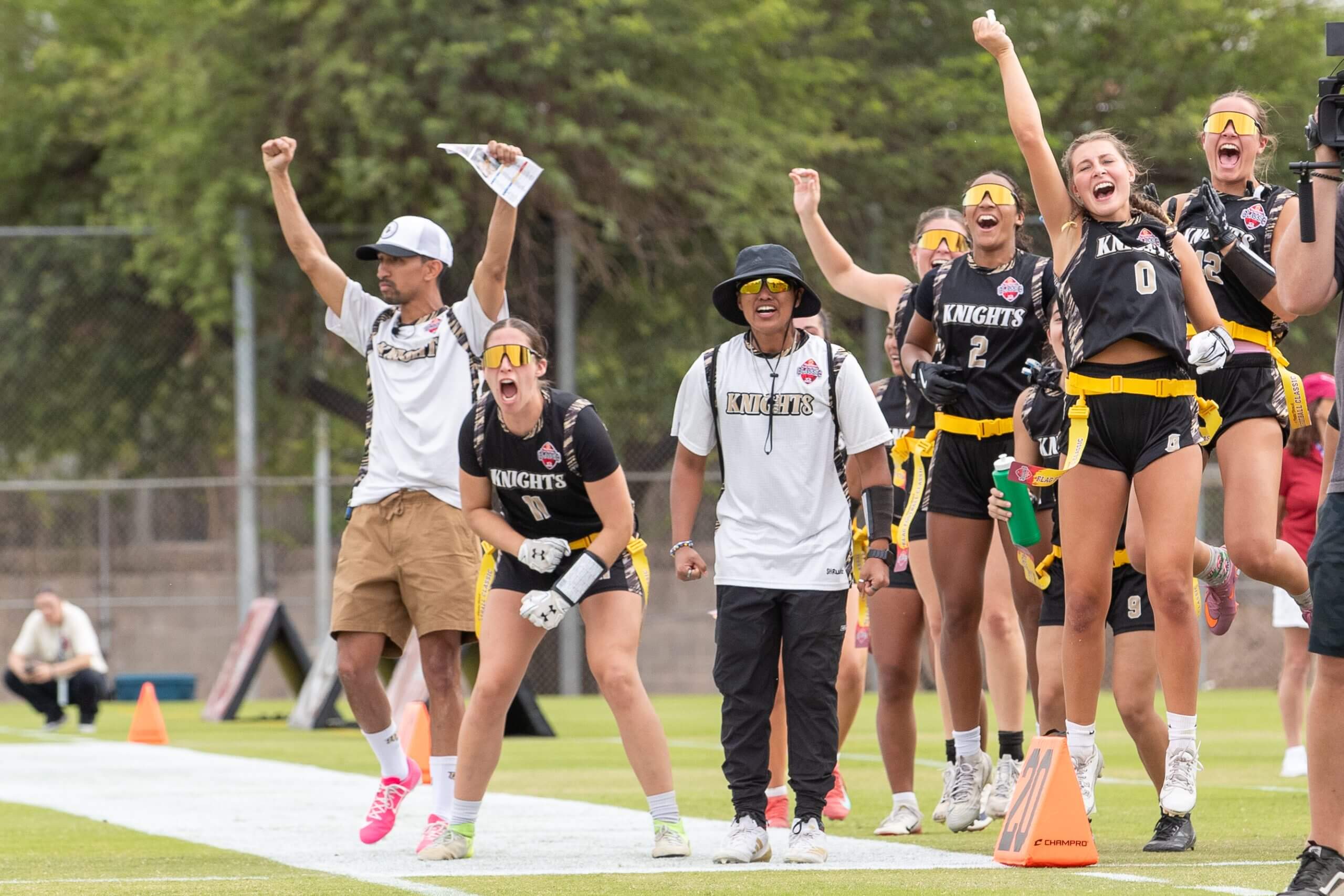
(Patty Kennedy / Fiesta Sports Foundation)
At least one Power 4 conference is already voicing its interest in adding flag football. Scott Draper, the Big 12 Conference’s chief football and operating officer, told The Athletic that one of the conference’s priorities soon after Commissioner Brett Yormark was hired in 2022 was to study women’s flag football. A year later, when it was officially added to the Olympic Summer Games starting in Los Angeles in 2028, that was the real “jumping off point,” Draper said.
Of the 16 Big 12 members, Draper said there are already a few universities interested in adding it, with more schools keeping it under consideration.
According to Miron, if flag football meets all the requirements and is greenlit throughout the various voting stages by the NCAA, the first official NCAA women’s flag football championship tournament would be in the spring of 2028, just a few months before the Olympics in L.A.
“We showed the world that flag football can be a female sport and that it deserves to be on the NCAA stage,” UCF coach Brandon Baroody said.
Alabama State head coach Tyrone Poole is a former two-time Super Bowl champion defensive back. Poole, who played 12 years in the NFL, quoted one of his favorite movies, “Talladega Nights,” in a metaphor often over the weekend: “If you aren’t first, you’re last.”
The Fiesta Sports Foundation, Poole believes, has laid the groundwork for other prominent bowl games to attempt to replicate a tournament of this stature in the future.
“People are finally putting money behind it,” he said. “Let’s not ignore the elephant in the room now.”
Poole said these flag football athletes deserve the opportunity to earn full athletic scholarships to minimize the financial burden of a college education.
“Flag football is becoming a very, very powerful sport, which is going to require very, very powerful people that have an understanding of how to make these athletes great and maximize their abilities,” he added.
Like past Fiesta Bowl participants, the players were treated to red-carpet treatment.
When the players arrived at Sky Harbor in Phoenix last week, Fiesta Bowl representatives stood waiting for them at the bottom of the long escalators in their yellow bowl game jackets. There was a dedicated Media Day on Friday for all athletes to discuss their personal paths in the sport and stylized photoshoots for social media content. The Fiesta Sports Foundation provided each team traveling in with a travel stipend, paid for all accommodations, ground transportation and meals.
Phoebe Schecter, an NFL and flag football analyst for Sky Sports, remembers when major international women’s flag football tournaments were played in the slop and mud. They used to have to walk the field before kickoff to make sure there were no mounds of dog or goose poop.
Now?
“This is the expectation,” she said, “and it should be.”