
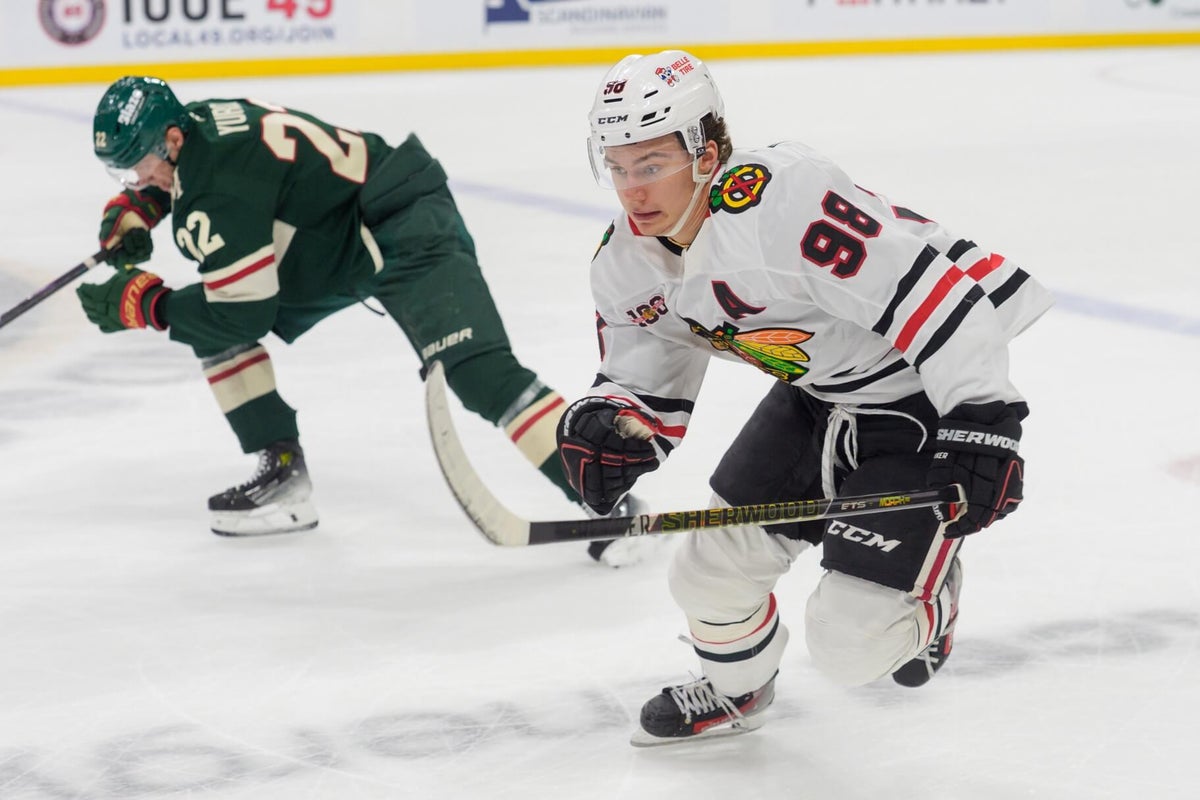
Late this season, the Chicago Blackhawks were younger than ever. Especially after the trade deadline, they were packed with drafted prospects from top to bottom. The results varied, but their play largely created hope for the future, while also providing insight into what to address this offseason.
The Blackhawks are supposed to be better next season. Chairman Danny Wirtz and general manager Kyle Davidson didn’t proclaim the 2026-27 season as must-win, but they agreed that another finish like this season — 31st in the league — would be disappointing.
To avoid that, the Blackhawks have to improve in several ways. They took a noticeable step back after the deadline and lost what coach Jeff Blashill described as team depth in the veterans who were dealt. They were among the worst teams in goals for and goals against, so both the offense and defense could use a boost. While some of that will likely come from within, Wirtz has mentioned that the plan was never meant to rebuild that way solely, so eventually, they may need to look elsewhere for help.
All of those areas of focus should make for a busy offseason. Davidson has Wirtz’s support and confidence, plus a new multi-year contract. That encourages Davidson to stay the course, but he knows the challenge ahead.
If everything breaks the right way, this is what the Blackhawks’ perfect offseason would look like:
1. Sign Connor Bedard to the longest and most team-friendly contract possible
Davidson’s funniest line during his end-of-season media availability came after a question about Bedard’s next contract.
“Yes, yes, we’d like to re-sign Connor Bedard,” Davidson said before laughing.
The Blackhawks will sign Bedard at some point in the coming months. Still, the question isn’t when, but for how long and how much. We speculated what Bedard’s next contract could look like back in November.
The Blackhawks would love to re-sign Bedard for eight years, the maximum still allowed before Sept. 16, when the limit becomes seven years, and probably in the $12 million-to-$13 million range per season. If Bedard comes in under $15 million a year on a long-term deal, the Blackhawks would be thrilled. Bedard could ask for 14 to 15 percent of the 2026-27 salary cap, regardless of how many years are attached to it — meaning $14.56 million to $15.6 million per season. That’s what stars often get. If the Blackhawks can lock him at that number for many years, that percentage will obviously shrink as the cap increases. Sidney Crosby’s famous $8.7 million cap hit was originally 15.34 percent of the cap, but dropped to 9.11 percent when he agreed to that number again in his last contract.
“You want to build a deep team. You want to build a team you feel is a championship roster, which is why we do this. So, we want to get it right. You want to make sure both sides feel like there’s common ground there. So, we’ll get down to finding that shortly,” Davidson said last week. “But certainly, we want to make sure we’re more than fair, while also understanding that there is a finite amount of money to go around to spend on our roster — again, while being fair to a very good, elite young player.”
2. Win the draft lottery
The Blackhawks are guaranteed a top-four draft pick in June. They should be able to get someone with a bright future there regardless, but the No. 1 pick would obviously open up their options.
The belief is that the Blackhawks would like to draft Gavin McKenna or Ivar Stenberg, both wingers. If the Blackhawks win the lottery, there will likely be an interesting debate on which player to take. The second pick would be welcomed, too, of course. Now, if they pick third or fourth, draft experts think one of those two wingers could still be on the board, but it would largely come down to the decisions the teams ahead of the Blackhawks make. Additionally, there are plenty of quality defensemen in the draft who could be selected in that top-four range, depending on the team.
It doesn’t sound like the Blackhawks want to trade their first pick this year. They could receive an unexpected proposal, but they’re likely to make the pick. They have only one first-round selection this year, as of now, and they would prefer it to be their last top-five pick for some time.
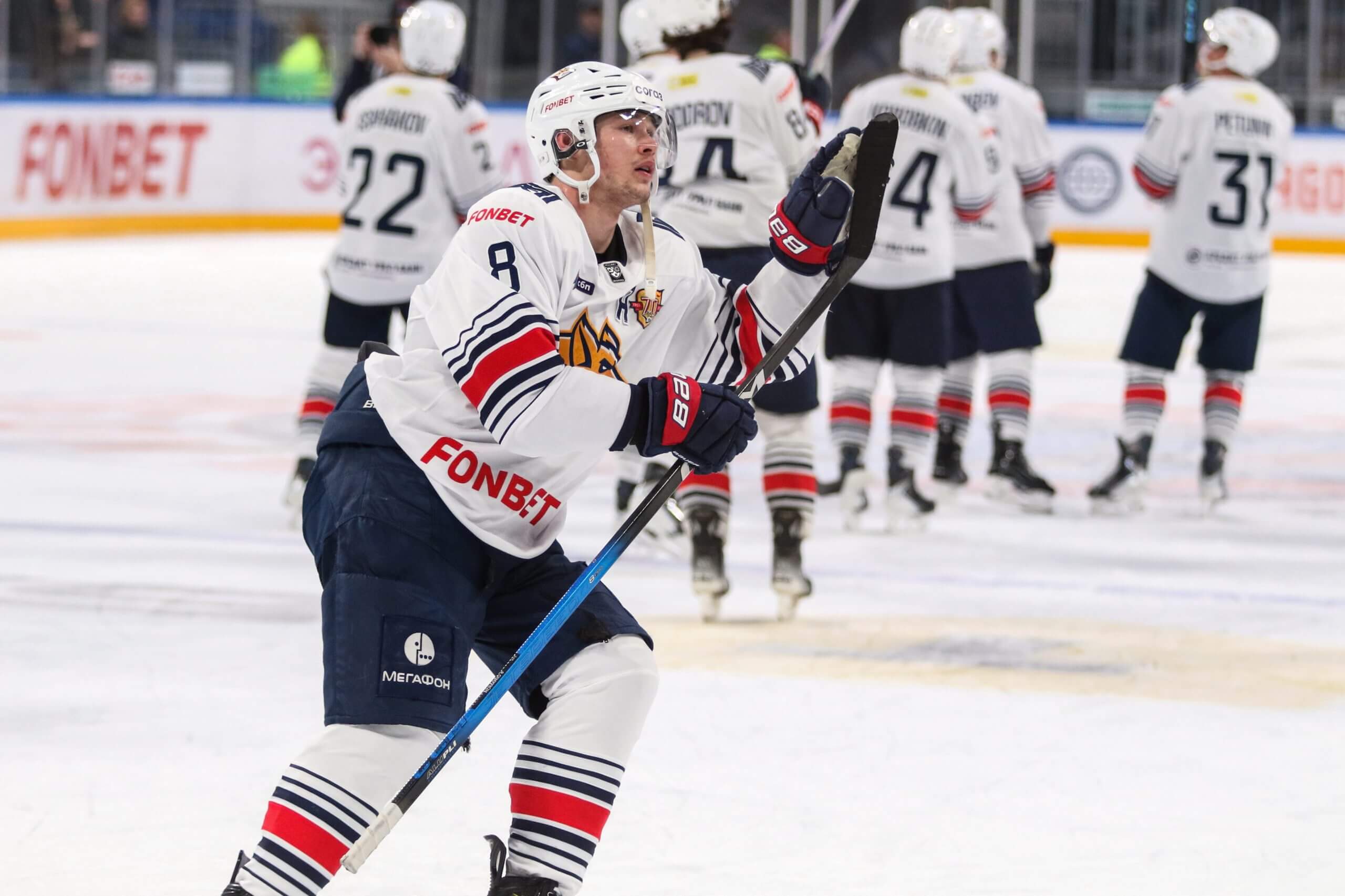
When will Roman Kantserov come to North America? (Maksim Konstantinov / SOPA Images / LightRocket via Getty Images)
3. Sign prospect Roman Kantserov to an entry-level contract for next season
Some Blackhawks fans caught that Davidson was quite vague when asked last week about adding Kantserov to next season’s team. I think it has less to do with Davidson’s concern that Kantserov won’t come over to North America and has more to do with not wanting to talk about it too publicly just yet. Kantserov has also been quiet about himself. Once the KHL playoffs are over, there should be more clarity.
I’d be shocked if Kantserov doesn’t sign with the Blackhawks for next season. He probably wouldn’t have signed his contract extension with Metallurg if he had known it would win the Gagarin Cup in 2024. Beyond that, everything is so teed up for the Blackhawks. He’s likely to get every bonus available to him in an entry-level contract. He has an NHL coach quite familiar with his game and ready to hand him a top-six forward spot, probably even on the top line. He’ll also join a team a little further in its rebuild, and he can play with a fourth-year Bedard instead of a less-polished version. The Blackhawks would never say it themselves, but it will be a massive disappointment if Kantserov doesn’t sign to play in Chicago next season.
What can Kantserov bring? The ceiling looks high after what he did this season in Russia.
4. Add a top-6 forward if Kantserov and the lottery don’t work out
The Blackhawks’ forward pool would look vastly different if they added McKenna/Stenberg and Kantserov this offseason. They’d have two more top-six winger options plus Bedard, Anton Frondell, Frank Nazar and Nick Lardis. That would give them six young offensive players. Tyler Bertuzzi gives them a seventh offensive forward for two more seasons. Ryan Greene, Oliver Moore, Ryan Donato and Teuvo Teräväinen can be plugged into holes throughout the lineup. If Ilya Mikheyev returns, he’d take another spot. Landon Slaggert is a bottom-six option. André Burakovsky and Andrew Mangiapane are signed for next season. Marek Vanacker, Sacha Boisvert and A.J. Spellacy will likely begin the season with AHL Rockford and could be options later in the season.
However, if the Blackhawks don’t draft McKenna or Stenberg and either draft another forward or a defenseman — even if Kantserov does sign — the forward pool doesn’t have the same feel. If that’s the case, the Blackhawks may look a little bit harder at potential trades or signings this offseason. All of that is easier said than done, but Davidson has the draft capital, especially in 2027, to put together some interesting trade packages. He’d likely have to give up more than picks to bring in a legitimate top-six player, especially if you’re talking about Jason Robertson, Robert Thomas or Matthew Knies.
5. Add a top-4 veteran defenseman
One of the more important things the Blackhawks learned after the trade deadline was that it might be too risky to go with such a young and inexperienced defense. Especially after Matt Grzelcyk’s injury, the Blackhawks were extremely young, with no one older than 24. While the hope is that a number of those defensemen take steps next season, there is a risk of running back the same group. Although Grzelcyk and Connor Murphy may not have the same ceiling as some of the Blackhawks’ defensemen, they brought stability to the group. Analytically, they were Chicago’s best defensemen this season.
The Blackhawks could probably sign a veteran defenseman in free agency. Would they consider bringing back Murphy? He checks a lot of boxes. Mario Ferraro and Darren Raddysh are two interesting names who could be unrestricted free agents, but both probably want more term than the Blackhawks want to give. Would John Klingberg or Jacob Trouba make sense on a short-term deal?
If the Blackhawks add a veteran defenseman, they’ll have to decide who to keep out of the lineup. Alex Vlasic, Wyatt Kaiser, Artyom Levshunov, Sam Rinzel and Kevin Korchinski have been projected to be part of the future for a while. Louis Crevier had a breakout season to join that conversation. Those would likely be the six defensemen starting next season if the Blackhawks don’t add a veteran. Ethan Del Mastro could factor into that mix, too. He is not waiver-exempt next season.
6. Re-sign Ilya Mikheyev
The Blackhawks tried to re-sign Mikheyev before the trade deadline, but he turned down their offer. They’d still like to keep him around. Their exact offer is unknown, but it is believed to be in the ballpark of his current $4.75 million cap hit for two or three years. We’ll see if the Blackhawks raise those numbers, but it could also be the best offer Mikheyev gets if he hits the open market. Some projections have him closer to a $3.75 million cap hit on a new multi-year contract.
The Blackhawks would like to bring him back because he can play up and down the lineup, he excels on the penalty kill and he has some offense to his game. He’s been helpful with Levshunov and could do the same for Kantserov.
7. Player development
The Blackhawks would love to see all of their young players return next season better than ever. Blashill gave a detailed answer about that process.
“What we do, my big focus on each one of these, is giving each player the things I think he needs to work on this summer,” Blashill said. “Some of that is off the ice, some of it’s on the ice, then we’ll follow up with their respective strength and skills coaches and make sure they know the messaging of what that is, and then keep tabs on that through the course of the summer.
“Ultimately, one of the biggest factors in individual success is inner drive. So, it ultimately falls on each individual to have that type of inner drive to want to work beyond what others are willing to do. We just have to make sure that there’s great intent in what they’re doing, that they’re not just working but working with great intent on specific areas. That’s where the communication’s critical.”