
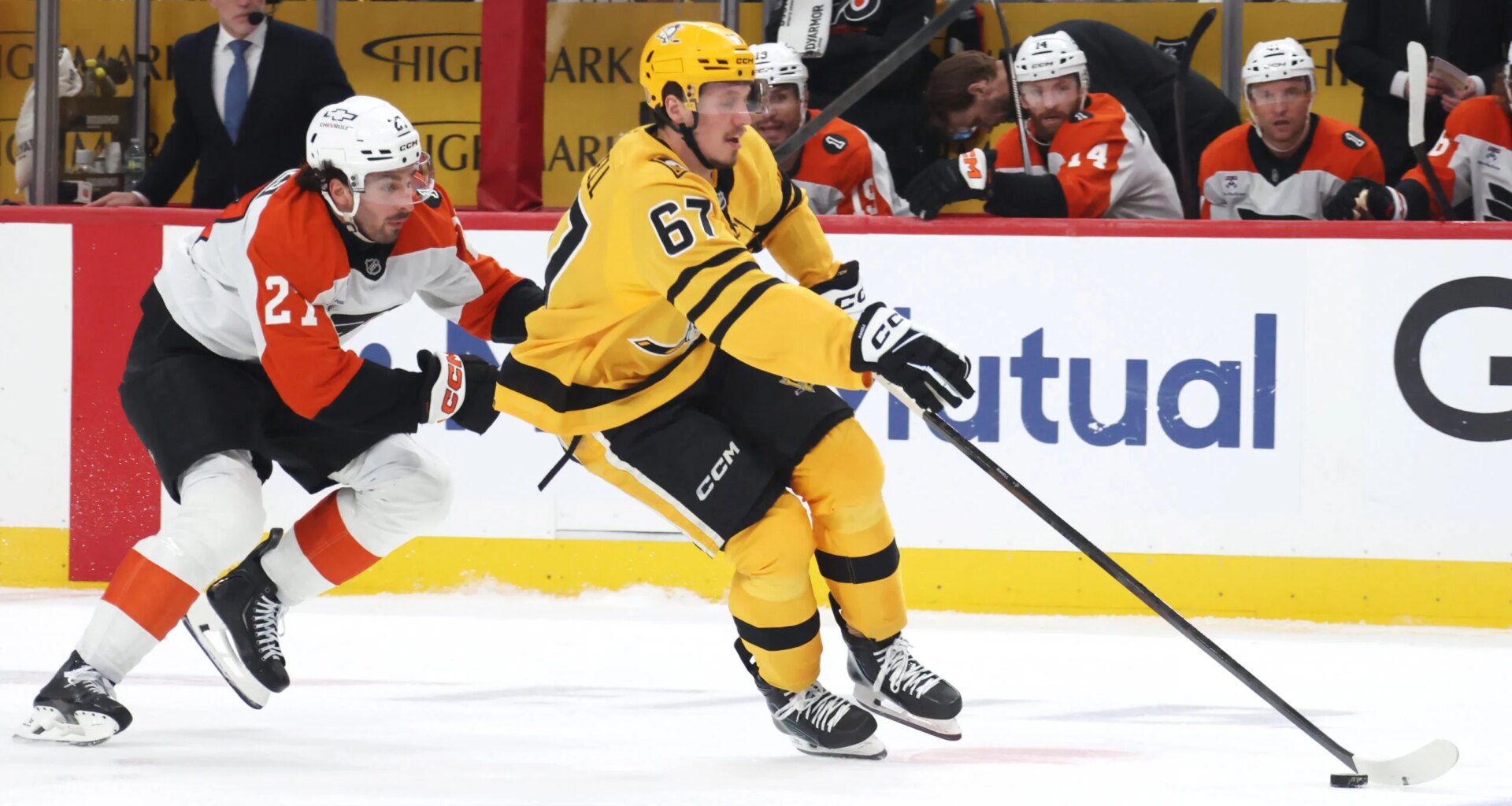
Games 1 and 2 were not just frustrating for Pittsburgh Penguins fans. The people wearing the uniforms were also grinding their teeth and dealing with the exasperation of plays not made and opportunities lost.
After just a couple of Stanley Cup Playoffs games, the Penguins’ invitation to the big dance has thus far been a vexing ticket as the Philadelphia Flyers have taken away their space, their speed game, and clean ice while replacing it with hand-to-hand combat of neutral zone trap.
Both teams had a lot of emotion, if not a little anxiety, for Game 1. The Flyers settled quickly, but as Penguins coach Dan Muse said, “we haven’t yet gotten to our game.”
And now the Penguins have one more chance to get to their game, to beat the Flyers, lest they fall into an essentially insurmountable 3-0 series hole. Sure, overcoming such a deficit is theoretically possible, and the Flyers have done it in this century (2010 Eastern Conference Semifinal vs. the Boston Bruins), but the Penguins have not yet shown an ability to win a game, let alone reel off four straight.
The Penguins need to figure out how to deal with the Flyers, and now their new enemy: Frustration.
“Yeah, obviously, it’s been a lot of frustrations for us in these two games that haven’t gone the way that we were hoping for,” said Rickard Rakell. “But at the same time, I think we’re a very tight group. We know that we’ve been through adversity before, and we know we can get ourselves out of this, but it’s gonna take everything. And I mean, we lost our first two games at home here. So we’ve just got to lay everything or leave everything on the ice for this next game.
“It’s, it’s a huge game for us.”
Yes, it very much is.
The Penguins must solve the Rubix Cube of Flyers coach Rick Tocchet’s soul sucking defensive posture, or their “Flip the Script” victory dance and the good vibrations of career years and resurgent campaigns will forever be overshadowed in Penguins history by an ugly loss to their most obnoxious rival.
Deeper into Game 2, Muse began swapping his lines back to the more traditional configuration with Rakell on Sidney Crosby’s line with Bryan Rust, and Tommy Novak in the middle of the second line with Egor Chinakhov and Evgeni Malkin.
Perhaps many fans didn’t notice the changes tactically and with personnel as the Penguins’ shots continued to leave a comet trail past the net to the glass or the protective netting. Indeed, if there is a statistic that encapsulates perfectly the potential for optimism of a better team bathing in the frustration of a team capable of taking away their game, it is the shot attempt ratio from Game 2.
The Penguins had a combined 75 shots on goal, missed shots, and shots that were blocked. Of those 75, only 27 were on net. The Flyers had just 35 combined attempts. It was the Penguins’ puck, but the Flyers happily yielded the perimeter in the offensive zone in order to protect the scoring zones.
Penguins defenseman Kris Letang knows the solution.
“I just think if you go back and you look at the film, you look at their posture, and everything else, there are plays to be made, and whether it’s simplifying (our game) or using our legs to get to the line and put it deep, and making sure we have speed on the puck,” said defenseman Kris Letang. “They’re doing a good job. And we can’t get stubborn at those lines, and we just have to find a way to transition quickly, make sure they don’t get in that posture, and from there, do what we do best and get on the forecheck.”
In Game 3, it will be the Flyers who deal with the amped energy of a home crowd that can barely be contained beyond the glass. Perhaps the overwhelming roar of a home crowd with cause the Flyers to put a skate out of place for the first time in the series, or encourage a few of the offensively minded players to take a few more risks. It’s not exactly uncommon to put on a show for the home fans.
There’s a reason it’s called “playing a perfect road game.”
The Flyers have indeed done that. Twice.
“I think there’s a number of things that could be better, in terms of the way that we can navigate (the Flyers’s defensive posture),” said Muse. “I just think the timing of it, the puck support, the willingness to just kind of take what the game gives you. You know, what they’re doing isn’t a surprise. I mean, I thought there were some moments (in Game 2) where that we played a little bit better in how we managed that. But we need to continue to–not just (attack)–but just all areas of our game continue to elevate.”
Tags: Penguins Analysis penguins game 3 Philadelphia flyers Pittsburgh Penguins Stanley Cup Playoffs
Categorized:2026 Stanley Cup Playoffs Penguins Analysis