
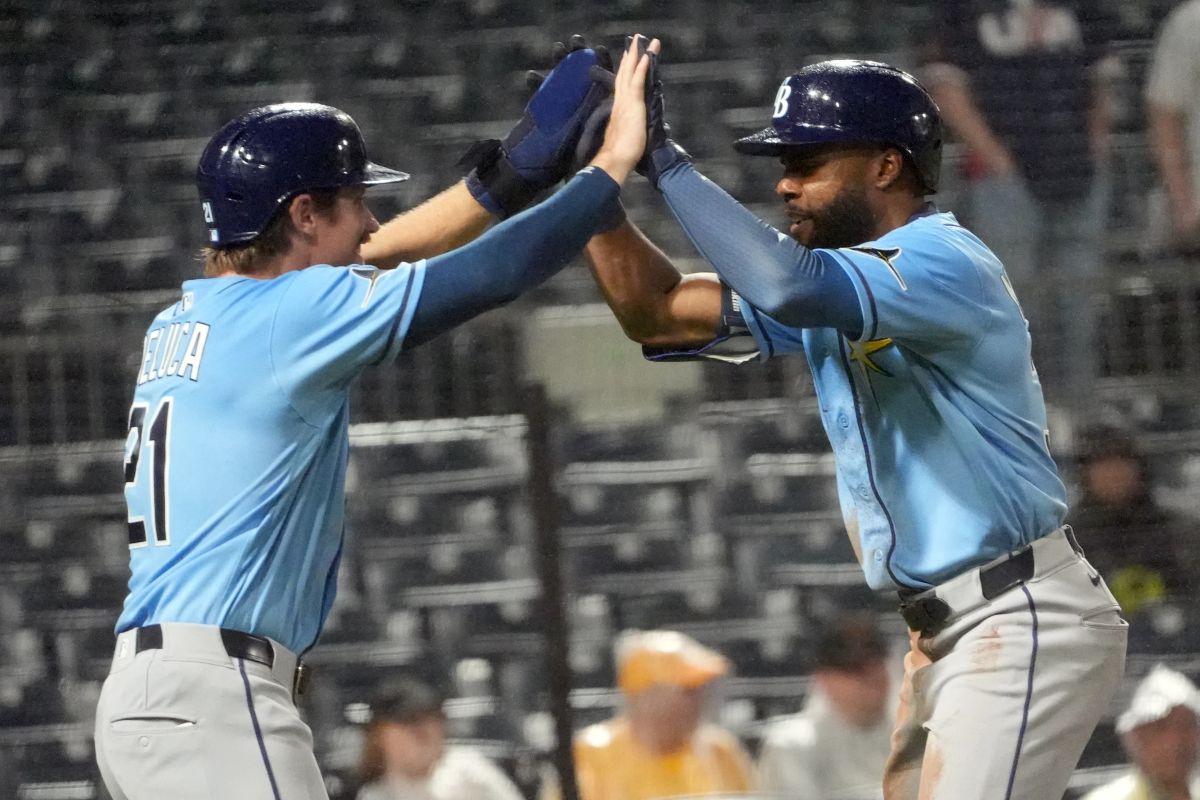
 Tampa Bay Rays’ Cedric Mullins, right, celebrates on his way back to the dugout with Jonny DeLuca after his two run home run off of Pittsburgh Pirates pitcher Yohan Ramírez thirteenth inning of a baseball game in Pittsburgh, Saturday, April 18, 2026. (AP Photo/Tom E. Puskar)
As the Lightning fans are glued to their TV sets watching the games on The Spot 66—at least for the first round of the NHL Playoffs against Montreal—about 90 miles east in Orlando and 280 miles south in Miami, the Magic and Heat, Florida’s two NBA franchises, are planning where their games will air for the 2026-2027 season. The NHL has shown Florida sports teams a better way to reach fans: put games on broadcast TV, add direct-to-consumer streaming, and build local reach, rather than waiting for cable to save the day. That model has already worked for the Tampa Bay Lightning and Florida Panthers, and it should become the blueprint for the Orlando Magic and Miami Heat as the FanDuel Sports Network era comes to an end.
The collapse of the regional sports network model has changed the conversation across the state. With Main Street Sports Group set to shut down its FanDuel-branded network operations after failing to pay rights fees, the old system that once carried local NBA and NHL games is no longer a dependable solution for Florida teams. That reality makes the NHL’s Florida playbook look less like an experiment and more like the future.
Why the NHL model works
The Lightning and Panthers have reached fans in ways their former RSN setups never could. Tampa Bay moved to Scripps Sports and The Spot Tampa Bay 66, giving viewers free over-the-air access and a streaming option through the team app, while the Panthers expanded their Scripps footprint across South Florida and added PanthersPlus.TV.
That matters because reach drives relevance. The Lightning’s distribution now includes Tampa Bay plus markets outside the core area such as Orlando, Gainesville, Tallahassee and Pensacola, while the Panthers’ games can be found on WSFL-TV, South Florida’s 9, and WFTX-TV depending on market. In a fragmented media world, that kind of visibility is stronger than a shrinking cable-only footprint.
Local News and On Air Promotion matter
The Lightning and the Rays dominate local newscasts in each of their OTA markets. Each night, the newscasts highlight the teams in sports blocks, anchors promote upcoming broadcasts, and stations build shoulder programming that RSNs rarely offer. Pre‑ and post‑game shows, player features, community‑driven segments, and cross‑platform promotion on digital and social channels all expand the team’s footprint. The result is a full‑market presence: more casual fans reached, more households touched, and more consistent brand exposure across the region. OTA partners treat the teams as marquee local content, not niche programming, and that shift has helped these franchises grow audiences at a time when cable penetration continues to decline.
What the NBA teams need
The Orlando Magic and Miami Heat now face the same question the NHL answered: how do you make games easy to find without relying on a dying RSN structure? The answer should be a hybrid model built around broadcast TV, cable/satellite distribution, and team-controlled streaming, not a wait-and-see approach.
The NBA is not ready to take over local rights for teams like MLB.TV did for the Rays and the Marlins. What the league is suggesting is that teams like the Magic and the Heat do short-term deals with local TV partners as the league works on a more long-term solution. The NBA is actively shopping a centralized local‑rights package to major streamers (Amazon, ESPN, YouTube TV, Apple, DAZN, etc.), aiming to bundle many of the 30 teams’ in‑market rights into one streaming RSN hub.
That hub is widely expected to launch in 2027‑28, after the 2026‑27 “bridge” season. But they would still face issues with cable exposure and distribution outside the local Orlando and Miami markets, where the streamers are involved. It’s not a bad plan for the NBA because streamers can pay much more than regional cable did, but there are still more questions than answers.
Meanwhile, the Heat are already discussing alternate local distribution, including the possibility of shifting games to WPLG 10 for the upcoming season. Orlando will need a similar solution, and there is no shortage of local broadcast partners willing to carry the Magic.
Baseball already proved the point
Florida’s MLB clubs are also showing the value of this shift. The Tampa Bay Rays and Miami Marlins have moved into MLB-managed distribution, with local cable and satellite coverage plus direct-to-consumer streaming through MLB.TV and team-branded streaming paths.
The Rays partner with Hearst TV for a ten-game over-the-air package. Games air on WMOR-TV in Tampa, WESH-TV and WKCF-TV/CW18 in Orlando, the MeTV multicast channel of WPBF-TV in West Palm Beach, and WBBH-TV, WZVN-TV, and WBBH’s Heroes and Icons (H&I) multicast channel in Fort Myers-Naples.
The Marlins struck a similar deal with CBS. Three games air in primetime on CBS Miami (WFOR), with the remaining seven games on its sister station CW33 (WBFS), expanding access to Marlins baseball without a subscription. Both teams pair these broadcast windows with direct-to-consumer streaming deals via MLB.TV and massive statewide cable coverage that reaches far beyond their core markets.
That is the key lesson for the NBA: fans do not want a maze of blackout rules and disappearing regional channels. They want an easy way to watch their team on TV and on streaming, and the leagues that control the full distribution chain can offer that more cleanly than the old RSN system.
Florida may turn into the clearest case study in pro sports media reform. The NHL has already used broadcast TV and direct-to-consumer streaming to broaden access, MLB has pushed its clubs into league-managed distribution with targeted over-the-air partners like Hearst and CBS, and the NBA now appears headed toward a similar reset.
For the Magic and Heat, the lesson is simple. Don’t chase the old RSN model after it has already failed; copy the Florida NHL blueprint, get on local broadcast TV, protect cable and satellite distribution where possible, and build a streaming product that makes every game easy to find.