
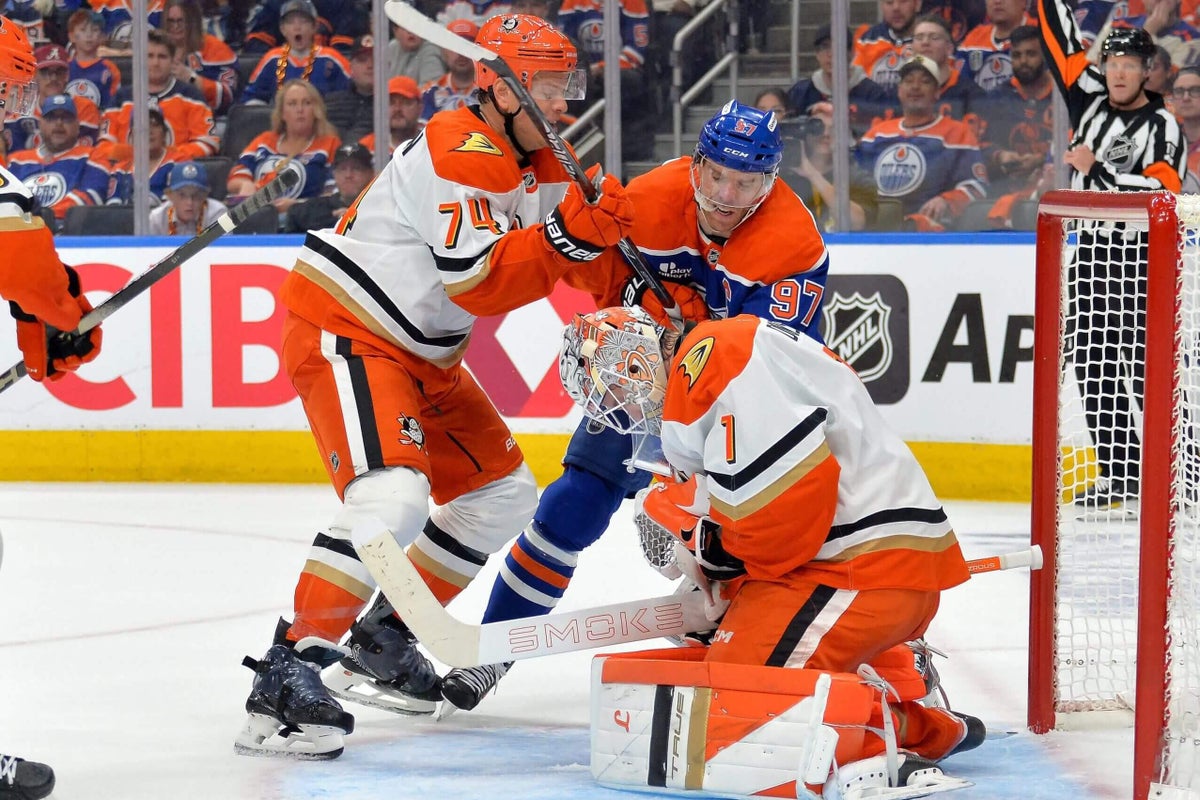
The Edmonton Oilers have a different look this spring. After making it to the Stanley Cup Final two years in a row with a veteran group, this year’s model offers plenty of youth and some unproven rookies in prominent places. The team has four lines with distinct skill sets. The defence is mobile and tough. The goaltending is unproven, but it delivered pristine results down the stretch to end the regular season.
The top two lines will play the toughest opposition during the postseason and are expected to outscore, while the third line will play lesser competition and should thrive. Edmonton’s new fourth line is a throwback trio built to hit, turn over pucks and exhaust the Ducks’ defencemen with furious work down low.
Game 1 against Anaheim, a 4-3 victory on Monday, saw the second line deliver (2-0 goals five-on-five), the third line (1-1 goals) perform well, while the other two lines went scoreless. Outscoring is the key to winning five-on-five hockey. It’s the largest game state. Edmonton reached the Cup Final one year ago with impressive outscoring depth from those veterans who are now gone. Can this version of the team duplicate or improve on last season? Is there one step beyond what we saw in the last two playoff seasons?
Last spring
Some fans may not remember this about 2025’s playoff run, but the depth lines effectively outscored the opposition through four rounds. Using centres as a proxy, here’s a look at how each line scored during the playoffs:
PlayerMinsPct (GF-GA)
207
52 (13-12)
186
47 (8-9)
177
46 (6-7)
248
63 (10-6)
152
67 (6-3)
185
64 (9-5)
All numbers five-on-five, via Natural Stat Trick
The Oilers’ third and fourth lines had exceptional results during the 2025 postseason. Ryan Nugent-Hopkins divided his time between centre and wing, while winger Mattias Janmark spent plenty of time at centre. The Connor McDavid and Leon Draisaitl minutes (together and apart) were against the best opposition, so the collective goal share (27-28) for the two men must be viewed in context. They were playing brilliant opponents every shift.
Meanwhile, the other lines were outscoring 25-14 (64 percent). The depth lines couldn’t score like the top units, but surrendered just 1.43 GA-60 while scoring 2.56 per 60. It was an underreported feat by a group of veteran support players. Meanwhile, McDavid-Draisaitl, together and apart, scored 2.84 goals-60 but allowed 2.95 goals-60.
The elephant in the room
It rarely gets discussed because there’s a mountain of goals by Edmonton that grabs all of the attention. If the Oilers are to have a different result this season, it will be necessary for all four lines to suppress opponents’ offensive output at five-on-five. Again, using the team’s centres as a proxy, and excluding the allure of goals-for, here’s what was given up on the ice over the past two years:
Player2024-252025 playoffs2025-26
2.66
3.48
3.02
3.05
2.9
2.91
2.09
2.37
2.82
2.34
1.45
2.73
2.63
1.18
2.4
2.51
1.62
2.59
All numbers five-on-five, via Natural Stat Trick
The numbers don’t lie. McDavid’s GA-60 was too high in 2024-25, and his line struggled even more in the postseason. When coach Kris Knoblauch put him with Draisaitl, the GA-60 ballooned last spring. Meanwhile, Draisaitl solo worked fine, so combining the two men meant taking an effective line out of the mix. Edmonton’s strongest lineup against top teams is two lines that are in trouble. These numbers suggest the coaching staff’s deployment last spring contributed to the team’s finishing shy of Stanley.
During the 2025-26 regular season, both of Edmonton’s top lines surrendered too many goals. All through this period, the team has been outscoring the mistakes, but as the competition gets more difficult in the playoffs, the problems become more dire. If the Oilers couldn’t outscore the mistakes in the regular season, it makes sense that the gap will increase as the competition increases along the playoff road.
Connor McDavid
The Oilers could win the Stanley Cup this spring if the top two lines commit to goal suppression. That means a lot of hard work, resisting jailbreaks before the puck is secured and the defensive zone is cleared, along with constant awareness of positioning relative to the puck.
An astute observer of the world’s best hockey player might suggest McDavid needs to shoot when his instinct is to pass (in moments when he is in a high-danger scoring area with the puck on his stick) and pass when he’s attempting to stickhandle through multiple defenders.
In Game 1 against the Ducks, McDavid found himself with a shadow on most every shift. The captain usually responds to that kind of attention by trying to do too much. He often stickhandles into the zone and tries to finesse his way through three or four defenders. It sometimes works. McDavid is so good that the impossible becomes inevitable. However, it’s a low-percentage play, and often results in a quick turnover and opportunities the other way.
McDavid would benefit by choosing a solo dash into a stacked defence less often. Dumping the puck into the corner is a boring play, but in some cases, it’s the correct one. The Ducks’ game plan against McDavid sorties is based on his established past.
Options include the dump and chase, having another forward transport the puck into the offensive zone and a quick short pass to McDavid in full flight somewhere in the neutral zone. Matt Savoie did just that during Game 1 against Anaheim, and it kick-started a great opportunity. All should be sampled, because it gives a different look to the opponent and makes the Edmonton game plan less certain.
Leon Draisaitl
The winning goal came late and was a thing of beauty. Draisaitl entered the offensive zone with a power move against two Anaheim attackers. Draisaitl drove around the back of the net, sent the puck back down low to Vasily Podkolzin, who sent a deft pass net-front to Kasperi Kapanen, who cashed in. The line scored twice, outshot the Ducks 12-4 (an impossible total at five-on-five over 12:39 playing time) and owned the high-danger chances five to zero. That’s the kind of production Knoblauch will need from the top two units.
The Draisaitl solo move that worked is reminiscent of the McDavid rushes, but Draisaitl is less predictable. He also has the edge in size, so he can leverage that advantage effectively on a solo dash.
However, there are areas that can improve and make the big centre even more formidable. Draisaitl is prone to drop passes at both blue lines, and that increases the chances of goals landing in Edmonton’s net. Draisaitl, like McDavid, should be more prudent with the puck and wait for the stars to align on a given play. Not every rush sets up a golden opportunity.
Bottom line
The Oilers have been so close to winning it all in the McDavid-Draisaitl era, and the formula for success is almost there. If McDavid uses his linemates more, or his wingers can dish him the puck when he is in full flight in the neutral zone, the stacking of the defence to stop him won’t be able to establish itself in time.
Further, if McDavid shoots more often in high-danger areas, eschewing his preference (the pass), the outscoring should take care of itself. The Oilers look like a solid team in goal and on defence, and the bottom-six forwards have been successful in recent games.
The ask of McDavid and Draisaitl is a little more discipline and some cerebral thinking. Making their next move less predictable could be key to winning the Stanley Cup.