
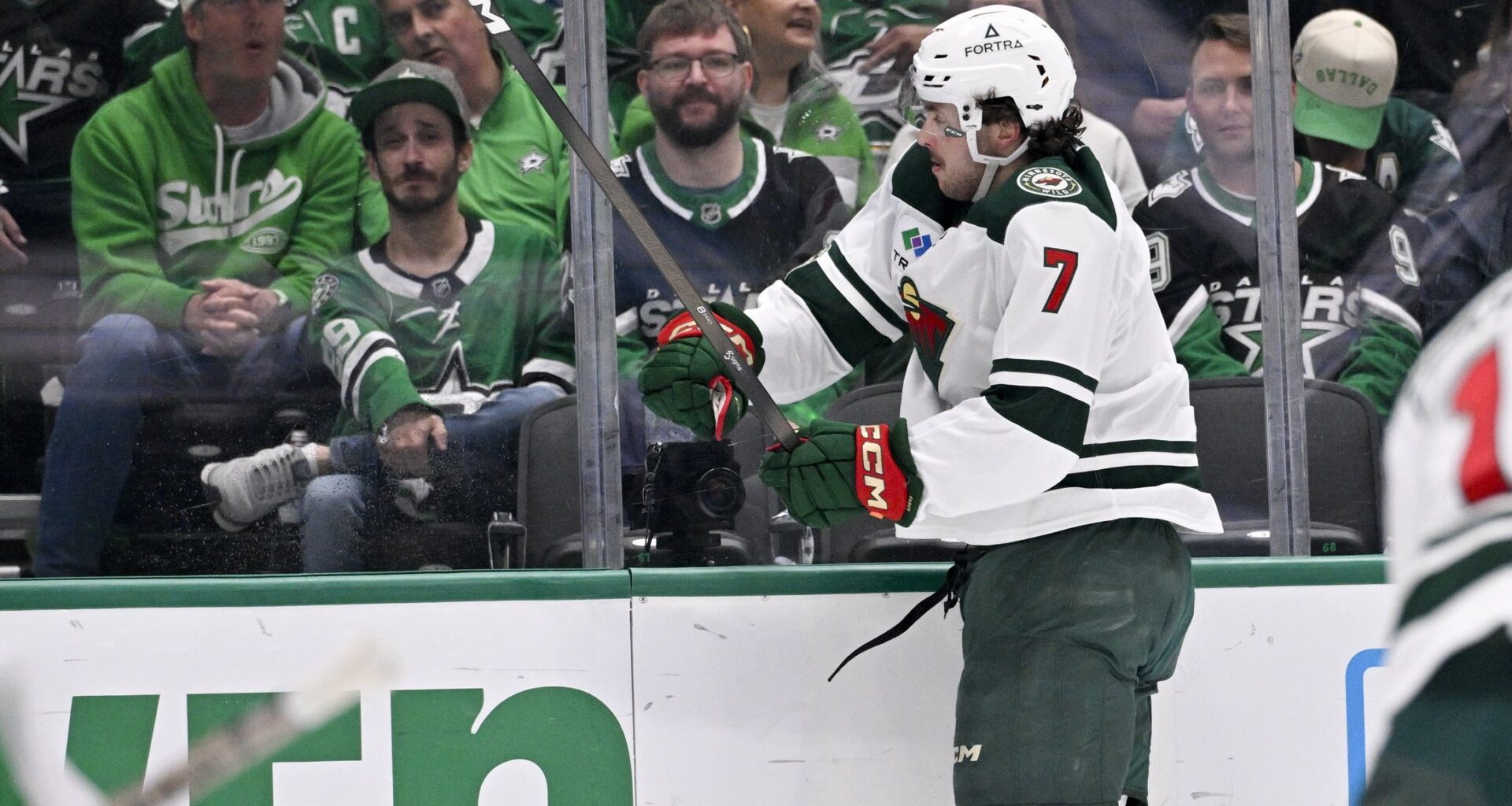
When the Minnesota Wild parted ways with longtime right-shot defenseman Matt Dumba, it was clear that Brock Faber was the heir apparent. The thought of Faber filling Dumba’s skates was more of a changing of the guard than believing Faber would one-for-one replace Dumba. At his peak, Dumba was a goal-scorer with a game-changing howitzer from the point, whereas most people saw Faber as a Jonas Brodin-esque defender.
It turns out, Faber filled Dumba’s skates more than anyone could have guessed.
In Faber’s third full season in Minnesota, he racked up 15 goals (tied for 10th among defensemen) and 51 points (21st). He’s building on this breakout in the postseason, notching an assist in Game 1 against the Dallas Stars and scoring the Wild’s only two goals in a losing effort in Game 2.
With 17 goals combined from the regular and postseason, Faber’s next goal would break Brent Burns‘ record for the most in Wild franchise history. It’s mind-blowing production for someone who had just seven goals in 97 games with the Minnesota Gophers. But Faber had the skating and smarts to be productive on offense, and he’s shown he’s got enough skill, too.
Especially when paired with Quinn Hughes. It’s not fair to give Hughes all the credit for Faber’s upward trajectory. Faber was on pace for 15 goals and 39 points before Hughes arrived on December 14. But there’s no denying what a transformative presence Hughes has had on his defense partner.
Since mid-December, the Wild have had a heliocentric offense that revolves around Hughes. That’s what you expect from a player who has a claim to be the best defenseman in the world. Almost no one skates like him. Hughes has the puck on his stick more than anyone in the NHL, and it’s not particularly close. As such, defenses key in on stopping the superstar.
It would have been easy for Faber to accept being the stay-at-home defensive partner, a safety valve for any mistakes Hughes might make. That’s not what happened. Instead, Faber is adopting more and more aspects of Hughes’ game, looking more dynamic than ever.
Faber thrives on the space that Hughes opens up for the Wild’s offense. You can see Faber hunting for that open ice on his 4-on-4 goal. When Faber recovered a loose puck in the offensive zone, Hughes drifted towards the blue line, drawing Matt Duchene with him. Miro Heiskanen was boxing out Joel Eriksson Ek‘s netfront threat, while Esa Lindell was covered for the one-timer.
That left Faber alone with Jason Robertson, whose one weakness is his footspeed. Faber danced around Robertson in Hughes-like fashion and cut to the front of the net for the goal.
The Wild’s cycle gets its defenders involved in the offensive zone, which also plays into Faber’s strengths. Minnesota was pressing in the third period, having Faber work down low at 5-on-5. He’s not only able to maneuver through those areas, but he also has the speed to recover when the puck starts going the other way.
Watch him go to work in the offensive zone and still have enough gas in the tank to catch up to Robertson, get inside position on the star winger, and snuff out a breakaway chance.
Forward Marcus Foligno is making waves in the Dallas media after he said: “[The Stars] can’t hang with us at 5-on-5.”
That’s not entirely true. However, the Stars have a tough time hanging with Faber and Hughes at 5-on-5. The two have out-scored Dallas 4-0 at 5-on-5 when they’ve been on the ice together, and lead the scoring chance battle 15-to-13, per Natural Stat Trick. When that pair is off the ice, Minnesota is out-scored 0-2 while running a 14-to-24 deficit in scoring chances.
We knew Hughes was going to give the Wild a chance to win this series, but we may have overlooked Faber’s potential to be a gamebreaker on his own. With Hughes still looking like he’s dealing with the aftereffects of his recent illness, Faber is kicking up his own game a notch and carrying Minnesota as much as any of his teammates. If Minnesota advances to the second round, these games might go down as “The Brock Faber Series.”
Think you could write a story like this? Hockey Wilderness wants you to develop your voice, find an audience, and we’ll pay you to do it. Just fill out this form.