
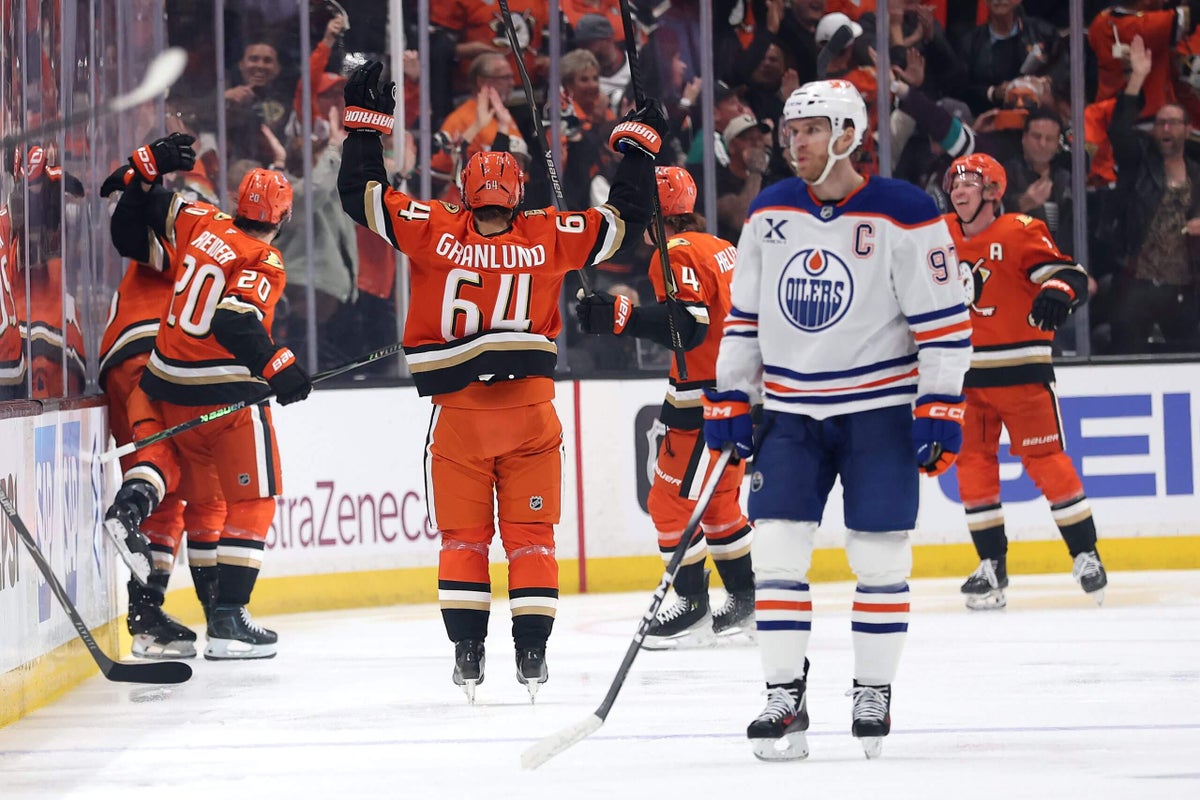
ANAHEIM, Calif. — A few minutes after his Edmonton Oilers officially ceded control of their first-round playoff series to the Anaheim Ducks, Kasperi Kapanen was asked how they could get it back.
Anaheim had beaten Edmonton 7-4 in Game 3, the kind of score often prefaced with “it was closer than it looked.” To say that about Friday’s game would be dishonest — the Ducks, from the moment they stepped through a neon-piped gate onto the ice at Honda Center, looked younger, faster and starving. Speed, if you were to boil it all down, was the primary issue. There, the Oilers had no counter and no containment. So, the question went to Kapanen, how do you deal with that?
He responded with an 18-second-long list.
“We’ve got to get pucks deep, so we can’t be turning pucks over because they counter pretty well,” he said. “They’ve got a lot of young talent and a lot of speed so we’ve just got to keep getting it deep. I think our forecheck could be a bit better. Just defensively we’ve just got to be a bit quicker and just skate more and kind of close our gaps a bit more.”
Those are, what, five separate issues? (Six, depending on whether you view “skating quickly” and “skating well” as the same thing.) Kapanen also omitted a) the possibility that Connor McDavid, their best player, might be hurt, b) the reality that McDavid had just chased two mediocre games with one of the worst of his career and c) that goaltender Connor Ingram appears to be having an increasingly difficult time making routine saves.
Other than that, things are going pretty well.
Kapanen, who scored his third goal of the postseason in the second period to tie the game 2-2, closed his answer on a relatively upbeat note: “There’s a lot of things, but there’s a lot of good, too, so we’re not trying to get too down on ourselves.”
Just as Kapanen was wise not to single out McDavid or Ingram, his teammates would be wise to follow through on his advice; before we go too far with this, it’s fair and necessary to point out that one year ago, Edmonton faced a 2-0, first-round hole against the Los Angeles Kings and dug themselves out with pace and authority on their way to a second straight Stanley Cup final.
That matters, but it’s also tempting to draw parallels where there are none to be found. Both teams play in Southern California. Both were thought to be overmatched. That’s largely where the similarities end. The Ducks had spent two games proving that they deserved respect, but Friday showed more than that, and certainly nothing that we’d seen over the course of four consecutive years’ worth of Oilers-Kings. There were instances that Los Angeles had control, but they felt like they were written in invisible ink — not enough talent, not enough speed, not enough goals to be found. Each time, that proved to be the case. The Kings’ approach, overall, was “hope to score, then hold on tight.” That might be sustainable in fits and starts, but not four games out of seven.
It’s also not the Ducks’ approach.
“That’s a big thing that (coach Joel Quenneville) talks about, is kind of dictating the pace out there,” Anaheim forward Beckett Sennecke said. “And I think we kind of demonstrated that tonight.”
On the other side of the puck, the Oilers demonstrated plenty — and very little of it was good. In some regards, it starts with McDavid, who briefly left Game 2 with what appeared to be an ankle injury. He finished the game and, on Friday, played 23 minutes, 50 seconds, but, by any metric, had a truly brutal game. Edmonton was outscored 4-1 with McDavid on the ice, out-attempted 33-17 and decisively lost the expected goal battle. Those numbers didn’t come quietly, either. McDavid wasn’t just bad; he looked unlike himself to a startling degree, late power-play goal aside. It’s a testament to his talent that such nights are so infrequent. Given the context, it’s hard not to wonder if more aren’t on the way.
This wasn’t fourth-liners dragging McDavid into the muck, either; this was first-line star Leo Carlsson holding an 80-percent expected goal share against McDavid, and second-liner Mikael Granlund helping deny Edmonton a scoring chance with him on the ice. Jackson LaCombe and Jacob Trouba were the defensive pair he saw most frequently, and McDavid likely wishes he saw them less — particularly LaCombe, who made some high-end, high-profile plays against him. A remarkable break-up on a second-period 2-on-1 and a bit of third-period gap-control wizardry lead an increasingly long list.
“We still got to be better against not just him, but everybody, at keeping the puck out of our net,” Quenneville said. “But certainly, he gets attention when he’s on the ice. We know that, you want to stay above him, you want to deny him the puck, and you don’t want to give him any room. I think we’ve been pretty good as a pack of five when he’s on the ice. That’s what we’re trying to eliminate.”
Like Kapanen said, though, there were other issues at work; to deny that would be to downplay just how well the Ducks played and just how reasonable it is to wonder whether the Oilers are a smart bet to shift the tide in Game 4. If that sounds alarmist, rewatch Anaheim’s sixth goal, the one that effectively ended the game with 3:03 remaining. There was McDavid, pressing in the offensive zone. There was Mattias Ekholm, losing a puck battle to Ducks forward Jeffrey Viel along the boards, then struggling to backcheck as Viel streaked down the ice. There were Ekholm and Connor Murphy, failing to break up a 2-on-1. There was Ekholm again, losing a puck battle to Tim Washe when Viel’s initial shot bounced off the back boards. There was Ingram, getting beaten short-side after Washe pushed the puck back to Viel and ultimately watching his playoff save percentage dip to .849.
And there were the Oilers, making what Ekholm called “mistakes on mistakes,” looking very much like a shaky defensive team with a journeyman goaltender and an all-galaxy center who, for whatever reason, is struggling to act as the eraser. No team is more capable of a playoff quick change than the Oilers, as we’ve come to know them. But the version of McDavid they’re getting, the version of defense they’re playing and the version of the Ducks they’re facing are, at the moment, very real obstacles.
“We’ll have to take responsibility for that,” Ekholm said. “It starts with me. It starts with the guys that I’m out there with and it goes on. We’ve just got to make sure we value the defensive side of the puck. I mean, it’s going to be hard winning games when you let in six or seven, right?”
Yep. And it’s going to be even harder to win games when they’ve got six or seven things going wrong.