
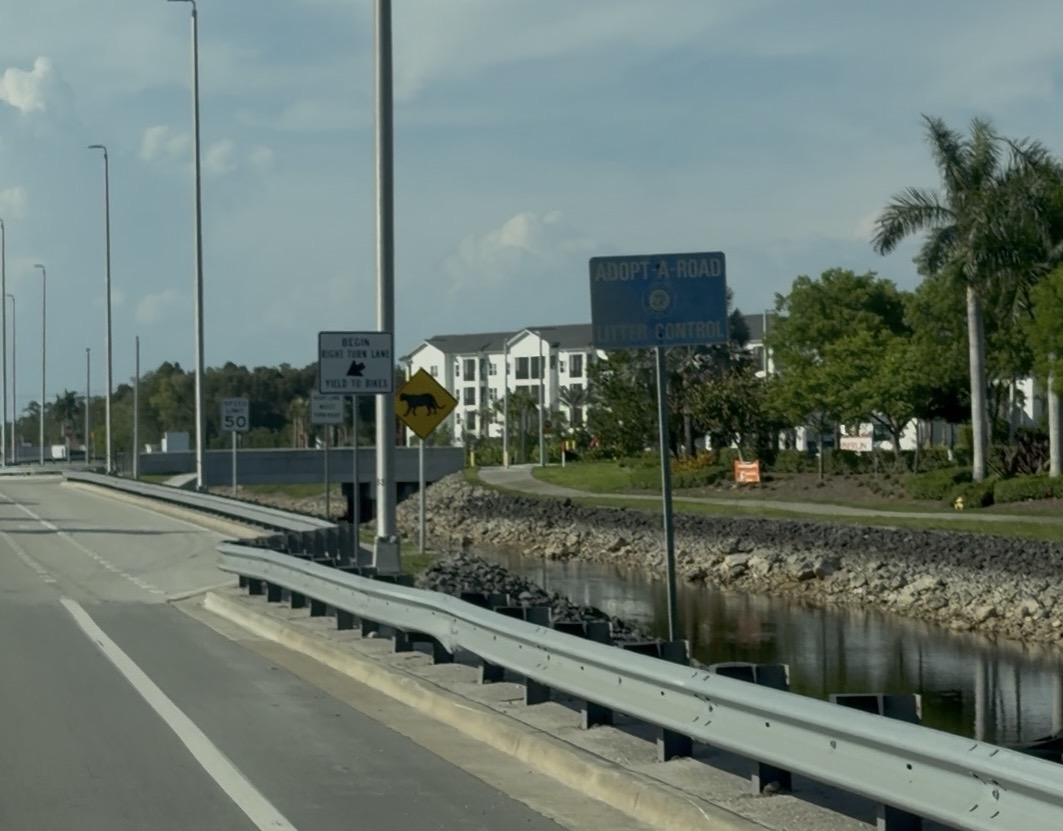
Florida panther crossing sign on Collier Blvd. Photo by Daria Mironova/WMNF.
Residents in Southwest Florida say rapid development in Collier County is destroying Florida panther habitat, increasing wildlife deaths, and straining roads and evacuation routes.
Marcela Zurita has learned to brace herself every time she gets in the car.
Driving through eastern Collier County means passing construction zones, cleared land, and roads where wildlife still tries to cross territory that once belonged to them. Too often, she says, the drive ends with another grim discovery – a deer, a bear, or another animal struck on the roadside.
“Every day I have to see all the wildlife – the roadkill,” Zurita said. “It’s heartbreaking.”
For residents living along Southwest Florida’s rapidly expanding development corridor, the debate is no longer about zoning maps.
Bulldozers push deeper into rural Collier County, and large-scale housing developments continue moving forward. Residents, conservationists, and environmental activists warn that one of the last wild landscapes in the eastern United States is being cut apart. It also puts rising pressure on roads, communities, and the already fragile future of the Florida panther.
Living in the middle
Zurita has been involved in development fights since 2020, when Rivergrass Village was first proposed in Collier County. Since then, she says, one project after another has advanced through approval processes despite public opposition and environmental issues.
“We’re in the middle of this development,” she said. “The wildlife can still roam there now. But they’re building right on it. I don’t know where else they’re going to go.”
She describes the rural portions of Golden Gate Estates as one of the few remaining places where younger panthers still move between fragmented habitats.
“I have one living on my street that’s been there for three years,” she said.
For Zurita, that sight is both extraordinary and alarming – proof that the animals remain, but also evidence of how little space they have left. The Florida panther, once widespread across the southeastern United States, now survives almost entirely in South Florida.
“This is their last home,” Zurita said. “This is the only place these animals have.”
Public trust
The crisis isn’t only about development. It is also about accountability. Marcela Zurita says the agencies and elected officials tasked with protecting Florida’s natural resources are failing both wildlife and the people who live there.
“I think all of these agencies that are supposed to protect them are not doing their job,” Zurita said. “They’re failing them. They’re failing the public because the wildlife is a public trust.”
Her disappointment also extends to county leadership.
“The commissioners are failing,” she said. “They’re not listening to the people. They’re listening to investors, developers.”
For residents who have spent years speaking at hearings, writing letters, and challenging approvals, those words show a rising belief that major decisions are being made despite public opposition.
Roads and growing pressure
The concerns stretch beyond habitat loss. Zurita says the consequences of growth are already showing up in infrastructure, traffic, and emergency planning. She points to roads near Brightshore Village.
“I don’t think we have enough roads if we have to evacuate,” she said. “Brightshore Village near me – we only have Immokalee Road and Everglades Boulevard that people are going to be able to use. That’s going to be another just about 4,000 cars on that road.”
For Zurita, that number represents more than traffic congestion. Those same roads cut through the habitat that wildlife still depends on.
“That road is surrounded by public areas where the wildlife use to migrate,” she said.
She believes residents are being asked to accept rapid growth without adequate planning.
“These projects are moneymakers for investors,” Zurita said. “It’s bad for the environment. It’s bad for people.”
She also points out that some larger developments appear to be advancing in smaller pieces. It makes the approval process easier. Meanwhile, the human-wildlife conflict continues on the roads.
“People don’t respect the signs,” she said, referring to panther crossing warnings. “They’re speeding. You can see all the roadkill there.”
The danger is not hypothetical. She pointed to the recent death of a Florida panther cub near her community. That loss, she says, proves how dangerous these corridors have already become.
“I believe another baby Florida panther got killed not too far from me,” Zurita said. “That’s close to Everglades Boulevard – not too far from the Rivergrass Village entrance. Literally within about four miles.”
That roadkill marked the sixth panther death in 2026.
For residents and wildlife advocates, incidents like that have become painful reminders that the pressure on panther habitat is already translating into real losses on the ground.
A legal fight for survival
The battle over development is now moving into federal court.
Matthew Schwartz, a longtime environmental supporter with the South Florida Wildlands Association, says conservation groups are pursuing legal action tied to habitat protections for the Florida panther.
“Panthers can’t sue,” Schwartz said. “Nor can concerned citizens who don’t use the habitat, who aren’t personally affected by it.”
Schwartz has spent years supporting wilderness protection, from challenging major highway expansions to opposing industrial development in panther habitat. For him, this legal battle is part of a much larger fight over Florida’s future.
“This is not the only place development is happening,” he said. “But this is the place where it could kill off our state animal.”
One of the last wild places
Schwartz says what makes Southwest Florida different is not just the presence of panthers – it’s the landscape itself.
The Big Cypress region remains one of the last significant wilderness areas in the eastern United States. He says panthers are surviving not because South Florida is an ideal habitat, but because it is one of the last undeveloped places left.
“Even the panther, as resilient as it’s been, has a limit.”
Zurita says she has spent years trying to make her opinion heard – speaking out publicly, contacting officials, even writing to the White House. Now, she believes the fight must begin locally.
“I think this is the last attempt to save the panthers,” she said. “If they continue to develop their primary habitat, where are they going to go?”
For Zurita, the question is no longer theoretical. It’s what she sees through her car window every day.