
This is my 12th year doing public sphere scouting, and you’re reading the ninth iteration of what has become one of my biggest passion projects: an all-encompassing look at how I do my job.
I wrote the first version of this in Future Considerations’ (now FC Hockey) 2016 NHL Draft Guide, and it has evolved in the years since into something more at The Athletic, where it has gone through annual updates from 2018, to now, 2025.
This guide to scouting is meant to be my manual for the work I do here on the evaluation side (which differs starkly from the work I do here on the storytelling side). It’s my opportunity to pull back the curtain for you, the reader. It’s also a chance for me to reflect on the work I’ve done in the preceding year, the way the game (and consequently scouting) is changing, my biases, areas that I need to emphasize and deemphasize, and the things that my process may be missing altogether.
The goal is transparency.
The outcome, I hope, is an annual primer for my final draft board which will give readers a better understanding of the why behind the choices I make in my rankings as you read through them. It should give you insight into the way I dissect the game and its players, while forcing me to map out and re-think it — all in an effort to avoid forming crutches.
The way prospects are playing the game and the tools they need to succeed at its highest level have already changed significantly in the decade-plus since I began this work. Teams are now developing players with wider consideration given to sports science, individualistic planning, time spent with one-to-one training specialists, and an emerging world of prospect analytics and tracking. Lessons are being learned in real time. It’s important I keep up and that my process doesn’t grow stale.
I hope you find what follows is both honest and introspective. That’s what this — along with some of my other annual projects like ranking reviews and my players I was wrong about column — is all about.
I hope it can also function as a companion tool for you as you evaluate players and watch the game in your own way. When you open up my upcoming 2025 NHL Draft package (which includes my top 15 overagers list, my honorable mentions list and my final top 100, totaling nearly 150 prospects), the rankings and evaluations inside it are the end product of hundreds of hours of work built upon the foundation laid out in this project.
This season, I traveled to Plymouth twice (for the World Junior Summer Showcase and the Chipotle All-American Game), Ottawa twice (for Team Canada’s selection camp and then the World Juniors), Buffalo twice (for the Rookie Showcase and soon a second time for the NHL Scouting Combine), Oshawa and London for the inaugural CHL USA Prospects Challenge, Brantford for the OHL Top Prospects Game, St. Louis for the Frozen Four, and Frisco and Allen for U18 worlds. When I wasn’t on the road, I hit dozens of OHL games, saw St. Andrew’s College play, hit Nobleton to see Simon Wang play with the King Rebellion, pored over tape and made countless phone calls to sources.
All of that work is informed by this, which is meant to answer your questions about my philosophy.
Context
There is (or should be, at least) a lot more to player evaluation than what you see of a player on the ice. Because hockey’s not a static game that can be judged in isolation from one event to the next, it is increasingly important to contextualize all of the exterior factors at play on the ice (and off of it) that may impact the way a player plays and the results that he produces. Live and/or taped viewings are invaluable. So is data.
And I can’t effectively blend what I see (all of those viewings) with what the data tells me (the raw production and the growing amount of publicly- and privately-available analytics) without understanding everything else that influences those outcomes.
Peripheral influences matter a great deal more in evaluating prospects than in evaluating NHL players, and yet they are often overlooked when NHL fans pivot their focus to prospects ahead of each draft. In the NHL, you can still look at the scoring race and quickly determine who the best players in the world are more or less. That’s particularly true for forwards (we have learned in recent years that counting stats like points don’t have the same kind of value for defensemen, making them tougher to evaluate and project across all levels of the sport), where both the stats page and a night spent watching the Oilers on TV tell even the most casual fan the same thing. You can do it with individual teams as well. The best players are still usually the ones with all of the goals and assists.
And while it’s true we can now use analytics to dig deeper on NHL players than ever before, available data gives the viewer a competitive advantage mostly in their understanding of good and bad depth players more than on the game’s true stars. The best players in the NHL are, at least relatively speaking, agreed upon. Just about every top-50 ranking of NHL players probably includes the same 35 to 40 names, with evaluators differing more the further down the list they get.
But that NHL game view creates some serious pitfalls when you transport those biases and ways of thinking to the way you approach prospect evaluation.
The assumption becomes that point-per-game Player X on Team Y in League Z is better (or will be) than 0.75 point-per-game Player A on Team B in League C. And that often isn’t the case. The parity that exists in the NHL doesn’t exist anywhere else in hockey.
In junior hockey, a player’s production changes dramatically from line to line, or team to team, or league to league.
In a 2025 draft context, Jake O’Brien’s 98-point season is better understood when you know that his running mate, Marek Vanacker, was sidelined through the fall with shoulder surgery and he had to drive his own line separate of league goal scoring champ Nick Lardis. Lynden Lakovic’s 58-in-47 looks better within the context of a rebuilding, post-WHL championship Moose Jaw team where he had to create his own offense — and with the knowledge of the impact a collarbone injury had on his draft year. Cole Reschny’s 25-in-11 playoffs with Victoria are better understood when you know that he was it for the Royals — that he did that on his own, and they wouldn’t have been anywhere near the second round without him carrying them there.
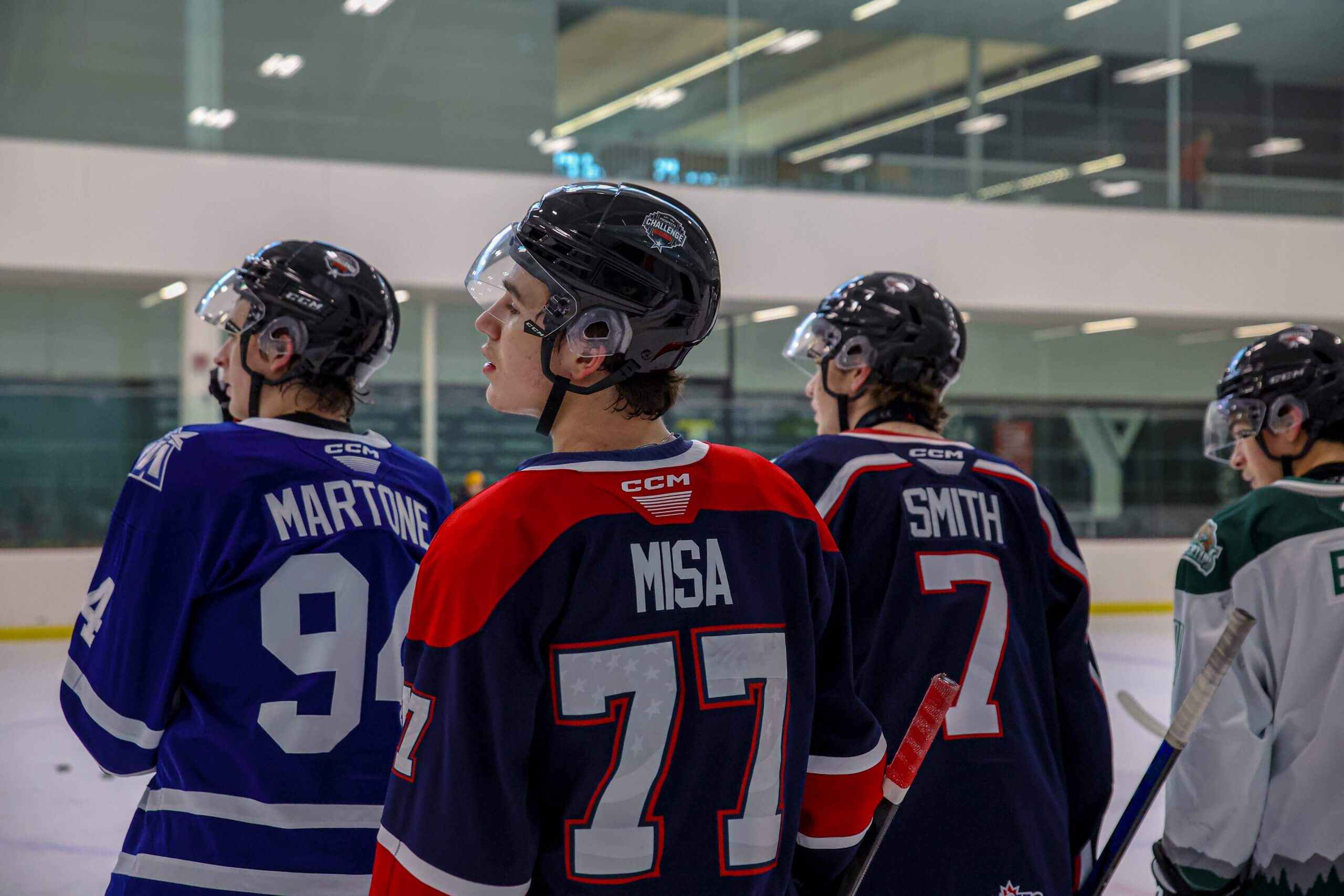
Michael Misa’s 134-point season has to be understood within the context of both the coach he plays for (Chris Lazary, who gives his players more offensive freedom than arguably any coach in major junior hockey) and the linemates he had (especially in the second half after the arrival of Yegor Chernyshov, who also immediately became one of the league’s best players). That doesn’t mean you necessarily have to discount the season Misa had. He was my vote for the OHL’s Most Outstanding Player award and deservedly won it. But it’s important information that teams should and do consider when plotting him side-by-side with the rest of the draft’s best prospects. Top 2025 prospect James Hagens’ played with very good players on a top college team at Boston College, but his season and production — and consequently the way we would be talking about him — would be viewed much differently had he played for the again-stacked London Knights, a path he considered and one that could have seen him put up the kind of gaudy numbers that Misa did.
Braeden Cootes, with his 1.05 points per game for Seattle in the WHL, is a no-doubt first-rounder. Mateo Nobert, with his 1.18 points per game for Blainville-Boisbriand, will be a mid-round pick. That’s because Cootes was the captain and driver for a rebuilding Thunderbirds team coming out of a multiyear run, and Nobert rode shotgun with Justin Carbonneau, one of the top forwards in the draft and in the Q this year. This was also a down year for the Q. These are the things that aren’t captured at a glance, that take due diligence.
If you just looked at Wang’s two assists in 32 games with the Oshawa Generals, you wouldn’t land on him as a potential top-50 pick. But once you do your due diligence on his story, how far his game has come, his excellent skating, the limited minutes he played on a Gens team with a deep blue line that was trying to chase an OHL title, and the way he looked in the OJHL (much more ambitious and involved), it all comes into focus.
All six Division I NCAA conferences aren’t created equal, either. The reality is that Atlantic Hockey and the CCHA don’t produce the same kind of talents as, say, the Big Ten or Hockey East.
Though all three of the SHL, KHL and Liiga now produce time-on-ice data and the excellent possession metrics that come with it, the same issues exist across Europe.
You have to know that prospects who are a part of a title-chasing club like Tappara have had a tougher time getting pro opportunities — and not because of their talent or their pedigree — than with clubs like the Pelicans or HPK, whose focus is different.
You have to understand the massive power imbalance that exists across all three levels in Russia, where the top KHL, VHL and MHL teams are backed by huge money, carry massive staffs, and play in big cities where all of the talent congregates, while the smaller rural teams have none of those things — and can play some pretty poor hockey as a result.
In the CHL, there are always prospects who don’t hit their groove until the second half of the season for a myriad of reasons, including time spent at the Jr. A or B level the year before (London has made a habit of having top prospects play their 16-year-old seasons there and it means something to scouts when Dale Hunter plays a 17-year-old), or a trade. Trades can put you in a better position to succeed. They can also disrupt a season with the time it takes to learn new systems and linemates, or even get comfortable with new billets or at a new school. If you’re moving from one province or region to another in a trade, sometimes it can take you farther away from home or put you in front of a new set of scouts who’ve seen you play less, disrupting how much exposure you have with teams. This season, Reese Hamilton, considered a potential first-rounder after his 16-year-old season in Calgary, failed to take a step, was dealt by a title-chasing Hitmen team to a bottom-feeder Regina team where he had more opportunity but with less talent, and became a mid-to-late rounder.
Some coaches rely heavily on their top players, which can limit a prospect’s production early on in their junior career. But a coach on a rebuilding team might thrust a 17-year-old into first-line minutes and top power-play time.
These things matter.
Only by watching those players, learning their linemates and deployment, and understanding the strength (or lack thereof) of their teams can we come to the conclusion that in different roles, or with different linemates, their outcomes could vary.
Beyond the context of team, league, linemates and depth charts, etc., you also have to consider age. Age is a very important piece of the puzzle for me in projecting (which is ultimately what this is all about) a prospect’s development curve.
You run into guys like Carbonneau, Shane Vansaghi, Porter Martone, Kashawn Aitcheson and Lynden Lakovic around the rink, and you’re immediately struck by their physical makeup. But they’re also all late-2006-born players in a predominantly 2007-born class. They should be further along. They’ve got 10 or 11 months of growth and gym time on some of their peers. They should be more productive, too. They’ve played three years of junior pre-draft instead of the standard two.
You shouldn’t be surprised when the scrawny player with the August birthday takes off down a steeper progression post-draft, either.
Age is beginning to play a larger and larger role in player evaluation across sports, too. After publishing the 2019 update to this guide, I received a note from a director of amateur scouting with an MLB team about just that. “I’ve found that hockey and baseball have more similarities in how we evaluate similarly aged talent and found your piece to be particularly enlightening,” read part of that message.
It’s important to remember that development from one year to the next, on and off the ice, can be seismic.
We can lose sight of that in all of the attention they get — and in their otherworldly, “he can’t possibly be 17 years old” talent.
They’re teenagers. Their bodies are changing rapidly.
Some players add baby fat early (in this class, Anton Frondell carries a little bit of it, for example), baby fat that helps them dominate at lower levels because they’re bigger and stronger than everyone else. Sometimes the development of those players turns stagnant as they get older and struggle to shed that weight, lean out and get faster (while the game around them does). Others grow two or even three inches in a year, add 10 pounds as a draft-eligible and their trajectories take off in a short period of time late in the year. Some of them have come into their own, filled out lanky frames, and learned to dominate. Some players struggle to keep weight on, no matter how much they eat (the NTDP’s William Moore and L.J. Mooney have struggled with this), and may never add the weight they need. Others may not have even trained at all. This year’s class includes 6-foot-5 goalie Joshua Ravensbergen, who has yet to get real time in a gym after losing his first serious summer of training to hip maintenance last year, and Brady Martin, who never trained year-round for hockey like his peers, putting his work in on the farm. Others, who’d developed different kinds of skills when they were 5-foot-8, are suddenly 5-foot-11 or 6-foot-1 with the elements of a smaller player.
All of these things make repeated viewings absolutely necessary over the course of a season because the player you see in September won’t be the same as the one you see in January and then May. They also highlight the importance of leaving your thoughts on or bias with a player from a previous viewing at the door. Never trust your first thought.
Growth isn’t just the physical, athletic kind, either. As they mature and their brains develop, their games change in imperceptible ways as well. Some players become more aggressive and assertive and learn faster than others how to find and take open space, or how to involve their linemates without having to slow down to survey. Others struggle with off-ice issues and their game suffers, or they plateau because they can’t problem-solve and bad habits put them into tough positions on the ice.
Other things, including proximity to their family, or a team’s travel schedule all impact a player’s season. Homesickness and culture changes have an even more pronounced impact on import players. The Soo Greyhounds are a three-and-a-half-hour drive from their nearest opponent and spend much of their season on prolonged road trips. The Mississauga Steelheads can get to Oshawa, Guelph, Kitchener and Hamilton in roughly an hour — and home to sleep in their own beds on the night of a game. In the more geographically widespread leagues, like the WHL or the MHL, some teams have the finances to take more flights than others.
In Europe, consideration must also be given to players who bounce between levels more than others, and the lack of consistency that stems from going too often from playing big minutes with a junior team to sitting on the bench with the pro club, without the ability to develop chemistry and little things that matter more than you might think, like reps on the power-play unit. (Not to mention the life disruptions of a new level, a new housing situation, etc.)
We must also evaluate players and their skill sets through the size of the sheet of ice that they play on. Whether that’s the Olympic ice most common in Europe and played on at some major NCAA programs, the hybrid ice most common to Finland, or the smaller surfaces in Canada, right down to the almost-square corners of the Peterborough Memorial Centre.
I try to consider all of these things (age, team, role, available data, etc.) and then use relationships with coaches, managers, players, agents, families, and scouts to fill in around the edges and build as complete a picture of each player as I can.
Though scouting still isn’t foolproof with all of that in mind, there are real advantages to be gleaned from maximizing your knowledge about a player. And the value of that knowledge is exponentially greater for draft-eligible players, where sample size can play tricks on you, than it is in the NHL where there’s no shortage of time to separate fact from fiction.
 My viewing process and limitations
This has changed a lot over the years.
When I first turned this whole prospect evaluation thing into a job with McKeen’s Hockey and later Future Considerations, I was juggling it with life in journalism school at Carleton University, internships and freelancing.
At McKeen’s Hockey, I filed hundreds of scouting reports across multiple seasons on entire draft classes, relying on live viewings in Ottawa and nearby Gatineau, where I had access to both the OHL and the QMJHL within a short drive. And though I covered CHL All-Star Games, the Canada-Russia Series, Hockey Canada evaluation camps, some world juniors and the scouting combine, and made efforts to get to many other OHL markets to add live viewings for a wider range of prospects, almost all of my non-CHL, non-international viewings were done through video.
At Future Considerations, I filed reports on a more narrow group of players and contributed to our rankings as an OHL/QMJHL voice (a lot like an area scout does on the amateur side of an NHL operation).
But it wasn’t until after I graduated, when I joined The Athletic full-time in 2017, that I began to make this my sole focus. And even then, as my time and travel budget expanded to include a wider range of destinations and viewings, I was also splitting my time with covering the Maple Leafs for the better part of my first two years at the company.
At the end of the 2018-19 season, when I began my current role and stopped covering the Leafs, all of that changed. With the move came more thorough work, a larger number of viewings on a larger number of players, and the face time required to really dig in on developing sources.
My job still prompts a lot of legitimate questions from readers, though.
How do you watch a game? Are you watching every player or just one? What does your game sheet look like? How does your approach differ in a live environment versus when you’re watching on tape? How many players in a draft class are you able to get to and which leagues are you watching more than others?
Some of you haven’t followed my work across all of those drafts and places, and may have questions about my record, too. Putting out a list or publishing scouting reports is one thing but being good at it year after year is something else altogether.
And then the answers to those questions are complex because the way I go about doing my job differs in some ways from the ways many others in the public and private spheres do theirs.
I, for example, am one of the small but growing few that does all of my work at in-person viewings on a computer. Most scouts track their notes across player grids and notepads and I have never been able to do that. Part of that is driven by necessity (I have a tremor, leftover from concussions playing hockey, which makes writing by hand almost impossible). Part of that, I truly believe, is about efficiency. I suspect that if my tremor didn’t make it a habit, I would have made it one by now regardless because the advantages I believe a computer provides (speed and detail) far outweigh the disadvantages (a distraction that can take your eyes off of the game if you allow it to).
The number of players I watch in a game has also changed over the years — and depending on the medium.
When I’m in an arena watching a set of players for the very first time, I try to really focus on only a small handful. That’s because in a live setting the play is moving so fast and shift changes are happening so quickly that I find watching all of the players in a game who may be of some interest (which can be upwards of double digits per team in some cases) results in extremely thin postgame evaluations across the board initially. If I really want to get to know a player I’m not particularly familiar with, I want my notes on that player at the end of a game to be thorough. Keeping the total number of players I’m paying close attention to as small as possible helps accomplish that. In doing so, it means that there are usually no more than one or two players on the ice at any given moment that I need to be following with my eyes in initial viewings. The obvious advantage there is that I can better isolate those players for their entire shift, rather than bouncing around the ice following the puck.
The obvious disadvantage to that strategy is making sure you aren’t tunnel-visioned to the player you’re tracking. Hockey at the highest levels is so fluid now that what’s happening around a player is as important as the way a player reacts to it. Isolation helps build my knowledge of a player’s raw skills (I do a much better job picking up on the little details in a player’s skill set when I’m honed in on them) but it can limit your understanding of a player’s ability to read the game around them. Some players can look great in isolation with the puck but can struggle within the whole. In this year’s class, players like Cameron Schmidt and Cullen Potter have continued work to do on their habits with the puck, and others like Jakob Ihs-Wozniak have had to learn the game away from it.
This isn’t to say I won’t pick up on other players in a game (you catch flashes here or there of everyone on the ice) but I try to limit the takeaways I garner from players who aren’t my focus. That’s because the really good plays or really bad plays are the only ones you’ll catch with a player you didn’t make an effort to watch closely. I believe that can work to an evaluator’s detriment, resulting too often in the wrong impression of a player at the end of a viewing.
Once I get comfortable with a group of players, though, I allow my scope to widen. By the time I was in Texas for U18 worlds this year, for example, I found myself watching all of the relevant players with a wider lens, rather than tracking one player across the ice, because I’d already done that with almost all of them individually.
On video, my focus is even narrower.
For the first five years I did this, I used all sorts of subscription platforms for my review of tape. But the tools and interfaces those services provided varied. Some didn’t even have playback buttons, so my focus was broader as I watched entire games.
But in the last six years, I have used two of the scouting industry’s scouting platforms, InStat and SportContract, providing feedback for the latter. InStat and SportContract, neither of which are available to the public (SportContract has asked me to make that clear in an effort to reduce requests), offer advanced interfaces and playback tools for virtually every junior, college and pro league on the planet. Now, I often watch just one player at a time — viewing only his shifts. This has made my process considerably more efficient, cutting a three-hour viewing into a half-hour one in many cases, allowing me to use the video days I set aside for myself during each week more effectively in order to take notes and catalogue as many prospects as possible. They are, simply put, the most important tools I have.
Live or on tape, if I’m there strictly to watch a player and storytelling isn’t my focus that day, my game sheet is a mix of notes on the plays a player made as well as detailed descriptions of the player’s tools (more on the skills I care about later), strengths, weaknesses and tendencies.
Because my job at The Athletic is so wide-ranging relative to the job an area scout has to do (or the more specific one I had to do when I was with Future Considerations, for example), the ability to speed up my tape viewings in recent years has been paramount. Even though this is my full-time job, there are only so many hours in a day.
That’s not a complaint, though. Having my work be mine and mine alone is my preferred way of doing this job. Every evaluator would likely tell you the same thing. On one hand, if there are issues in it, or if I fail, it’s on me. On the other, I don’t have to trust anyone else’s eyes or evaluation of the available data but my own in forming my opinion. If I feel I lack information of viewings on a player, I can ask people I know who are more well-versed in those prospects than I am. And if I’m confident I’ve seen enough of a player, I can rank them accordingly without having to consult anyone.
At Future Considerations, I had to trust others, not knowing their familiarity with the players or how their process works (this isn’t to say those people weren’t good, but control breeds comfort with something like this).
Still, though, there is a reason NHL teams do what they do and build lists with entire staffs, and that needs to be understood before you dive into my rankings. NHL Central Scouting’s final rankings for 2025 list 364 skaters and 47 goalies and I am not well-versed on all of them. My lists start at 32 players and build to 64 and then eventually 100 for my final board because it takes the full year to confidently get to that point with that large a group.
I have worked diligently in recent years to correct against blind spots that I’d identified in my lists with the USHL, VHL, MHL, CJHL, NAHL and U.S. high school talent pools; corrections that have resulted in higher representation for all of those leagues on my boards of the last couple of years. But I’m ultimately always going to return to the players I’ve identified as more worthwhile than attempt to build a book on every last player that I need to watch. While I feel like I’ve closed the gap on the USHL, VHL, MHL and CJHL fronts, I still rely mostly on recommendations from sources for the NAHL (which are rare and are likely to get rarer after the NCAA’s move to open up eligibility to CHL players) and U.S. high schoolers that I dedicate time to. Not every relevant high school even broadcasts their games as of yet (though that list is growing) and even those that do aren’t under one streaming roof because of the different circuits most of the non-Minnesota schools play in. So I rely on their coaches (or on local scouts) for additional insights into their tools/upside in the early going.
It’s important to keep all of this in mind when you read my work. Those limitations are also reason enough to search out other voices than my own for their insight. It can be a mixed bag but there are intelligent, diligent evaluators at all of the major public scouting services. If you’re reading this, you already know that The Athletic’s Corey Pronman’s work is a necessary resource.
Skills-based evaluation
I have been asked a couple of times by the Stratford Warriors, a Jr. B GOJHL team here in Ontario, to do a presentation for their weekly coaches, management and scouts meeting. The first time they asked, the presentation could be on whatever I wanted it to be on, and I chose to speak about the language of scouting, mapping out much of what I’ve laid out in this section of my guide over the years.
Last summer, I was asked to present at The Coaches Site Live, an annual coaches conference held at the University of Michigan featuring presentations by coaches from across the NHL, AHL, CHL, NCAA and Europe. The topic of my presentation was “How to move your scouting evaluations from vague to specific.” It was an expanded version of the presentation I’ve given to the staff in Stratford that dove into specific case studies. I talked about Evan Bouchard and the “look” of a player, Brandt Clarke and the “look” of a skater, Logan Stankoven and the expectations of size and Jason Robertson and the expectations of size.
I chose those topics because they’re where I feel I can be most useful in moving the conversation forward on player evaluation in hockey.
If this guide leaves you with anything, I want it to be what the second slide of my presentation outlined in my rules to live by:
Ambiguity is the enemy of description. Specificity is the goal.
Your audience (reader, or listener, or boss) shouldn’t have to guess what you mean.
Unbox.
Fill in the blanks, don’t brush over them.
Words have meaning. Jargon disguises it.
You’ve done the work, show it! Don’t cut corners at the finish line (the report/explanation).
When I’m reading about hockey, watching people talk about hockey or listening to people talk about hockey, I always try to keep those pillars in mind.
Because there are words that sound like they mean something but don’t, or words that mean something to one person that mean something completely different to another — jargon that we use that confuses and obfuscates. If the goal in analyzing the sport is to be nuanced, some of the ways we talk about it don’t quite meet that standard.
“Comparables” are my most common gripe. We all do them because you all eat them up. But they aren’t the best version of player analysis, they’re the simplest. The average member of the intended audience spends the majority of the season focused on the NHL until it’s all over and suddenly the draft is around the corner. If you’re part of the league’s North American audience, that’s understandable because of how wide-ranging hockey’s lower-level branches extend around the globe (with each NHL team’s prospects playing across different time zones in leagues where broadcasts are hard to find and carried in foreign languages). People like me are meant to fill in the blanks for you when you don’t have the bandwidth to keep tabs on everyone you’d like to. The audience wants to know how the available prospects play without watching them. Comparables can provide them with a mental image in an instant.
I get it.
But player types are changing. And comparables fail to recognize that players are more different now than they ever have been. They also box players in. I’d rather attempt to unbox them and find where the missing pieces are needed while trying to put them back together. Every first-round pick gets tagged with all-star expectations. And we start to see the same names over and over again. How many times did we used to hear a rangy, north-south forward with speed compared to Jeff Carter or Matt Duchene, the small, uber-talented winger compared to Patrick Kane, or a bulky, menacing one projected as the next Milan Lucic and then Tom Wilson?
They don’t just box the player in, either. They box us, as fans of the game, into lazy habits. And they often serve as a veil for analysis that isn’t centered on the work required to actually describe a player, so they revert to disguises as detail. Sometimes, that’s out of necessity. Publications have word counts, radio stations and TV broadcasts have time limits. We need to find ways to condense.
But much of the jargon we most often hear or read leaves the intended audience with more questions than answers.
“Plays with urgency”
“Hockey IQ/hockey sense”
“Stay-at-home D/safe player”
“Grit/compete”
Etc.
These can be interpreted in different ways. When we hear or read those terms second-hand, we superimpose our biases onto someone else’s viewings. We try to interpret meaning. And our takeaway may not be what the person who was presenting it intended it to be. Whenever possible, detail and description should always be the focus. They mitigate against that.
Hockey IQ can be described with specifics — how the player plays within his team’s structure, whether he picks up on his man consistently, if he surveys the ice to stay ahead of the next play rather than always reacting and finding himself behind, a note on the decisions he makes with the puck, the reads he makes without it, or whether he plays with his head up, and so on.
A safe defender might carry a negative connotation to the author (someone who struggles with the puck, lacks ability and dumbs down his game out of necessity, relying too much on the glass-and-out play, etc.) but it may be perceived as positive by the reader (someone who picks their spots, doesn’t make mistakes, and executes the kind of smart, careful plays that reduce risk and advance play in the right direction).
When we talk about “playing with urgency” we’re often just pointing to whether or not a player played well in a given game. It’s near-impossible to infer effort or interpret feeling. In many cases, those who look like they’re working hard are also inefficient or wasting energy.
Is a gritty player someone who finishes every hit, plays through contact, extends plays by not giving up on them, stays on pucks, gets up and under on sticks, and wins inside body positioning? And if you are to say that a player is gritty, are we to assume that he does all of those things well? Why not tell us which?
If the evaluator is going to use ambiguous terms, they should, wherever possible, explain what it means to them first, too. Or, instead of using those terms, take a step further. If player comparables are meant to give the audience a mental image, well specificity can give them an even clearer one.
Good communicators tell you exactly what they mean. Paul Boutilier, a development coach who works specifically with D, can tell you exactly what hockey sense is in a defenseman and how to train it and teach it. Moncton Wildcats head coach Gardiner MacDougall has a definition for compete. Longtime shooting coach Tim Turk can tell you exactly what makes a good shooter or a bad shooter.
When I started doing player evaluations of my own, I set out to build a glossary to detail the things I value and explain my language. Through that process — the process of annually adding and subtracting skills I look for in a player — came a baseline for everything I do and the way I view the sport.
Here’s the 2025 version of what that baseline looks like:
• Skating: This includes a player’s posture (the balance and center of gravity between their shoulders, hips and knees in a variety of stances), how light or heavy a player is on their blades (some players really dig their skates into the ice before releasing into their push, while others are smoother in their glides or have the quick twitch found in sprinters), their top speed after a zone’s worth of pushes (less important these days), their first few steps and their recoveries through those hurried strides, their acceleration through to their top speed, the fluidity of their movements, their ability to maintain rather than lose speed with possession of the puck, how far they can extend/lean on their edges while skating backward in order to close gaps quickly, their ability to pivot without catching an edge, whether their feet drag (a lot of young players drag the toe of their blade because they’re rushing through their stride), if they don’t drag their toes whether they lift more than a few inches off the ice (many young players who don’t drag their blades overcompensate with a choppy stomping motion), whether they pick up their stick into a pitch fork (which wastes energy when they start to sway) or hunch over their skates to put them off balance, and their lateral edge work (including ability to go heel to heel and lean on inside edges to dodge checks and shuffle around defenders or the net on wraparounds). The two most efficient strides: long, fluid motions that give straightaway speed or tight and mobile edgework to create a rounded, agile skater. Both have their place, but I prefer a player who can move, change directions and turn feet attacking on tight angles than one who can explode down the boards with a longer stride. In today’s game, I believe changing tempo is now more important than top speed. Wherever possible, I try to avoid using the lazy “good/bad skaters” catch-alls. There is such a thing as too much detail for a reader as well, so you’ll never see me using very technical terms like “ankle flexion” in my public work.
• Playmaking: This includes ability to see the ice in front and on either side, see through layers of traffic to the weak side of coverage, recognize secondary and tertiary options, see lanes before they open (there’s a knack to this skill that is hard to evaluate but when a player is really talented at it, it’s impossible to miss), accurately pass (both short and long ranges, routinely failing to execute short little bump passes can speak to focus or lack thereof), timing and sharpness of passes (passing hard is not always a strength, feathering a pass through traffic is more of an asset), creativity in passing (does the player surprise defenders with the lanes he finds?), calculated confidence/pass selection (if a player is going to make a high-risk play, do they have support?), passing in motion, passing off of his backhand (a lot of junior hockey players aren’t confident enough to fake a forehand pass and cross their body to pass backhand but it can be an effective way of wrapping the puck around rangy defenders), and the overall ability to plan out plays faster than structure can react to them.
• Puckhandling and deceptiveness: This includes hand speed (loose grip is better, I want to look for players who avoid tightly controlling their stick, though it can be hard to spot, especially on tape), creativity with the puck (do they rely on the same move or can they adjust in traffic/under pressure?), one-on-one play with defensemen and goalies (does he always go outside, does he too often cut inside, can he make defenders move laterally or, better yet, make them turn?), ability to maintain possession of the puck at high speed and both identify and execute plays at pace, playing in and out of stops and starts, core control (reflexes and instincts come into play here), ability to protect the puck against bigger defenders, skills of dexterity and first touch (catching pucks in tough spots, quickly finding pucks with reflexes off of a bobble), ability to handle the puck or pick a dead puck off the boards on a player’s backhand or in tight (the difference between getting the puck up ice and being trapped can be a brief miscarry from a dead puck), the ability to control the puck out wide or in his feet (the latter is a challenge for taller players so when they can do it well it’s a real asset), and the use of baits, delays and fakes to draw defenders in or force them into a misdirection.
• Shooting: This includes velocity and accuracy, the quickness of a player’s release, the consistency of their one-timer, whether they’re specific about shot selection or a volume shooter, a disguised release point (some players have tweaks to their releases and blades that distinguish them by, say, pushing the puck off the heel to set up a snapshot rather than just applying pressure to the shaft, or curling from the toe and releasing before the heel), how and whether a prospect finds holes for shots (I like defensemen that move a lot at the offensive-zone blue line both laterally and inward to the high slot, which makes skating an even bigger asset in today’s game because you need to be able to recover defensively from those spots or get to them before defensive schemes can front you), how a player shifts their weight through their shooting motion (a lot of young players throw themselves off balance), and the ability to tip and deflect pucks (another sign of dexterity), elevate it in tight or slide it along the ice while moving, which includes whether a player relies on finishing in one way (a lot of young players shoot high too often when the low rebound is the best available option). Shooting (particularly as it pertains to how hard a player shoots) is increasingly of less value to me for defensemen. Shot variety and a player’s ability to manipulate their shot to get it off from a variety of spots on their body (including the instep of both feet), is something I’m increasingly placing emphasis on for forwards. But a player’s movement off the puck is often a greater determining factor in their acumen as a scorer at the next level than their actual mechanics as a shooter are. Again, I try to avoid lazy go-tos like “good shot/bad shot.”
• Defensive acumen: This includes whether a player comes back in the play consistently or counts on others to (even when it’s his job), understanding of personal defensive responsibilities, picking up and covering for a teammate’s missed assignment, reading the developing play and reacting accordingly, communicating on the ice (an underrated asset for players who understand systems), a defender’s ability to funnel and steer play to the outside (particularly in transition), a defender’s ability to surf (track opposing carriers laterally rather than head-on), whether they shoulder check going back to pucks, their ability to count weak-side and strong-side coverage when they do, a forechecker’s angles to pucks, choices on pinches, how a player uses their skating to gap up and disrupt (some players play much tighter gaps than others, gluing themselves to the hip of the opposing carrier, which if done well can allow them to swallow the play up and which if done poorly can result in a lot of glaring mistakes and compensating penalties). If they’re a passive defender in the neutral and defensive zones, do they give too much (requiring that they compensate by reacting and breaking up plays with raw instincts and reflexes) and can it be corrected? If they’re an aggressive defender in both zones, are they calculated in how far they extend on attackers (you’ll see things like a player hunching over his stick if he’s pushing too far off their center for a hit) and do they have the skating ability to make up for it? Defenders who are aggressive and slow are the worst. I also hate penalties. There are good ones (compensating for a teammate to prevent a high-danger scoring chance) but they’re otherwise not the asset many fantasy leagues teach us to believe they are (cross-checking means he wasn’t in proper position defensively, hooking normally means he wasn’t moving his feet, etc.).
• Intangibles like attitude and leadership are extremely hard to identify so I tend to use coaches and managers to find out more about them. Although body language can be evident for some players on the ice, you have to be careful not to equate being upset with not caring.
And at the end of it all, scouting hockey will always be an imperfect science. These are just the blurry outlines of it. It’s my job to cover the NHL Draft and I give it as many hours as I can in a year. I’m lucky to have the time and the flexibility to do that at The Athletic. I hope that I view player evaluation and the game in a progressive way. And I still make plenty of mistakes and am a much different evaluator today than I was when I started. The goal, here, is to be as thorough as I can be, to make this coverage as comprehensive as I can and to look back in a few years and be proud of my rankings, evaluations and projections.
Hopefully we can learn something about this sport and its players along the way.
(Top photo: Eric Young / CHL)