
The Laval Rocket’s 2024–25 campaign ended with a frustrating four-game sweep at the hands of the Charlotte Checkers in the Eastern Conference Final. It was a disappointing result for a team that had dominated the American Hockey League (AHL) regular season and looked ready for a potential championship season. But focusing on that playoff exit would be missing the bigger picture.
This season wasn’t about just chasing a Calder Cup, it was about building something bigger. For the Montreal Canadiens, the Rocket’s year was a complete success in what matters most at the AHL level: player development, internal growth, and long-term impact on the NHL roster.
A Big Development Year
Laval’s main objective, like all AHL affiliates, is to develop young talent into NHL players, and on that front, this season was one of the most productive the organization has had in over a decade.
Prospects like Owen Beck, Logan Mailloux, Adam Engstrom, Sean Farrell, Florian Xhekaj, and Jared Davidson all took major steps forward. Each of them improved areas of their game, earned larger roles, and, most importantly, looked more and more like legitimate future contributors at the NHL level.
Beck brought his mature, two-way play to the pros and even earned 12 games with the Canadiens. Mailloux continued to refine his defensive game while maintaining his offensive upside, earning a recall to Montreal and logging top minutes in the AHL playoffs. Engstrom adapted quickly in his first season in North America, while Farrell found his stride offensively after a slow start.
Perhaps the biggest surprise was Xhekaj, who combined physicality with scoring touch, putting up 24 goals as a rookie. Davidson, another 2022 Draft pick, quietly had one of the most productive campaigns of any Rocket forward with 45 points.
And it wasn’t just the skaters. Goalie Jakub Dobeš showed poise and progress, even earning a recall for half of the season in the NHL and providing quality depth at a position that desperately needs stability in Montreal’s system.
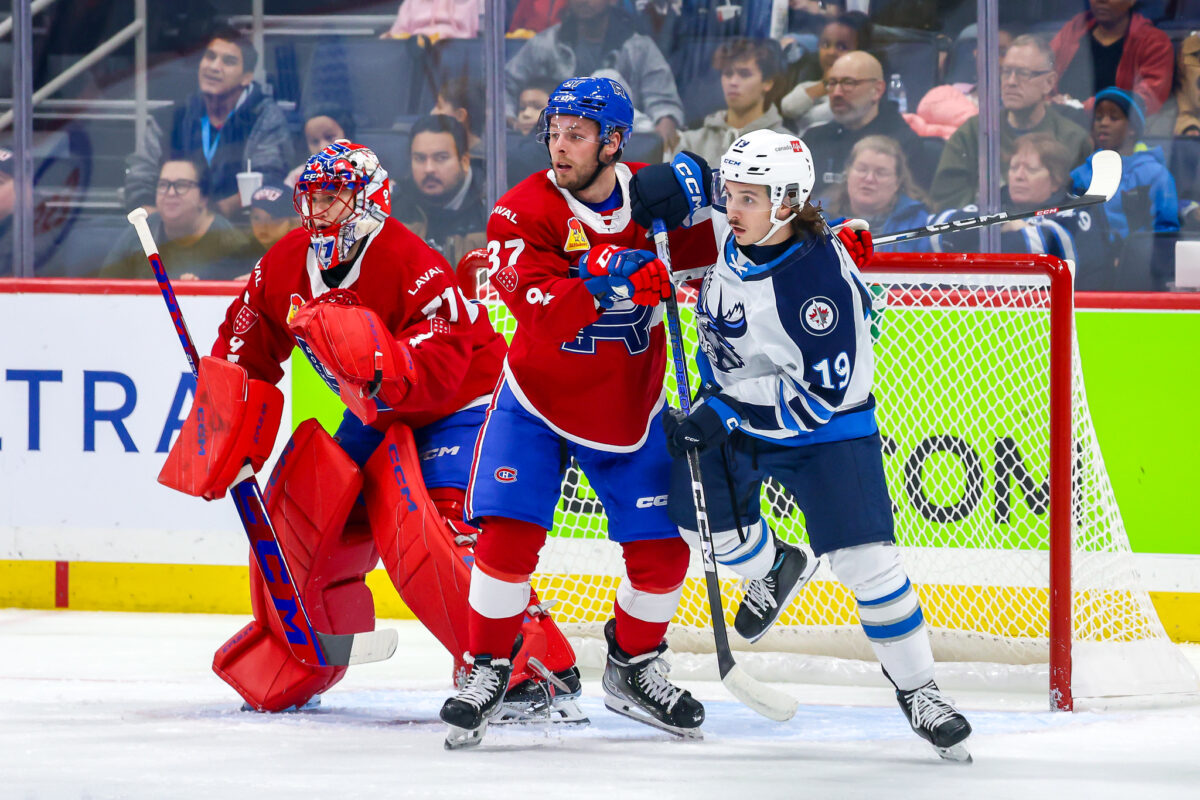 Brandon Gignac, Laval Rocket (Jonathan Kozub / Manitoba Moose)
This wave of players, all still in their early 20s, represents something the Canadiens haven’t had in a long time: a solid pipeline. One that’s functioning well, delivering results, and helping bridge the rebuild from potential to reality.
Winning While Developing
Development is the main goal, but winning matters too, especially when it reinforces strong habits and gives prospects experience in pressure situations. Laval didn’t just squeak into the playoffs, they dominated the AHL.
The Rocket finished with a league-best 48-19-5 record, showing consistency, resilience, and chemistry from start to finish. That team success wasn’t driven by veterans alone. In fact, seven players from the Rocket’s playoff lineup played NHL games this season with the Canadiens, including Mailloux, Beck, Alex Barré-Boulet, Joshua Roy, and Cayden Primeau.
AHL playoff hockey isn’t just about exposure, it’s about development under pressure. Laval’s trip to the Eastern Conference Final gave many of these prospects their first taste of postseason hockey at the pro level. Even though it ended in a sweep, the Rocket’s run gave its young core a chance to compete in must-win games, handle adversity, and learn the stakes of spring hockey. Those experiences are invaluable.
A Couple of Surprises
What makes this season especially impressive is that Laval didn’t succeed just on the backs of their top-ranked prospects. They got real contributions from depth players and unexpected sources, a sign of a healthy, functioning development system.
Nobody expected Davidson, a fifth-rounder, to be one of the team’s top scorers. Xhekaj was known more for his grit than his goal-scoring, yet emerged as a 20-plus goal forward. Dobeš wasn’t projected to see NHL ice this season, but played meaningful minutes in Montreal when Primeau struggled. These kinds of performances matter. They create depth, force competition, and raise internal standards.
In recent years, too many prospects faded away in Laval. This season, players emerged. That’s not by accident. It reflects strong scouting, effective coaching, and a developmental philosophy that’s now starting to bear fruit.
The coaching change from Jean-François Houle to Pascal Vincent also went well. Vincent inherited a young, unproven group and did a masterful job blending development and team success. Houle had some success with this group last season, but the transition went well. His experience and structure gave players the freedom to grow while demanding accountability and strong habits.
For years, Montreal’s biggest organizational flaw was its inability to properly develop young players. Prospects were either rushed to the NHL or left to stagnate in the minors. That’s no longer the case. The 2024–25 Rocket were the embodiment of what a development pipeline should look like.
The team didn’t win the Calder Cup. But it created a foundation of growth, improvement, and internal promotion that will help the Canadiens far more in the long term. As Montreal continues to position itself for future contention, the value of a strong, productive AHL team like Laval cannot be overstated.
