
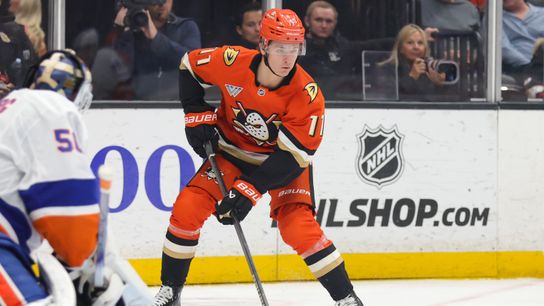
ANAHEIM, Calif. – Trevor Zegras had no longer become a cohesive fit with the Anaheim Ducks.
That was Ducks general manager Pat Verbeek’s conclusion when he traded the creatively skilled Zegras to the Philadelphia Flyers for bottom-six forward Ryan Poehling and two draft picks on Monday.
“I want to thank Trevor for the past six seasons and his contributions to our club. Obviously, it was a difficult trade to make from that perspective,” Verbeek said on a media call. “But I think as we gather with our group, I think the big thing is we’re trying to retool the roster in a way that all the pieces fit cohesively and to where you have different players on different lines that complement each other.”
In Zegras’ first two full seasons with Anaheim, the 24-year-old produced highlight reel goals and a pair of 23-goal, 60-plus-point seasons, including team highs in his sophomore campaign.
Over the last two seasons, Zegras had been beset by injuries, and as the rest of the Ducks young centers developed in that time, Zegras had been pushed to the wing to stick with Anaheim’s top six.
“Ultimately, Trevor, he’s been wanting to play some center, and I think that he’ll be given that opportunity in Philadelphia to play center,” Verbeek said. “When he’s more creative in the middle of the ice and having to play from the wing–we’re fortunate there’s Leo (Carlsson) and there’s Mason (McTavish), so that we find that they’re two pretty good centermen–so, Trevor has to kind of get pushed to the wing, and that probably doesn’t suit his best attributes being able to play and create from the middle.”
After being a transitional star of the Anaheim rebuild, Zegras had slowly become the odd Duck out. Even when Verbeek made a move two weeks ago to acquire Chris Kreider–a close friend and offseason training partner of Zegras–the dial of the Ducks identity continued to shift Zegras out of focus.
“Bringing in Kreider kind of changed the line combinations from that aspect,” Verbeek said. “As I said before, we’re looking to have different ingredients of players to complement each other’s assets. You can’t always have the most skilled guys on a line and expect that line to be great. There’s always another ingredient that helps make those skill guys better. So I’m looking for those types of scenarios to have our lines have a different look and a different feel.”
As he did when discussing the Kreider trade, Verbeek reiterated that under new coach Joel Quenneville, Anaheim will look to play fast and heavy and forecheck hard, and that’s what Verbeek acquired in Poehling.
Kreider is 6-foot-3, 230 pounds, and Poehling is 6-foot-2, 204 pounds.
“They’re mature players,” Verbeek said. “This is part of the different chemistry and different makeup that I’m looking to get accomplished. Where they fit will be ultimately left up to Joel as far as the line combinations, but we have a vision of where they’re going to play. They’re going to be great fits for our team and how Joel wants to play.”
Poehling also helps Verbeek continue to address the Ducks special teams’ deficiencies, particularly on the penalty kill.
“Ryan, is the number one guy that goes over for the Flyers on a penalty kill and (we’re) looking to improve in that area,” Verbeek said. “So he certainly is going to add speed, and he’s going to add penalty-killing ability for our roster.”
Verbeek also mentioned that the draft picks acquired–Anaheim now has 10 picks in this week’s NHL Draft–gives the Ducks flexibility to look into more trades to improve the roster. Verbeek said that Anaheim’s first-round pick, No. 10 overall, is in play, and if the Ducks keep the pick, they have the ability to swing for best player available.
On the surface, trading a dynamic skilled forward that led your team in goals and points just three seasons ago in Zegras for a bottom-six forward and two draft picks doesn’t seem like equal return.
Despite Verbeek’s notion that there is no pressure, the onus will be on Verbeek to use this acquired flexibility to continue making swings to move Anaheim further down the road playoff contention and not sliding back into the rebuild.
Below is a full transcript of the media availability with Ducks general manager Pat Verbeek on Monday (questions and responses edited for clarity):
Trevor had a couple of injury-riddled seasons and the production wasn’t quite there because of the injuries and just other circumstances. So why the decision to deal him away at this time when perhaps his value was at its lowest?
First of all, I want to thank Trevor for the past six seasons and his contributions to our club. Obviously, it was a difficult trade to make from that perspective. But I think as we gather with our group, I think the big thing is we’re trying to retool the roster in a way that all the pieces fit cohesively and to where you have different players on different lines that complement each other. So I think from that aspect, ultimately the decision that we came to is just kind of reshaping and retooling our roster.
What are you getting back in Ryan Poehling? Or why did you decide to target someone like Ryan in this deal?
Well, Ryan’s 6-foot-2. He’s 215 pounds. He has really good speed. And as I had mentioned before, some of the special teams, Ryan, is the number one guy that goes over for the Flyers on a penalty kill and looking to improve in that area. So he certainly is going to add speed. and he’s going to add penalty-killing ability for our roster. And so I’m trying to shore up certain aspects of our special teams play, players that can do a good job there.
What made this trade need to be done now? Was there any sort of thought to, let’s see how Trevor plays with Quenneville or just you didn’t see the fits with him in the roster going forward?
You start imagining lines and how you want certain players to complement each other. We started looking at that scenario, and so ultimately we made the decision to move Trevor because of that. And I think getting a couple other picks to go with it, those picks could come into play. It gives us the flexibility to do some other things and look at other things to enhance our roster. So I think that went into it as well.
And do you feel that his value was lower than it had been in previous seasons?
I’ve never had any value (comparison) because there was never really anything talked about in the past, as far as Trevor. I made the trade and thought I got what we wanted.
With freeing up that cap room and moving players around or even looking towards next season with the amount of space that you need for players, is this a sign that you will be more aggressive than maybe people might have anticipated at free agency time to get a higher skilled player to fill in what Trevor was bringing on the power play and things like that?
Well, I don’t know… aggressive… Like, when you start analyzing that stuff and you try, obviously it takes two to tango to try and go after free agency. Obviously, it’s not always about the money. It’s certainly about fit for players to go to teams. And so we’re going to look at everything we can to keep improving this team to make the playoffs. That’ll be our goal moving forward. The cap space is–we have lots of that, so we manage it and work to improve the team.
You said there was no real serious discussion about trading Trevor previously. What changed as far as that concerned today? Would you talk to Joel when he came in? Was it just a matter of being deep down the middle and not necessarily having a clear place for him?
Ultimately, Trevor, he’s been wanting to play some center. And I think that he’ll be given that opportunity in Philadelphia to play center. When he’s more creative in the middle of the ice and having to play from the wing, we’re fortunate there’s Leo (Carlsson) and there’s Mason (McTavish), so that we find that they’re two pretty good centermen. So, Trevor has to kind of get pushed to the wing, and that probably doesn’t suit his best attributes being able to play and create from the middle.
Bringing in Kreider kind of changed the line combinations from that aspect. And as I said before, we’re looking to have different ingredients of players to complement each other’s assets. You can’t always have the most skilled guys on a line and expect that line to be great. There’s always another ingredient that helps make those skill guys better. So I’m looking for those types of scenarios to have our lines have a different look and a different feel.
Is it fair to say that you had maybe some questions about his fit? I don’t want to say from the outset, but maybe from the time you were negotiating his deal forward because in that position people are looking to lock up guys up long term, you guys kind of went with a bridge term there for him and Jamie (Drysdale).
Well, I don’t know if that the fit… When you arrive to the organization, it’s not like I had a long history. So the bridge deal obviously allows us to catch a little longer look at that player. And so that’s why we ended up doing a three-year deal. And so I would never say, I wouldn’t accept your premise on the question that he was never in my long-term plans. You have to intimately get to know these players in their games, and I felt that I got to do that.
Just to clarify, I didn’t say it was never in your plan, that you may have had some question whether stylistically or positionally, because typically you have a guy lead the team in scoring, you try to lock him up long term, but you guys went with an evaluative period to get a better feel for the type of player he was. So I’m wondering, if at that time, you said to yourself how do they fit in stylistically, positionally with the rest of the group? That was my premise.
That’s fair. But that’s what we do. We analyze players on a daily basis, and on a yearly basis. So, that’s the approach I took with it.
I was wondering if Coach Quenneville had any input in this decision and what was his reaction to it?
No, no. No to both. When I talk to coaches, we have conversations, but, I mean, Joel ultimately doesn’t know the player like I know the player. So I can go in and talk to him briefly about it, but it’s not like I’m persuaded by Joel’s opinion on this case.
I’ve spoken to him after the trade today. He understands that we’re getting a good player back and going to be able to fill a role for us that, we’ve been looking to fill. And he’s excited for Ryan Poehling to come in here.
Similarly, Z was one of the most marketable players in the NHL. I was wondering if you’d spoken to ownership and what their reactions were losing a guy like that.
Well, I spoke with Henry about it. He was completely fine. He understands that there’s moves that have to be made. Ultimately, Henry wants to wn, and I have to make moves that I feel improve the team and the chemistry of this team and the makeup. He was fine with it.
With the Poehling and Kreider, do those two–-and you talked about the stylistic fits here–are they examples of the type of player, the that they play, being more of what you are looking for in the overall picture when building out this club? When you’ve been building out this club?
Obviously, Chris is a big kid. He’s 6-foot-3, 230 pounds. I’m looking at Ryan Poehling. He’s 6-foot-2, 215 pounds. They’re mature players. and based on, whether in their roles and stuff, this is part of the different chemistry and different makeup that I’m looking to get accomplished. Where they fit will be ultimately left up to Joel as far as the line combinations, but we have a vision of where they’re going to play. They’re going to be great fits for our team and how Joel wants to play. He wants to play fast. And they have that ability to play fast and forecehck. So it’s going to be about playing fast.
You’ve talked previously with us about being active this summer. And there’s certainly the potential to be very aggressive here. How much pressure comes with that with landing a major impact player?
There’s no pressure. We’re going to go about the process. You’re recruiting. It’s no different than trying to recruit a player to go to college for your team. It’s no different. It’s the same process. Now you’re dealing with professionals, and you have to put your best foot forward and try and sell your team. You have to try and sell the players. There’s a lot, the Orange County. So, ultimately, players make decisions for a lot of different reasons. We’re going to do our best. and hopefully things work out.
With Trevor being a restricted free agent next year and having so many guys that are RFAs next summer, did the contracts that need to be negotiated next summer have any play into alleviating that from you guys?
All of that stuff’s part of the process. There’s certain things when you’re managing the cap and contracts, there’s a lot of thought two, three years, advancement and plans. So certainly, that was thought about. It was thought about, but I think ultimately, we came down to just wanting to retool this club for this season.
Looking towards the Draft, you get another pick back here, 10 picks now. Does that make it easier to draft for best player available or are you still going to be looking for specific needs out of the Draft, particularly at No. 10?
That’s an interesting question. Where we are at pick 10, it’s going to be interesting to see what player is available. Certainly, you can go for best players, no doubt, or something more specific. I think we feel comfortable with our depth and what we have and what we have coming that there’s a lot of slots filled up to supply the Anaheim Ducks lineup in the future. So, yeah, we can probably take an aggressive swing at the player that we think has the most upside.
Poehling has only a year left on his deal. Is that something you’d like to explore, maybe perhaps with an extension with him and do you see him as part of the long term futures of the franchise beyond this year?
Well, you guys are asking questions like I had a crystal ball, but I mean, ultimately, we were excited to get him in here and we’re going to evaluate like I always do when it comes to the whole season. If things look like he’s going to be a really good fit, then obviously, it’s important that we try and get him under contract and go from there. But I’ll have six months to evaluate this.
Would you be willing to put that No. 10 pick in play if that can help execute a significant trade?
Yes, I’m looking at that as well, certainly. I think there’s a lot of teams looking at that. You can go after a player that’s probably in his prime right now and be able to add to the group. So there’s certainly some of that stuff we’re exploring.
You talked about selling the franchise, the organization, Anaheim on possible free agents. In terms of the trade market. Do you see where that could be fruitful and maybe more of an avenue? In terms of a high impact forward, if that’s a goal, that maybe the trade market could be more fruitful?
Yeah, no, there’s certainly… I’m looking at everything. Obviously there’s free agency, but there’s trade. I’m exploring trades. That’s why I explored with Kreider. Sometimes trades can be a little easier than even free agents. So, I’m looking at everything.
This trade that you got done today, how quickly did it come together and how much did you explore trading Trevor to different teams around the league besides Philadelphia?
Well, I don’t want to get into all the teams that I talk to, but I talk to every team. That’s what we do. Certainly, there was interest in Trevor, and I kind of made a decision that was probably the best fit for a club moving forward with today.
Did it come together pretty quickly with Philadelphia then?
Well, I mean, there’s been discussions, but when I make a decision, does it come quickly? Everything can come quickly together. But it’s where you finally make the decision to pull the trigger. And so today was the day I decided to do it.