

DULUTH — The Minnesota Duluth men’s and women’s hockey programs are planning to increase the amount of scholarships offered over the next three seasons, going from the equivalent of 18 full athletic scholarships in 2024-25 to 22 by 2027-28.
UMD athletic director Forrest Karr said both teams will have the opportunity to offer up to 20 full scholarships starting in 2025-26, 21 in 2026-27 and 22 in 2027-28.
The move comes after the
approval of the NCAA v. House settlement,
which removed scholarship limits in NCAA Division I sports, but imposed roster limits. Hockey rosters are capped at 26 players.
“There is still work to be done. This thing can change, as we’ve seen, very quickly,” said Bulldogs men’s coach
“We have a good plan in place and we’re going to continue to work toward that. It benefits both our programs to try and stay competitive in the world we’re in.”

Minnesota Duluth coach Scott Sandelin, a member of the NCAA Division I men’s hockey committee, listens to a question April 11 during the NCAA Men’s Frozen Four at Enterprise Center in St. Louis.
Clint Austin / File / Duluth Media Group
In addition to increasing the amount of scholarships offered, the Bulldogs will begin paying out academic achievement awards to returning student-athletes and incoming transfers. Also known in college sports as
it follows a 2021 Supreme Court decision (NCAA v. Alston) that allowed schools to provide additional education-related benefits, including academic awards of up to $5,980 per year.
UMD is offering $3,000 per student-athlete in 2025-26. Karr said UMD hopes to increase the amount offered in the future. UMD’s academic achievement awards — which Karr said are treated like scholarships — will come from donations to the hockey programs via the University of Minnesota Foundation.
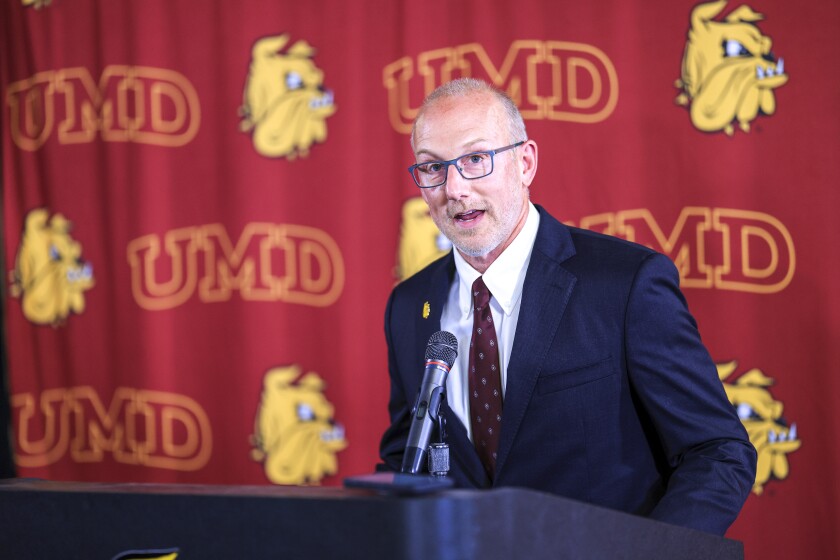
Minnesota Duluth director of athletics Forrest Karr speaks during a press conference introducing Laura Schuler as the head coach of the Minnesota Duluth Women’s hockey program July 11, 2024, at Amsoil Arena in Duluth.
Clint Austin / File / Duluth Media Group
Many of the Bulldogs’ conference rivals are already offering Alston money, including
and the Big 10 schools in the WCHA.
“This investment is a vital step in attracting and retaining top-tier prospective student-athletes — individuals who excel not only in sport, but also in the classroom and in their communities,” UMD women’s coach Laura Schuler said. “By raising scholarship dollars and enhancing academic recognition, we are not only leveling the playing field, we are reaffirming our commitment to student success, well-being and the values that define our institution.”
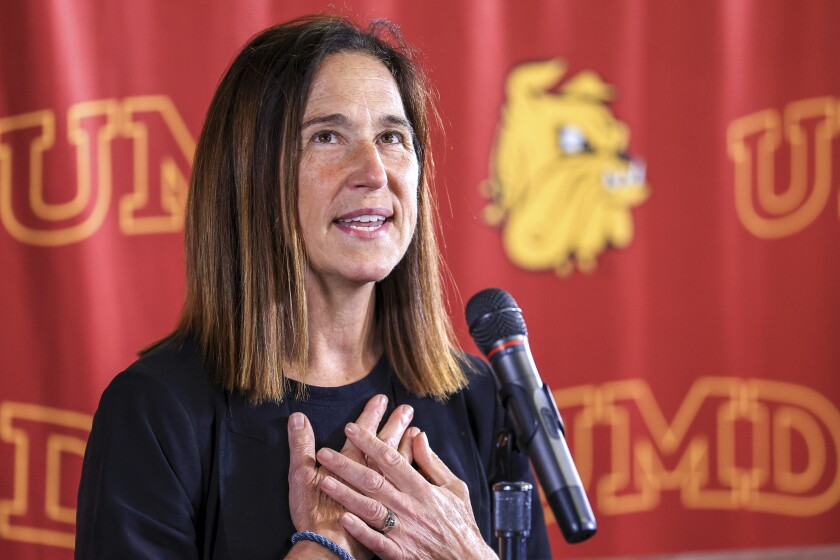
Laura Schuler speaks during a press conference introducing her as the head coach of the Minnesota Duluth Women’s hockey program July 11 at Amsoil Arena in Duluth.
Clint Austin / File / Duluth Media Group
The House settlement stems from a 2020 lawsuit in U.S. District Court. The NCAA and its five biggest conferences at that time — the Big 10, Atlantic Coast Conference, Southeastern Conference, Big 12 and Pac-12 — were sued over back pay for name, image and likeness licensing and revenue sharing from broadcast agreements.
A $2.75 billion settlement was formally approved by a federal judge on June 6. The settlement includes a revenue-sharing agreement and name, image and likeness back pay for former student-athletes who began competing in 2016. Terms of the settlement — including the lifting of scholarship limits and implementation of roster caps — go into effect on July 1.
Schools have until June 30 to either opt in or opt out of the settlement. Minnesota, Wisconsin and Ohio State in the WCHA and Arizona State in the NCHC are required to opt in as defendants. UMD had the option to opt in for its Division I sports,
and announced its intention to do so back in March.
Denver also announced it will opt in. North Dakota
for 2025-26,
Terms of the House settlement only apply to the Bulldogs’ Division I programs — men’s and women’s hockey. The other Division II sports are not impacted.
“We have been planning for the House settlement to be approved for over a year, and we are now able to move forward,” Karr said. “Any additional adjustments that we make in the future will be informed by changes being made at other WCHA and NCHC programs.”