
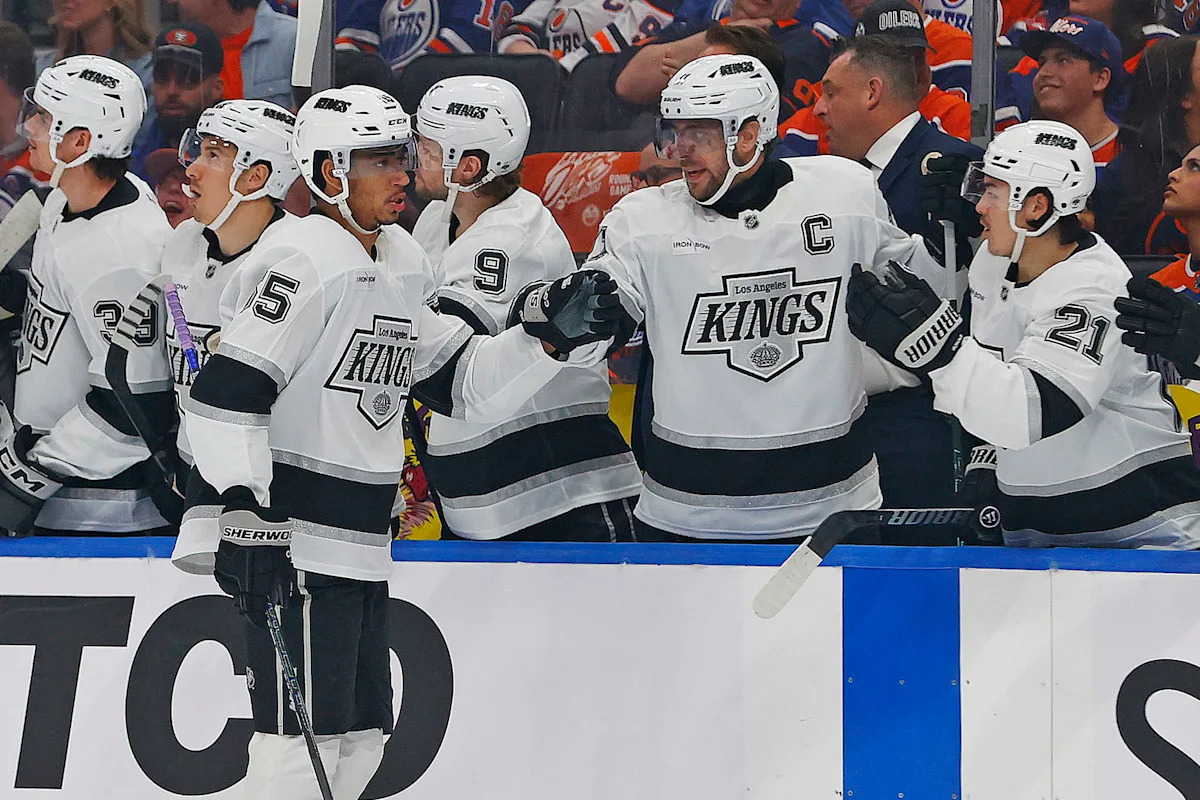
EL SEGUNDO, CA — As I continue my ‘Summer Series of Sunday Thoughts’ regarding the Los Angeles Kings, it’s about time we talked about one of the most pressing matters on my mind—and realistically, what should be on everyone’s mind: Quinton Byfield and his pivotal next season in the City of Angels.
Change is a good thing, right? This club could surely use a young facelift despite the franchise juicing some legacy players into positions of failure. I have previously written about the changing of the guard and how the Kings have relied on and have been unwilling to commit to their future while Drew Doughty and Anze Kopitar remain on the roster. The two former champions have been deployed at 1C and 1D (top positional spots) regardless of the prospects available or the proof-in-the-pudding result at the end of the previous four seasons.
Advertisement
The ladder in Kopitar, however, does have a player who has shown promise to take over a top positional spot, given that Jim Hiller gave him the leeway to do so this last season. The shift goes back further, happening two seasons ago when Byfield was elevated to the top line as Kopitar’s wing, flanked by burgeoning star Adrian Kempe. Last season, he was locked into the center position, becoming the best player on the roster down the final stretch (12g-14a-26p in the last 30gp of the regular season). Despite the franchises’ turnover at 1D not looking very good, the top center turnover looks at least past the handshake mark.
Byfield, by all accounts, must be their fully fledged 1C next season.
I’ll mention that credit should go to Hiller because, man o’ man, he was deploying Byfield as the 1C/top matchup center right around when the Kings left for New York last December. The young 6’5″ centerman ran with it in his first full season at his natural position. Kopitar was still getting routine deployments against top competition but with a new rotation. Unlike the previous few seasons’ rotation with defensive stalwart Phillip Danault, the rotation was reinvigorated with the prowess and potential of a 22-year-old showing signs of stepping into some massive skates rather than shoes.
For example, here are some of the matchups between Kopitar and Byfield against some of the top centerman in the league:

Even strength statistics courtesy of Natural Stat Trick
Byfield saw more ice time than Kopitar in three of the seven matchups: against the Panthers, the Lightning, and against Edmonton (Leon Draisaitl). Oddly enough, Byfield saw almost every minute of Brayden Point playing against Tampa last season (which means he also saw an onus of Nikita Kucherov). He had generally better possession rates than the stalwart Kings Captain (Corsi, 4 times; Fenwick, 5 times). In this graph, Kopitar still had the edge in outshooting or sawing off top competition (5 times). Still, Byfield had better outchancing ratios (4 times). High danger, per the chart, is an even split.
Advertisement
It’s a promising side by side comparison to an outside-his-prime Hall of Famer and an up-and-coming player. From my viewpoint, Hiller gave Byfield a ton of leash for a 22-year-old centerman, and he ran sprinted it, which is an excellent sign as they transition their future cornerstone into place.
Hiller gave Byfield shutdown and 1C minutes sprinkled heavily across the midway mark and the last 2/3rds of the season with various results, yet still a net positive. Except for a cratering under a few mighty centermen (Draisaitl, Aleksander Barkov, and Nathan Mackinnon), he largely held his own and sometimes even dominated (Mark Sheifele, Jack Eichel). In the curious case of Barkov, the league’s new version of Kopitar, Byfield only saw 1:30 of him on the road. This would indicate that Paul Maurice chose to combat the Kopitar line with Barkov head-to-head (8:52 compared to Byfield at 1:30) while owning the last change.
Now let’s fast forward to the playoffs, aka when it matters most, aka Edmonton again:

Blue: Worst performing values Yellow: Best
Point blank, Kopitar was crushed in this series. It might be his worst playoff performance of his career if it wasn’t for the first two games. When Connor McDavid and Draisaitl were separated they were humanized, yet he could not handle either matchup, getting caved in against both players. He was likely the go-to center to face Draisaitl strictly due to the size matchup coupled with his experience. Size might’ve been the most significant factor against Draisaitl since Byfield almost doubled the ice time that Danault had against the imposing superstar German.
Advertisement
Byfield, imposing in his own right, was the best head-to-head center option against the lethal top two Oiler centers when they were separated. Draisaitl and McDavid posted their worst numbers shot, possession, and chance-wise (all in shaded blue) against Byfield head-to-head.
Now, Danault deserves a lot of credit here. He saw the ‘nuclear’ or, rather, superline more than both Byfield and Kopitar combined, sawing them off scoring-wise (1 to1), but my goodness, outchanced 10 to 28. His possession numbers were cratered but the least when considering Byfield and Kopitar’s folly against Edmonton’s yearly go-to nuclear option. But in the argument of Byfield over Kopitar, Byfield himself saw nearly twice the amount of ice time (20:55) against the superline than Kopitar (11:30).
You also can’t say, well, “Knoblauch really chased Byfield as a matchup” when considering the 11-0 shot advantage, 10-3 chances for, and 2-0 scoring advantage when deploying superline against Kopitar. Both lines with Kopitar and Byfield were victimized by the superline, which is clear as day. However, despite a more than 3:1 shot advantage (18-5), the Oilers were outscored when deploying the superline against Byfield, with the closest high-danger ratio of all three Los Angeles centermen (6:4). This was with the Kings second best offensive weapon to boot.
If anything, more than the regular season, the playoffs proved three things for these Los Angeles Kings. First, Byfield is ready for 1C duties. Secondly, Kopitar, while not needing to be ‘sheltered,’ as he’s a two-time Selke winner, cannot continue to be the 1C for both short-term/long-term success. And finally, Danault continues to be an excellent high-leverage center despite getting long in the tooth and having one of the more moveable contracts on the roster.
Advertisement
Speaking of leverage, Byfield was the most used forward (all situations) in the six-game defeat to the Oilers (134:40) over players like Kevin Fiala (131:15) and Kempe (130:21). Kopitar was fourth most (128:55), Danault fifth (123:54). Numbers speaking for themselves, it seems the franchise has already started to pass the baton. Still, has the team given Byfield the horses to run with?
Byfield’s most common linemates last season were Warren Foegele, Alex Laferriere, and Fiala. Two of those players will not assist in cultivating bundles of points needed for a true 1C (Foegele and Laferriere). That’s not to say Byfield isn’t a self-starter, but rather someone who could use the proper weaponry around him to hit higher point totals. His last most common linemate listed has historically gotten shut down when facing top competition (Fiala). Fiala might be the most expensive forward on the roster, but the clear-cut best player is Byfield’s former linemate, Kempe.
So why not play your best center with your best winger, you may ask. Good question, for the Kings have glued Kempe and Kopitar together for four seasons straight. In all fairness, the duo has been a staple for the Kings’ lineup, but with Kopitar aging, it would be high time to give Byfield a weapon on the wing to be able to push 70+ points. With Kempe emerging as a league star, it’s relatively plausible to imagine an 80–90-point centerman in Byfield with Kempe fixed on his flank. The size, speed, and skill between the two players? Is this really not under consideration?
Unfortunately, the two barely saw one another this season at even strength. Byfield-Kempe, as a duo, in a measly 67:55 away from Kopitar across the 82-game season, produced an excellent 56.52% and a 52.94% Corsi and Fenwick, respectively. They outshot the opposition 54-48, outscoring 3-0 and outchancing 35-26, while high-danger chances were almost two to one, 15-8. In that small sample size compared to Kopitar and Kempe’s gargantuan 871:22 together, the percentages for Byfield are better in every category outside of shots on goal ratio. It is also worth noting that Kopitar-Kempe duo was outchanced at even strength last season (383 to 384).
Advertisement
From another numbers standpoint, Byfield is the best option for 1C moving forward as long as management is ready to commit. From an analytical perspective, he should have the best winger moving forward.
There should be minimal pushback here, with overwhelming evidence favoring Byfield as next year’s penciled-in 1C and his top wing fixture being Kempe, one of the first six recently announced to Sweden’s Olympic roster.
The one thing I would caution for is the fact that the Kings, under Rob Blake, committed to an expensive forward in Fiala leading up to 2022-23 who has only meshed well with centers like Danault, Blake Lizotte, Rasmus Kupari. Fiala finally gelled with a higher end center in Byfield around halfway through last season after a failed union to start the year.
Hiller will want balance, which may threaten Byfield getting Kempe as a wing since it is unlikely he loads up that line with Fiala unless under dire circumstances, putting the vast majority of the team’s ability to create and finish on one line. Kopitar and Fiala have not worked, as Fiala needs a speedy center, and with both demanding the puck. That puts this all in jeopardy, as the realistic duos that work would end up as Fiala-Byfield, Kempe-Kopitar, and Danault-Trevor Moore. That’s a repeat of the same roster schematic that had an earlier than expected end to the season, yet again.
Advertisement
The Kings could always stick Fiala with Danault, which has seen stretches of success, but then it would diminish Danault’s ability to shut down top competition.
That leads me to question: Has Byfield emerged as the clear-cut number one for the Kings? I would say yes. Can he develop a higher threshold for his potential next to Kempe? Absolutely.
There’s a 1C ready to burst onto the scene with the right horse running alongside him, but the Kings, under new management, will have to shape a roster together to put the proper alignment in place for their young future cornerstone to thrive.
Last thoughts, quite literally: Byfield did say he’ll be thinking about his failed clear near the end of game four in Edmonton that would eventually lead to the Oilers capitalizing on the pulled goalie —all summer long, as he mentioned in his season-ending media availability.
Advertisement
That is a tough pill to swallow, as if he clears that or makes a play behind Evan Bouchard, the Kings come home for game five with the opportunity to close out. No point lingering in hindsight; he’s got a hell of a career in front of him.
Currently in front of him: the throne at the top of the center chart.