The Cavs are good enough where they should be paying luxury tax, but I understand wanting to avoid the second apron.
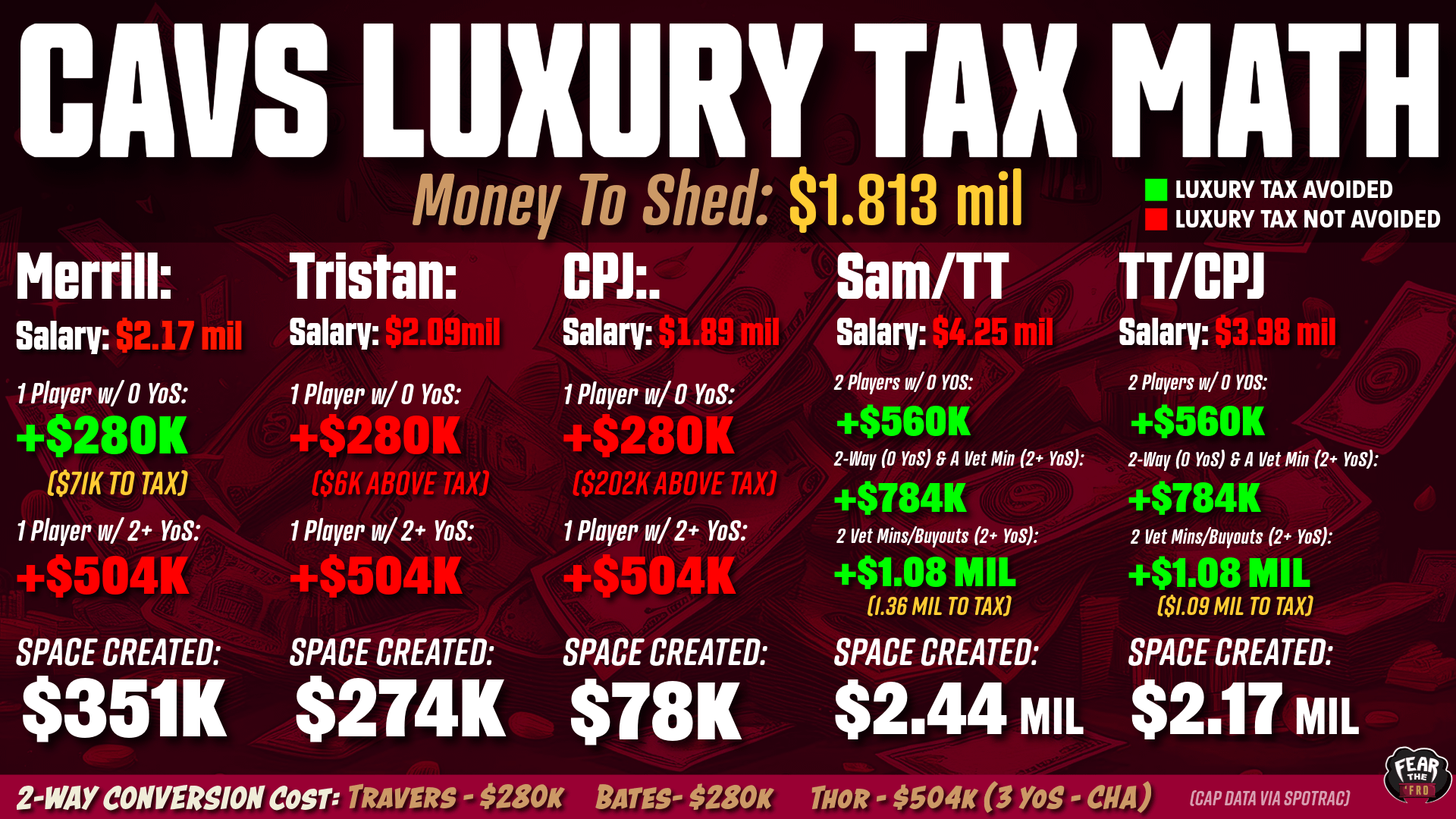
After seeing the discussion on this earlier, I thought I’d add this infographic here to illustrate the realistic pathways to get under the luxury tax (if the team is in fact committed to that pathway). Relevant things to consider:
1.) There is almost no way to pull this off with just dumping a single player, unless that player makes “Sam Merrill money” or above. A TT solo dump would be EXTREMELY close (less than 10k off, based on the cap figures available). Even in the event of dumping Merrill in a solo construction, Thor could not be converted while still allowing you to remain under the luxury tax.
2.) In the event, the Cavs duck under the tax and convert one of their 2-way guys, converting JT Thor is more expensive than the other 2 guys (Bates & Travers), because he had already accrued 3 “years of service” while on his rookie deal in Charlotte)
3.) Lloyd had eluded to this in his most recent article, and it is true that dumping 2 or more bottom end guys give you sufficient cushion to duck the tax, while still adding any vet min replacements you want (and/or 2-way conversions).
4.) Any vet with 2+ years of service or more, signed as a minimum counts for same dollar amount against the cap. This figure (504k), is less than their actual take home salary, but it is a rule the league has in place to make sure teams aren’t deterred from signing more experienced (and therefore pricier) vet mins.
5.) All of these constructions are presented under the assumption that the Cavaliers are taking nothing back in any salary dumping trade. That will limit the available pool of trade partners.
This information is great but isn’t part of the problem the Cavs only having 14 roster spots filled? Which is the minimum. So any roster move dropping/trading players to cut salary means the team still has to sign or receive guys back in said trade to stay at least at 14 active players.
If you dump someone I believe you have to replace them. So it’s not really plausible unless they trade a rotational al player like niang or levert. But those guys perform well in their roles
It might just be me, but I cannot make sense of this graphic.
Good stuff, Bob. Really appreciated you talking through these options. Did you use some sort of database/salary machine to determine the figures?
Welppppp, clearly the logical way to get under the tax is to trade our best player for an older, worse and more defensive player. Donovan Mitchell for Jrue Holiday and a 1st?

7 comments
The Cavs are good enough where they should be paying luxury tax, but I understand wanting to avoid the second apron.
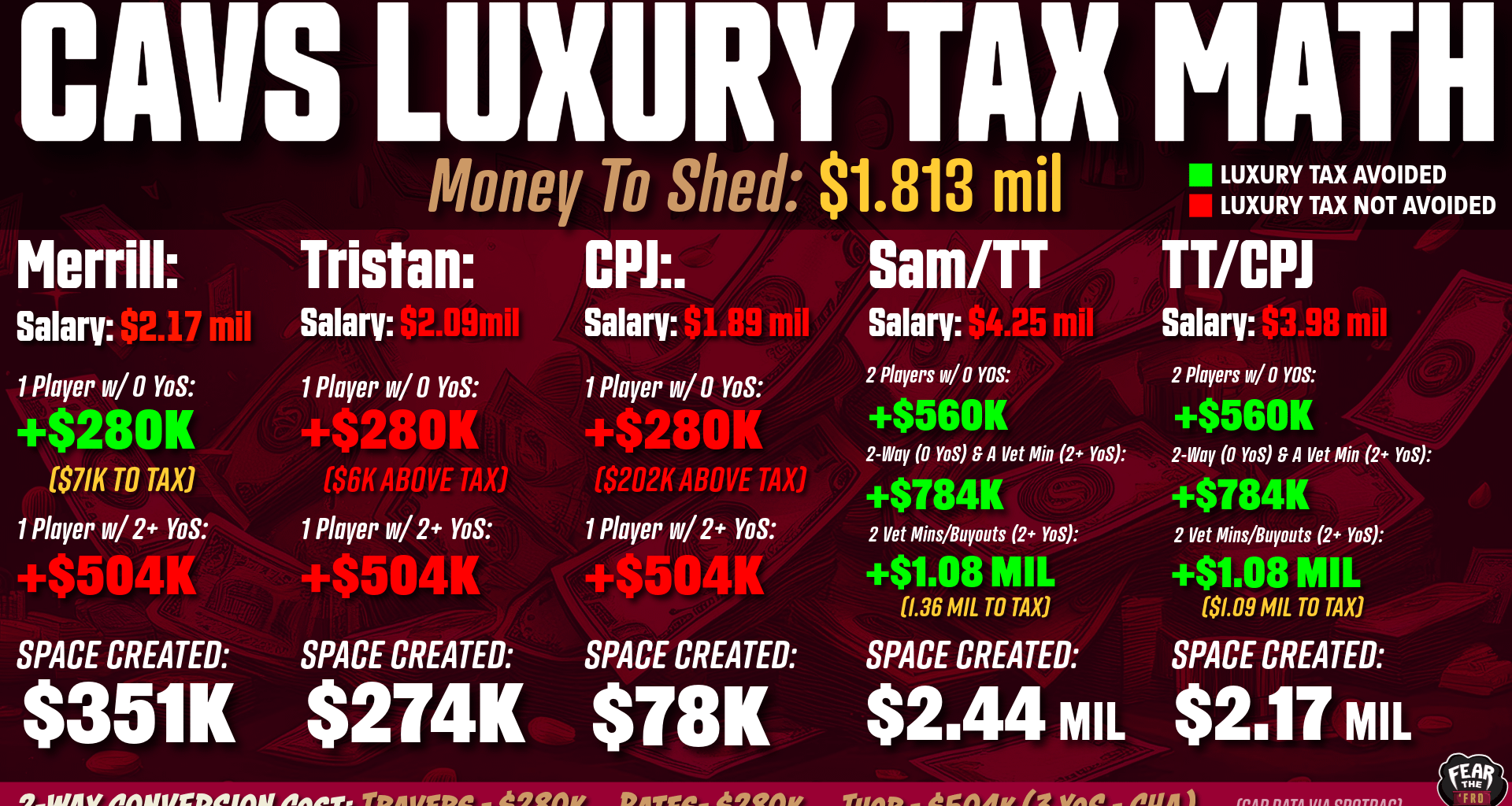
After seeing the discussion on this earlier, I thought I’d add this infographic here to illustrate the realistic pathways to get under the luxury tax (if the team is in fact committed to that pathway). Relevant things to consider:
1.) There is almost no way to pull this off with just dumping a single player, unless that player makes “Sam Merrill money” or above. A TT solo dump would be EXTREMELY close (less than 10k off, based on the cap figures available). Even in the event of dumping Merrill in a solo construction, Thor could not be converted while still allowing you to remain under the luxury tax.
2.) In the event, the Cavs duck under the tax and convert one of their 2-way guys, converting JT Thor is more expensive than the other 2 guys (Bates & Travers), because he had already accrued 3 “years of service” while on his rookie deal in Charlotte)
3.) Lloyd had eluded to this in his most recent article, and it is true that dumping 2 or more bottom end guys give you sufficient cushion to duck the tax, while still adding any vet min replacements you want (and/or 2-way conversions).
4.) Any vet with 2+ years of service or more, signed as a minimum counts for same dollar amount against the cap. This figure (504k), is less than their actual take home salary, but it is a rule the league has in place to make sure teams aren’t deterred from signing more experienced (and therefore pricier) vet mins.
5.) All of these constructions are presented under the assumption that the Cavaliers are taking nothing back in any salary dumping trade. That will limit the available pool of trade partners.
This information is great but isn’t part of the problem the Cavs only having 14 roster spots filled? Which is the minimum. So any roster move dropping/trading players to cut salary means the team still has to sign or receive guys back in said trade to stay at least at 14 active players.
If you dump someone I believe you have to replace them. So it’s not really plausible unless they trade a rotational al player like niang or levert. But those guys perform well in their roles
It might just be me, but I cannot make sense of this graphic.
Good stuff, Bob. Really appreciated you talking through these options. Did you use some sort of database/salary machine to determine the figures?
Welppppp, clearly the logical way to get under the tax is to trade our best player for an older, worse and more defensive player. Donovan Mitchell for Jrue Holiday and a 1st?