
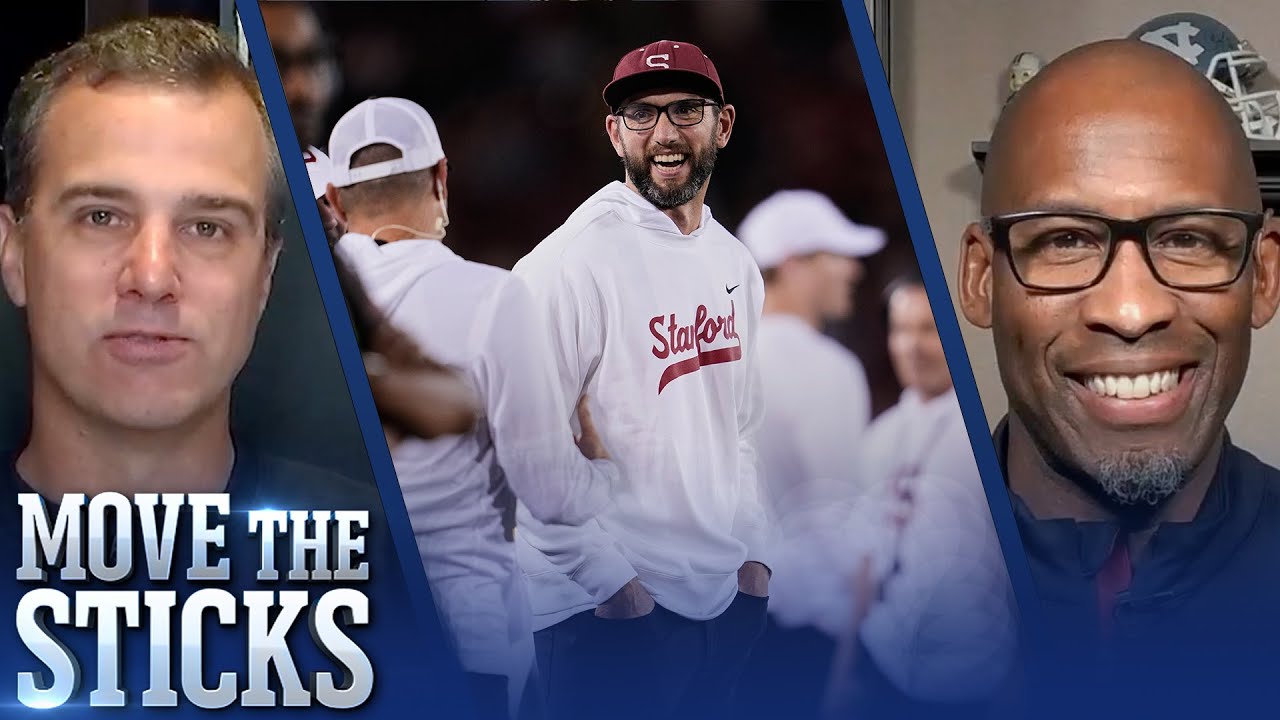
The Pursuit of Excellence with Stanford GM Andrew Luck
What’s up everybody? Welcome to Move the Sticks. DJ and Buck with you. And Buck uh man, I we’ve had some cool guests on this show. We’ve had World Series champs, we’ve had NFL champs, college champs, uh you know, you name it, across a wide variety of uh of spectrums. But today’s guest, I might be more fired up than any of them. Yeah. Former number one overall pick Andrew Luck is going to join the program. talk about all things Stanford, his new role as a general manager and just making a transition from being a standout player to being a standout team built. Yeah. And if you’re if you’re thinking this is going to be a deep dive into his NFL career or, you know, why he decided to retire at such a young age, no, that’s not what this is. This is uh this is about the future. This is about Andrew Luck as the general manager of Stanford football. um someone who has such a unique background and experiences, you know, really at Stanford as well as going on to the NFL, whose dad was an administrator and an athletic director. Um and now he finds himself in this role of trying to revive a Stanford football program that that he helped build up uh has kind of come crashing back down and he’s in the process of trying to get it back onto the mountaintop. So, uh one of the more fascinating men in all of sports and a conversation we’re really looking forward to and I think you’re going to enjoy it. Here’s our chat with Andrew Luck. All right, Buck. Excited to have with us a player we both scouted uh back in our NFL days and someone who has had an incredible journey and is now the general manager for the Stanford Cardinal. Andrew Luck join us. Andrew, how you doing, man? I’m doing really well. To be clear, this is not my jersey behind me. It’s John Brody. I’ve get dogged on. No, no, no. That’s good. I have my trunket jersey next to it. I tried to switch over the the wire was wrong and I I was I gave I gave up. So, I put John Brody back up. That’s fantastic. Uh, hey, as we get started here, I was going back through my notes on you. I think I was That was 2012, right? Was your was your draft year? Yeah. So, I was with the Eagles and I I just remember going through there and the first question that everybody asked was, “How did how did you guys get this guy?” So, I’ve never heard that story from you, your recruiting process, why you chose Stanford. Yeah. Well, I I I I’ve thought about it a lot more being a GM now and and spending a good chunk of my time recruiting to this amazing university, you know, in the football program. Um, we were in Houston, Texas. Uh, you know, my I grew up in a in a football family. My dad was a sports exec for NFL Europe, right? Uh, and the sports exec and a bunch of other ways. We ended up moving to Houston for middle school and high school. And I was a football obsessed kid and I and and you know, we were a family that stressed academics. you know, my my parents did a great job, I think, with all of us growing up. Um, and I enjoyed school, you know, and I was a nerd and I liked playing with Legos and I love playing sports and I love playing football and I love playing basketball and baseball, you know. Um, and I got to, you know, I won the starting job on our varsity team, Strapford High School, my sophomore year and started getting recruited, right? And and certainly when you’re when you’re the son of a former NFL quarterback, like, you know, you get there’s name recognition. You know, Jim Harbaugh was hired by Stanford. I can’t remember exactly when um and my I but I remember was you know we used to have a computer in like our living room and my mom was a early adopter of computers and like Yahoo and she had you know emails like it was cool. So we had a computer and so my dad I think was figuring out like that he could go get his sports news on the internet not you know wait for the Houston Chronicle to come in the morning. So he would sit there and type like an old man, you know, bah. And he yelled out, “Hey, Stanford just hired Jim Harbaugh as the head football coach.” And I didn’t, you know, it went way over my head, but but I think a seed had planted in his mind. He’s like, “Let’s go out and visit Berkeley and Stanford.” So a spring break, my dad took me out to visit Jim Harbaugh, who was who was pretty new in his job, and getting a a very infamous bathroom built connected to his office, which you can read about at some point. and and I I visited I fell in love with coach Harbaugh and his enthusiasm and his deep conviction that you can win here and I looked at Stanford as as the singular place that was going to get the most out of all of me as a quarterback. I wanted to be like Jim Plunkett and John Elway, right? Like I I wanted that this place had history. Um I knew Coach Harbaugh was going to push me. I knew the staff was going to push me. I knew I was going to go to one of the best, if not the best school in the world. And I like and I and I wanted to challenge myself that way. I I wanted to make sure I was growing. So, you know, I committed to a team that went 1 and 11 the year before, you know, coach Harbaugh got there because I believed in this thing and believed in in in doing it a little different uh perhaps than some others in my situation. And I was like I was a pretty big recruit. Not like big big big, but you know, I was good. And um I met a bunch of the other guys too. A bunch of other commits, a bunch of guys in the locker room, these guys are from all over the country. They love football. They’re obsessive over it. And like you walk by and they’re having a conversation about the Israeli Palestin Palestine conflict or like why, you know, what happens when water actually boils at 212 degrees. What’s happened, you know, like whoa, this is cool, you know, and uh and I’m I’m I’m sure glad I did. I I was pushed. I I grew a lot. The coach Shaw, Coach Harbaugh, Greg Roman, the Pep Hamilton, the coaching staff challenged me. I was prepared for the NFL when I came out. I really was. the way the way they asked me to run an offense was like an NFL team. Um, and they taught it. They were great teachers. And so I take a lot of that to my job now. You know, it’s funny, Andrew, because that was going to be my natural transition because because you went in to a program that was one and 11 before you got there. You’ve seen it go from the bottom to where they’ve had the the pinnacle of Stanford football. How do you try and replicate that in your current role as a general manager where you currently have Frank Wright but eventually you may have a full-time coach? Like how do you take what you learned as a player and replicate that now as a general manager? Yeah, absolutely. Well, one, you know, there I think there are pretty there are some timeless principles in our sport, right? And there’s probably some timeless principles organizationally across industries and like the world has changed. We are paying players and we’re excited about it, right? The transfer portal was different than than than when I was in school. One, coach Harbaugh’s having a leader of the program that had deep deep conviction that we were going to win and in and what might be perceived as challenges were not going to be excuses, right, at all. Right? Coach Harbaugh said, “Well shoot, if we can only recruit 40 or 50 guys a year because of the academic threshold, let’s go find the best 40 or 50 and make sure our yield is higher than everybody else, right? In high school recruiting, good. That’s profoundly affecting how I do this. Two, let’s build a foundation of like hard work, respecting each other, holding really, really, really high standards because we have high expectations. We have very high expectations and those have to be rooted in very high standards and really high care, right? And and so those coaching staffs, Coach Harbaugh, Coach Shaw afterwards, they did it authentically. Coach Harbaugh was authentically himself. Coach Shaw was authentically himself. I learned to be the best quarterback I could be. I had to be me, right? including walking into a locker room where Pton Manning had been the previous quarterback because if I if I was trying to beat Payton, a version, you know, Andrew’s version of Payton that it would fail quickly, right? Fail quickly. Um and and I was was given license by Dwight Freeny on day one walking in that locker room said, “Andrew, you need to be the best you you can be. No one else. This team just needs you.” That that meant a whole lot as a young rookie quarterback coming into, you know, um into that space. So, you know, one, bringing all of me as a leader to this thing. Uh, two, going and finding the unicorns around the country at high school that that have the grades and and ball out, right? That are willing to put their work in um and and willing to learn and play great football, building a culture of brotherhood where our young men are playing for each other, right, and understand our plan. And and you and you mentioned it too, Frank. Frank has done an unbelievable job this year. He He saved my bacon, man. Coming in for eight months and and doing this thing. And the and the progress and that that our team has made is unbelievable. I’m proud of him. I’m proud of our staff. Um I I get proud watching these guys every Saturday go out and lay it on the line and and and and it’s it’s a wonderful thing to be a part of. You you touched on two things I wanted to to get some further thought on because um you talked about the foundation and and building a foundation. I think of your your studies and your background in design, architectural design, like how that plays into it and what does this foundation need to be to go forward. And the second thing is we we’ve talked a lot and just talking to our buddies in GM roles in all different sports. The phrase that we’ve heard more than any other the last 24 months has been care factor. We can talk about it’s easy. The scouting the talent is is really it is what it is. But trying to find guys with a very high care factor is the challenge. How do you go about doing that when you’re visiting with 17 18 year old kids? Oh man, it’s it it is a that’s what a great question, right? It it is the question. I think I think of care factor at two different levels. Yeah. I think one at the individual. Do I like do I love football? Do I and do I love learning? Right. Because that and do I and and and have I seen enough evidence that I can get better at football? Right? Like you want kids who are just obsessed about getting better at football because it’s that gets to become an addictive feeling and that’s a virtuous fly cycle, right? Like like a flywheel of like yeah better better. Frank Reich has done that for our guys. He’s they’ve gotten better the coaching our staff like in better and then also for our staff, right? Are we getting better? Am I getting better in this job? Is there is there a level of intrinsic motivation often tied with love of something, right? hard to hard to want to get better at something if you if you just sort of like it a little bit or or like really don’t like it. But sussing that out, I’m not sure I have a formula yet. You know, some of it some of it I think is gut instinct and feel, right? And maybe that’s the art of recruiting or or personnel. Um I think some of it’s the right line of questioning and and and and oftentimes it’s you got to find character references, right? You got to find people who who who who will spill some story that has some nugget of truth and put enough of those nuggets of truth together to find a picture and then you take a leap of faith, right? But I also I also believe of care factor of how are we as a program taking care of our our people, right? And giving everyone the best chance to have their care factor grow as they as they’re it’s not a static thing, right? Is not a static, right? Like I we we have to be a place that you know I mentioned high expectations and standards and high care like high standards and high care. That’s the right combination. You it gets old if there’s really high standards and low care, right? It also gets old. It’s kid gloves if it’s real high care and low standards, right? And there’s a there’s a quote from one of my mentors, Admiral Sandy Winterfeld, an amazing man. He’s got a great book on leadership called Sailing Up Wind. Uh he was I’m gonna say the words wrong, but chief of staff for Colon Pal at some point and Colon turned him in a car. He tells this great story. We turned him in in a car and said, “Sandy, morale has never been improved by lowering standards.” Right? Like, so how do we have a system of high care and high standards and find the people that will thrive in that system? And look, I’m like nine months in this job. I I like the data is not there. this like we got I should say the the big big big data. I know we’re on the right path. I have a deep conviction that this is the right path, but it’s there’s a there’s faith in this, right? You know, man, I’d love to be sitting here five years from now saying, “Yeah, we just won four national champions.” But that’s that’s I approaching both the the like sussing out care factor and Andrew, you got to hold up your end of the bargain, too. You got to help young men tend to that care factor and grow it. You know, you know, Andrew, I’m so fascinated because I do remember going down and watching uh you play one of your final games uh down in the Fiesta Bowl and how the brand that Stanford had become. You guys have talked about Nerd Nation or intellectual brutality and those things. Um talk about it when you look at Stanford because you’ve been a part of it. What is that brand when it comes to the football program? Yeah. You know, I I think why Nerd Nation and intellectual brutality were were so authentic was because they they they and this is an overused word, but they organically grew out of an identity, right? And so I what I see our team doing right now is working their butts off and practicing hard and being professional and understanding the better we the better we execute a game plan, the better we understand the game plan, the better chance we have of of winning a game. So, uh, I love Nerd Nation because Shane Scove, my teammate, who, you know, who was an all-American linebacker, some, you know, someone from the stands, gave him a pair of glasses with some tape around. I remember it. Yeah. After after a huge win and he put him on for the press conference and it was like, yeah, we let’s own who we are because we are a bunch of nerds because everybody has they love on the team at least, you love football and there’s probably something else that you just that you’re willing to go deep in. And then intellectual brutality. I I give that to Mike Bloomren, the current uh offensive line coach of the Cleveland Browns because it’s it’s all about, you know, getting rid of either or getting rid of a paradox. You’re either intellectual or you’re brutal. Let’s combine like this, you know, and create a new paradigm. And I love that about Stanford, right? Scholar, athlete, we do it right. Intellectual brutality that like I love it. So those those are models, those are huristics, I think. But we’ve also got to chart our own path. And I’m I’m I’m curious as this goes what what comes up. We certainly have a vision. I mean, we certainly do. We’re built different to be different, right? We got kids who want who who like embrace the grind, who want to earn it, who are looking to be challenged in every way, shape, or form. We think better men make better players, right? Better players make better teams. Um, and I’m curious what what sort of catchphrase social media slogan comes comes out of this. But it’s got to be authentic and there’s got to be integrity and fidelity to who we actually are because that’s what resonates, you know. Absolutely. I I I was thinking back to the first time I went on campus at at Stanford and where we used to park as scouts. We’d have to walk across the whole campus. I remember the first time Buck, we’ve talked about this. I remember parking the first time and it was a fall day. It wasn’t an early visit. It was a little bit later in the fall and I remember walking across and I swear I thought it was I was on a a sound stage or something because the leaves just kind of started falling. I looked to my left and there’s the women’s soccer team practicing. I’m sure there’s probably six Olympians there. Then I hear the ping of the of the baseball bat and I’m sure there’s probably a couple first round picks on that field as they’re kicking some BP. Walk by the pool where there’s a high diver and I’m sure I don’t know which country but there’s an Olympian that’s just jumping off the high dive. And then I walk in the building. I remember after that day, Andrew, I called my parents and I said, “If you would have taken me to Stanford in eighth grade, I would have got better grades in high school. I didn’t know a place like this existed.” So, how important is it for you when you’re recruiting these guys to get them on campus and not just take your word for it, but come experience it? Oh, it’s huge. We I I mean, I don’t mean this in a snobby or snoody way, but it’s a special place as you laid out. And like I’ll finish your story and then you walk into a football building and there’s David Diccastro and Kobe and Michael Thomas and myself Zack Z who is like down the fountain of youth and just an like still balling at a level that you know these these tight ends playing forever is unbelievable man. Um and yeah we think it’s a special place. I you know I met my wife here. She was a gymnast right representing the Czech Republic. We all live in a dorm freshman year with a random roommate. Like that’s where else do you get that in life right? And we need kids to embrace that. It’s I’m still friends with my dorm mate Dennis Carman from Turkey. He’s an amazing dude who lives in the Bay Area, right? Like it’s an amazing place. And you mentioned the sports. You’re also going by a you know an academic building where we’re we’re where unbelievable breakthroughs in whatever mission it is are happening. It’s it’s it’s a place that rewards the pursuit of excellent. Not just attaining excellence, but the pursuit, you know. So getting getting young men and their families on campus is core to our recruiting strategy because we think it sells itself. And then my job really is to make sure that the football is serious, right? Like serious like what I like aspects of what I had old school principles, some new school methods, you know, but there are some timeless truth. But because I came to Stanford, you know, I mean to maybe more succinctly answer the first question, I came to Stanford because it was serious about football and serious about other things and it was a place where I did not want to take myself too seriously. But, you know, we’re our guys are are embracing the seriousness of football. You know, my my year I think we had we had NECA OM go first overall in the WNBA. An amazing, you know, this amazing hoopster from Houston as well. I went first overall in the NFL draft. Mark Appel was either drafted as as a pitcher, drafted like first or top five. It was like you’re just surrounded like I go to the Olympics. My wife’s a producer for gymnastics on NBC. I w I went to the Paris Olympics. What a treat. Like there’s 59 Stanford affiliated athletes. My classmates, you know, Katarina Stephaniti, Paul Valter, Greece, gold medalist at Rio. We were in the training room together. Like that’s awesome. I watched Eric Soji win a bron bronze medal in men’s volleyball who was freshman doormates with with my teammates. Like we’re we’re boys. We party together, you know. It’s a it’s it’s an amazing group to be a part of. And I I I love that our football team is part of a broader fabric and culture of let’s go figure out how to be excellent. You know, Andrew, I gota ask you this because I find it fascinating. uh when I watch you on game day, I notice that you’re right on the sideline and it looks like you’re almost in the huddle uh as a general manager. Tell me why you feel um the need to be on the field, be on the sidelines to really immerse yourself into the game. Yeah, I you know, one of the things Coach Reich encouraged me uh and us and and and I’ve learned so much from that man and the you know, one as a as it was, you know, my last year playing in the elf was him. I I quit, walked away on him and Chris Ballard and we and our relationship only got stronger, right? Like he brings a humanity and a steadfastness and a integrity and a care factor for his job and his people that like is is inspiring and I know in large part that’s what our young men are responding to and so I’m eternally grateful. So, you know, one of the things he challenged was is like we just had this theme of like, Andrew, embrace how unique and weird this season is. Just embrace it. Embrace it. Because the first game I was up in the booth and it was a tough pill for us to swallow. We lost to Hawaii and you know, Frank and I downloaded for like five hours after the game. We didn’t both didn’t sleep while you wake up. You talk, you know, what’s you know, how does this go? He’s like, I need you out of the booth, Andrew. I need you on the field, right? I I I you know, because I I’m involved in training camp. I’m involved in practice. you know, our we have a very we have an egoless group of coaches and I I respect the coaching profession too much to step on their toes, but like I’ve you know, I’m going to go talk to our quarterback coach and Frank about the cover zero plan or or cadence or, you know, how to you just the little finer points. I I know I have value there. So, Frank asked me to be on the sideline, right? He said it would help me as the head coach, Andrew, if I knew you were there. And so, I said yes. And then it’s like, well, if I’m going to be on the sideline, I better bring all of myself. And that is all of myself. Like, that’s way that’s the only way I know how to be on a sideline. I mean, I think the the guys laugh because I say the same two things the whole game. I just yell it, you know, one play at a time, re-engage, and persist. One play at a time, re-engage, persist. And and and you know what? I don’t know if I’m there forever. I don’t know how I, you know, but but it’s what this team this year that it’s what our head coach wanted and I’m and I want to provide for our head coach. That’s you know, providing for our players, providing for our coaches and and being a resource for our head coach. If that’s going to help us win games, I’m there. You know, I absolutely love it. We got a couple more minutes with you here. Um uh this is a quick one. Is the Versa Climber still in the weight room? No. And no, come on. The torture rack. Oh, I’ve got I’ve got scar. I’ve got psychological scars from the Versa Climber. Oh, I can remember being in there. It was coach Curley, I think, at that time in in the strength coach’s office and you look out and you saw like I think that man is going to die. He is on the Versa Climber and there’s somebody who’s going to literally drop dead in this weight room right now. That thing was a torture rack. It It was We We still have the the I love a dungeon weight room, too. I love an underground weight room. We still got it. The guys go down to the pressure cooker. Our strength coach, Ryan Dietrich, is amazing. And uh I’m you know what? I’m going right down for the vers climber question after this. Yes. Yes. Let’s bring that thing back, man. Uh last thing, we’ll let you run. You’ve been so generous with your time. Um you mentioned and I and I wrote it down. I’m looking forward to to reading Sailing Upward upwind. I have not read that book, but is there any other book you would recommend to us and and those are listening. If you’re if you want to build an organization or build a culture, give give us a good book uh that that we can dive into. Oh man, I look I need help on this too. I like this is this is part of what I’ve reached out to the folks I know like like Lynch and Chris Ballard. I had a chance to go to Brad Stevens. Um you know I’m I’m trying to embody being the best at getting better, right? If if I expect that from our players. There’s an old school book. I’m gonna have to text it to you guys after so I’ll take it. I think it’s called The Winning Way. It’s it’s a book written in in the 80s or 70s about and there’s a chapter on each of the sort of wooden Lombardi some of these old school coaches and their philosophies and look it’s you know it would need a rewrite in today’s day and age I guess is all I’d say right but it but and so you have to read it knowing this was written in a different era you know but there are some real nuggets of how you know when head you know college sports has changed so much but head coaches used you know forever and It was the head coaches program, but it’s like there are some real nuggets of truth and and and style and substance that that I that I that I love from that book. I’ll I’ll text it to you guys, put on your socials, connected to this thing, all that jazz. All right, guys. You’re the best, man. Hey, we’re uh we’re rooting for you. It’s been fun to watch your journey and uh let’s get Stanford rocking and rolling again. Let’s go. Appreciate y’all. Take care. Thanks for having me on. Fun time. All right, Buck. That was fun. I mean, I, you know, in some ways, uh, very thankful we got 25 minutes with Andrew Luck, but I could have done another hour there. He’s a fascinating guy, man. Yeah, he’s so fascinating. And DJ, like it’s not only like him, but I just remember because I felt like we watched Stanford rise to prominence while we were scouts. And so, and people don’t understand how unthinkable that was. Well, they were the doormat of college football. They were the doormat of college football. and all of a sudden they became the bullies in the Pack 10. And and just watching them do it and having a premier quarterback like that who embraced the physicality and toughness and old school demeanor that they played with. To me, I’m fascinated, but I do believe he can take the lessons that he learned as a player and apply them down the road. I just can’t wait to see when they they hire a permanent coach and he kind of gets settled in his role to see what that looks like because I do believe it can return. I’m just excited to see what kind of iteration uh it it becomes. Yeah, I was uh I was doing some research for that thing and looking at it. The uh the last six seasons Stanford, you know, coming into this year had won 20 games. Um at one point in time that in the previous six in the previous six seasons they won 102. So that like they had an unbelievable run and then it’s come kind of crashing down and he’s trying to build it back up in a new era with NIL and everything else. And you know that the question is can you have it all? Can you have the academics and the athletics? Are there enough kids that want to pursue that that you can have a championship level roster? I think he wholeheartedly believes it and uh he’s out to try and get it done. And the other thing, you know, reading about him was uh he spent it he’s he’s so smart. He realizes, yeah, build the culture. You got to do all those things, but the other thing he’s got to do, he’s got to go raise money. Um, and he’s been out there hustling and doing that with the alums. Yeah. No, I I think he’s uniquely qualified because one, he knows that spot and and we don’t know if it’ll become a trend, but I think Andrew Luck being at Stanford, Clark Lee being at Vanderbilt, some people being at these prestigious academic institutions, knowing the the warts and the the lay of the land and how to navigate around it to have success is critical. And I do believe like because what he talked about the brand it exists beyond what we talked about on the field being around all those Olympians and being around all the business people that spend time there. They have a nice offering. I just believe it’s the way that you package it, sell it, and the audience that you direct that that message to that is really what matters. Sailing upwind. I had not read that one. So, I’m going to uh I put wrote that one down and then we’ll figure out um you know, he I’m sure he’ll text uh Singer, our our booker, and and let us know what that book was once he figures out what it was. Be on the lookout for that. We’ll post that on uh on socials. Uh anything else, Buck, before we get out of here. No, it was fantastic, man. I love uh talking to him to to have his perspective now in a new role. We know how great he was as a quarterback, but now to see him in a new role and to take all those different experiences and to put it together, really excited for him. Yeah, no doubt. Um, all right. That’s going to do it for us. We appreciate appreciate you guys. Hope you’ve enjoyed this episode. If you if you did, share it with a friend. Uh, and if you haven’t, uh, we do appreciate those reviews. Uh, like, rate, rate, subscribe, all that good stuff. We don’t ask you for that often, but, uh, it does help. We’ll see you next time right here on Move the Sticks.
Watch live local and primetime games, NFL RedZone, and NFL Network on Plus.NFL.com
00:00 Intro
01:22 Andrew Luck interview
22:42 Luck’s impact on Stanford football
25:45 Outro
Check out our other channels:
NFL Mundo https://www.youtube.com/mundonfl
NFL Brasil https://www.youtube.com/c/NFLBrasilOficial
NFL UK https://www.youtube.com/channel/UCVe0dAja_vZCmvfHXjtdRQA
NFL Fantasy Football https://www.youtube.com/nflfantasyfootball
NFL Play Football https://www.youtube.com/playfootball
NFL Throwback http://www.youtube.com/nflvault
NFL Films http://www.youtube.com/nflfilms
#NFL #Football #AmericanFootball
8 comments
Wsgggg first
You always manage to share encouragement in such a natural and uplifting way, never forced or fake 🥳🎉
This is how you build a team!!! 🙏🙏🙏
This isn’t about winning — it’s about how much you refuse to quit when everyone else does.
… bar got raised 👻👻👻
Intellectual brutality…👻👻👻…🫶… Happy Halloween
Nooo way early😮😮
Great Cardinal 💪 talk chat*
Should David Shaw wait for the 49ers to sell the team or just knock on their door now