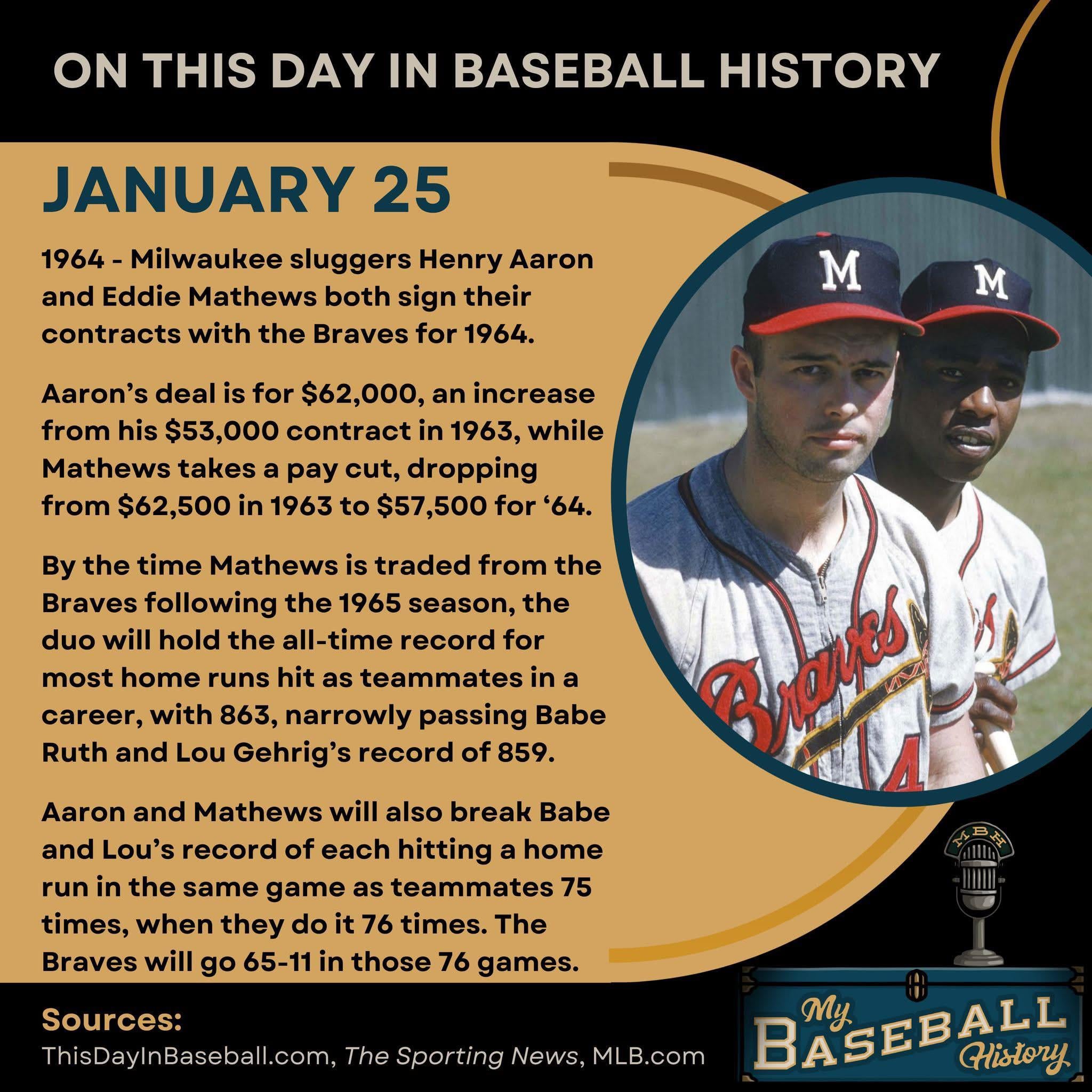
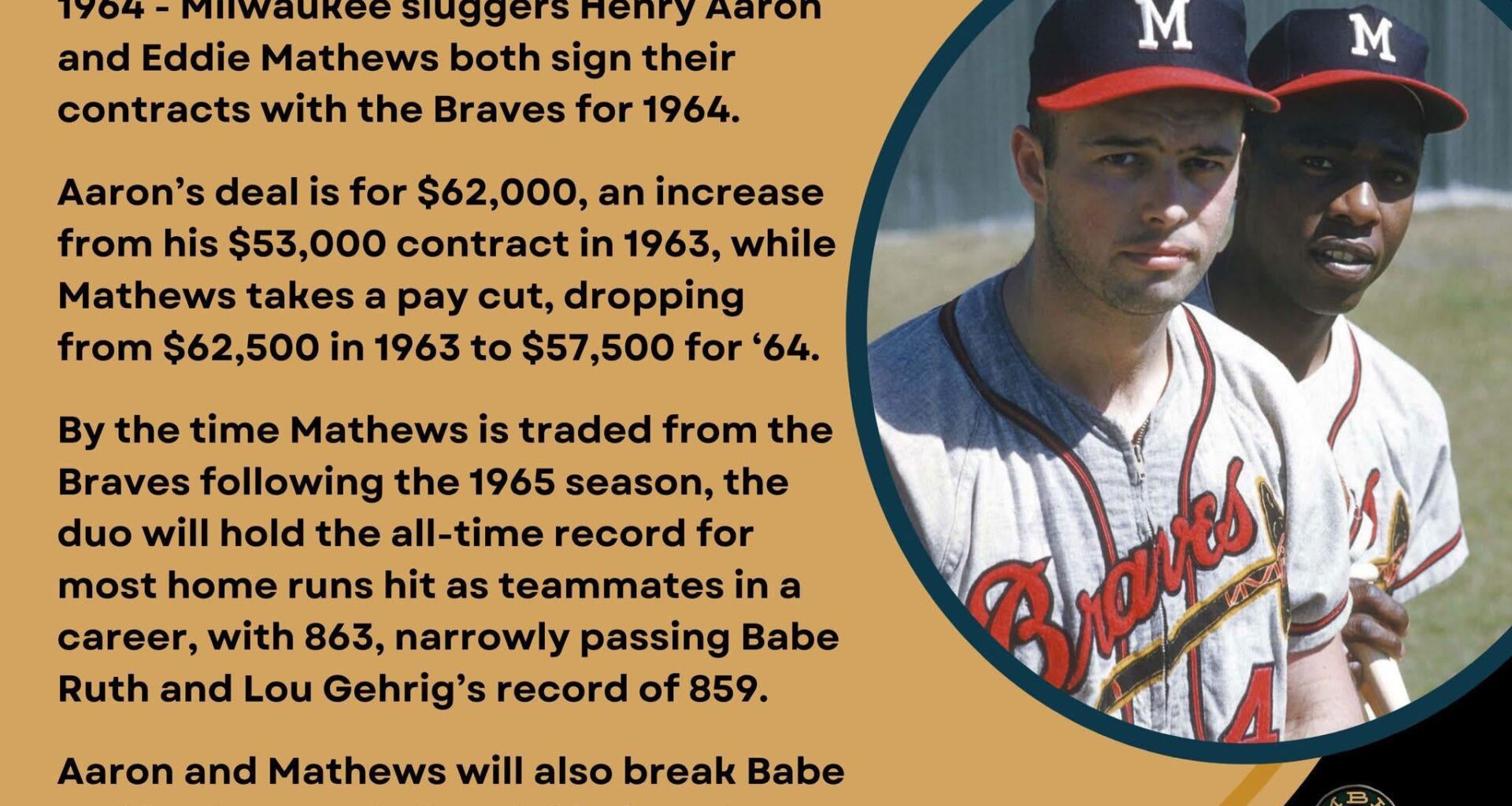
It’s not difficult to figure out how the Braves mathematically made the Aaron and Mathews deals work. Mathew’s pay cut funded a good portion of Aaron’s raise. I’m interested in knowing if the Braves made it up to Mathew’s in other ways, or was this the beginning of the end, and thus, the trade of Mathews the following season? There is no doubt Hammerin’ Hank was worth it. Mathews would have benefited from a stronger MLBPA that didn’t become an effective labor union until 1966.
Eddie Mathews hit a HR as a Boston Brave, Milwaukee Brave, and an Atlanta Brave.
I know it’s not talked about now too much because most of the people from Mathews and Aaron’s generation are dead, but there was a lot of bitterness from that generation towards the boomer generation of ballplayers who came afterward and started to see some big paydays in the 70s and 80s.
Most people think salaries have steadily risen over the years. They haven’t. That’s only been a recent phenomenon.
Your highest paid player in 1950 was Joe DiMaggio. His salary? 100k.
In 1965, it was Willie Mays. His salary? 105k.
Yaz finally overtakes him in ‘71, but it’s still only around $167k.
You don’t get your first player making $500k until Mike Schmidt in ‘77. Three years later, Nolan Ryan becomes your first million dollar free agent signing.
By the end of the decade, salaries of $2 million are becoming the norm for star ball players, but anyone who came up before them didn’t see a dime of that money.
Even someone as big as Ted Williams had less than a million dollars in the bank at the time of his death.

3 comments
It’s not difficult to figure out how the Braves mathematically made the Aaron and Mathews deals work. Mathew’s pay cut funded a good portion of Aaron’s raise. I’m interested in knowing if the Braves made it up to Mathew’s in other ways, or was this the beginning of the end, and thus, the trade of Mathews the following season? There is no doubt Hammerin’ Hank was worth it. Mathews would have benefited from a stronger MLBPA that didn’t become an effective labor union until 1966.
Eddie Mathews hit a HR as a Boston Brave, Milwaukee Brave, and an Atlanta Brave.
I know it’s not talked about now too much because most of the people from Mathews and Aaron’s generation are dead, but there was a lot of bitterness from that generation towards the boomer generation of ballplayers who came afterward and started to see some big paydays in the 70s and 80s.
Most people think salaries have steadily risen over the years. They haven’t. That’s only been a recent phenomenon.
Your highest paid player in 1950 was Joe DiMaggio. His salary? 100k.
In 1965, it was Willie Mays. His salary? 105k.
Yaz finally overtakes him in ‘71, but it’s still only around $167k.
You don’t get your first player making $500k until Mike Schmidt in ‘77. Three years later, Nolan Ryan becomes your first million dollar free agent signing.
By the end of the decade, salaries of $2 million are becoming the norm for star ball players, but anyone who came up before them didn’t see a dime of that money.
Even someone as big as Ted Williams had less than a million dollars in the bank at the time of his death.