
Welcome back to “The Needle,” a ratings-focused column on Sports Media Watch that will break down the numbers, attempt to put some context behind the data, and discuss broader trends in measurement and television viewing.
It is, as the kids like to say, a bit of “cope” to suggest that the ratings do not matter. One only hears that the ratings do not matter when the ratings are not good. Roger Goodell is not downplaying the importance of the ratings.
Even so, it is hard to look at the decisions being made throughout the sports media industry and come away with the idea that the ratings are the be-all and end-all, as they are so often portrayed in reporting.
The past three weeks have produced some of the smallest audiences in recent years for the NBA Finals and Stanley Cup Final, plus double-digit declines for NASCAR on Prime Video.
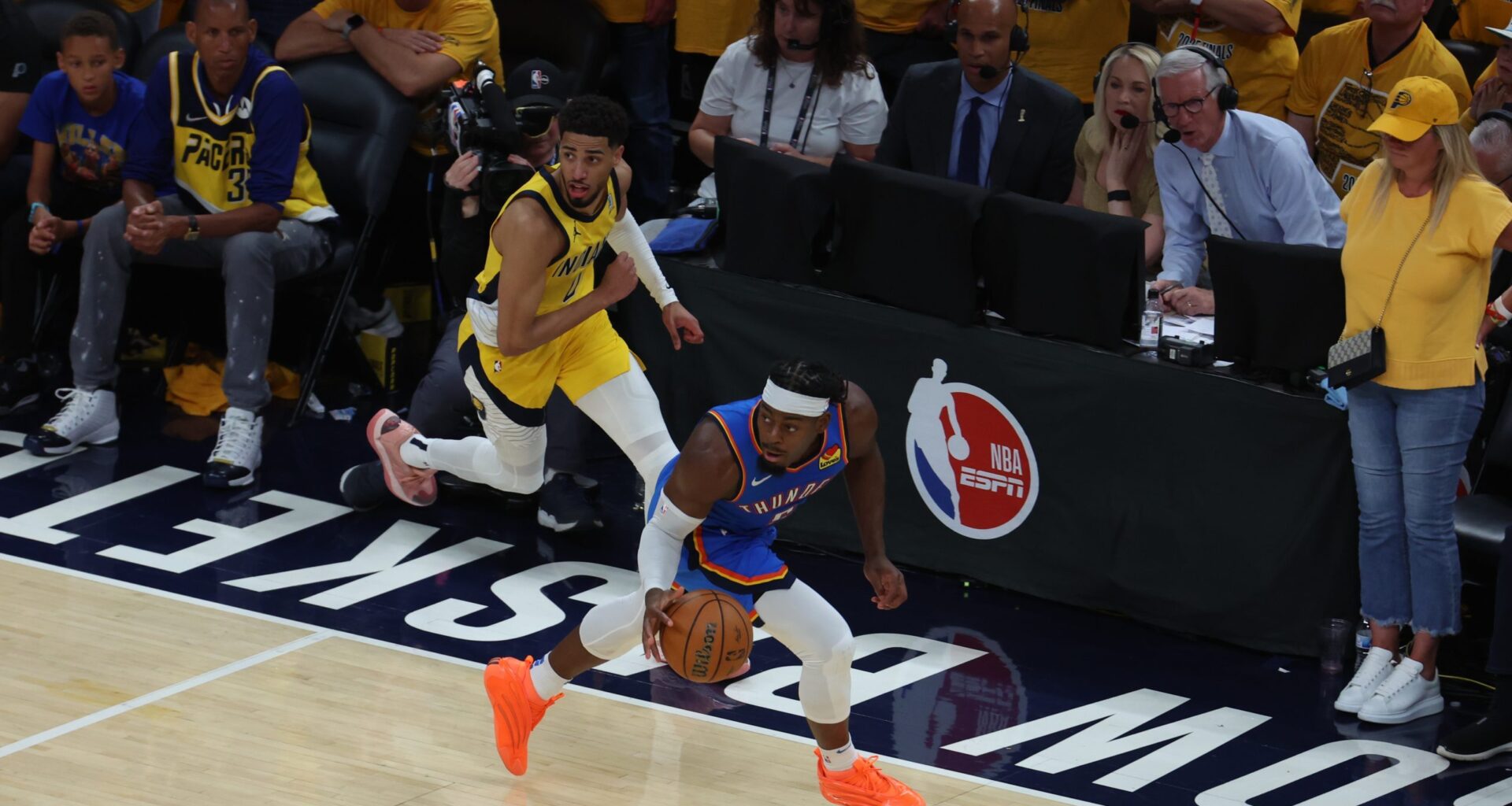
Viewership for the first three games of the Pacers-Thunder NBA Finals declined 19, 29 and 20 percent respectively from last year, each ranking among the least-watched in the Nielsen people meter era (1988-present). The first four games of the Stanley Cup Final on TNT Sports declined from last year on ABC, generally surpassing only the COVID-era years of 2020 and 2021 as the lowest since 2012. Then there is NASCAR, which for its first three races on Amazon Prime Video saw declines of 21 percent from the equivalent three races a year ago.
About a decade ago, certainly two, this would be an occasion for questioning the status of those properties.
Today, the significance is being downplayed across the board, from NBA commissioner Adam Silver (“We don’t even think in terms of ratings … It seems a little unusual how much discussion there is around ratings in this league.”) to NHL commissioner Gary Bettman (“You get some in the media in the U.S. saying, ‘Well, the ratings are going to be soft in the U.S.’ They’re going to be great in Canada, they’ll be fine in the U.S.“).
Even Pacers G Tyrese Haliburton had the opportunity to shrug off the ratings — as one would expect of a player — when asked in a media availability Sunday: “I do not care, to be honest with you. This is high-level basketball, and I’m excited to be a part of it. So, I mean, I couldn’t care less.”
Coming off of the least-watched Coca-Cola 600 in at least 31 years, NASCAR was not only unconcerned about the ratings, but “pretty encouraged” — as Senior Vice President, Broadcasting & Innovation Brian Herbst told Sports Media Watch soon after. “We’ve been on linear TV, traditional television, for decades and decades. So to have the first ever event streamed digitally and to transition essentially our entire cable audience — and then some — for the first event, we were pretty encouraged by the results.”
Is it possible that all of these comments downplaying sharp declines in viewership are simply public relations? Perhaps. But as compared with pronunciations of doom, they seem fairly sober and accurate. The reality is that none of these three properties are suffering.
To begin with, all three leagues chose their current condition with their eyes fully open. The NBA made changes in its most recent collective bargaining agreements to reduce the possibility of big-market “superteams” and dynasties. The result has been unprecedented parity, as either Oklahoma City or Indiana will become the seventh-different NBA champion in as many years. No defending NBA champion has even made it past the second round since 2019.
The NHL chose to put the Stanley Cup Final exclusively on cable every-other-year as part of its most recent media rights deal. That decision does not look particularly good now, but it is a bit hard to blame the NHL for signing up with a Jeff Zucker-led, AT&T-backed Warner Media — only to have the rug pulled out from under them with WBD and a looming spinoff.
Finally, NASCAR chose a partnership with Amazon, knowing fully that it would result in short-term ratings declines and relentless criticism from older fans who have been left behind. Those issues are a small price to pay to grow the sport’s younger audience, a goal that NASCAR has been pursuing — to limited success — for many years. A look under the hood reveals that the declines on Prime Video are concentrated among adults over 55 (where viewership is down 40 percent), while the younger demographics of adults 18-34, 18-49 and 25-54 are up 32, 11 and 21 percent respectively.
All of these decisions were made with broader goals in mind. For the NBA, it was to ensure that all teams believe they have a chance to compete. For the NHL, it was to maximize its media rights revenue. For NASCAR, it was to grow its younger audience.
Perhaps most importantly, there is no indication that the low ratings will have any meaningful impact on league business. One of the big misconceptions in reporting about the ratings is that conditions in the industry are the same as 20, 30, 40 years ago. There was once a time when television ratings seemed to have a significant impact on media rights revenue. It was not coincidence that the NBA had to scrape by with minimal increases in its 2002 and 2007 rights deals, during an era of sharply declining ratings.
But the relationship between ratings and media rights ruptured long ago. The NBA is about to begin a new $77 billion media rights deal in which ESPN insisted on keeping rights to the NBA Finals — an event that right now is averaging less than half the audience it had less than a decade ago. Simply having the content is now more important than the trend line of the audience, and it is hard to imagine a circumstance where ratings could drop so low as to change the calculus.
Part of the reason for that is the state of television. The percentage of homes using television is down 13 percent from a year ago — and while that does not fully account for the declines in the NBA Finals, which fell 19, 29 and 20 percent respectively in the first three games — it gives a good idea of the environment in which these events are airing.
In an appearance on ABC’s NBA pregame show prior to Game 3 of the Finals last week, Silver expounded on that point. “It’s interesting that people compare us to 20 years ago, but Games 1 and 2 so far are the highest rated programs in May and June on television. And if something beats us, it will be another sports program. Back 20 years ago, we often didn’t win the night when the finals were on, but the ratings, the absolute rating, is lower now.”
While clearly an exercise in expectations management, Silver’s comments are hard to dispute. In fact, his ’20 years ago’ comparison is exactly correct. 20 years ago in 2005, the Spurs-Pistons NBA Finals routinely finished behind other programming, even on ABC. “More television viewers were interested in B-list stars leaning how to dance and Diane Sawyer interviewing Brad Pitt than either of the first two games of the National Basketball Association finals,” wrote the AP at the time.
In the three weeks the seven-game Spurs-Pistons series took place, games finished eighth and ninth for the week (Games 2 and 1); second, fifth and seventh (Games 5, 4 and 3); and first and third (Games 7 and 6). In all three of those weeks, at least one game trailed ABC’s “Dancing with the Stars,” then in its debut season. Some games trailed CBS reruns of “CSI” and “CSI Miami.”
By comparison, not only did Pacers-Thunder deliver the top two audiences of the week, the margins were substantial. The third-place Tony Awards had 5.1 million viewers, compared to 8.8 million for the competing Game 2.
The reality is that linear television usage has collapsed. The first three games of the NBA Finals averaged ratings of 4.7, 4.5 and 4.8, the kind of numbers that would have been unthinkable prior to 2020, and about 40 percent lower than the 7.9, 8.0 and 7.8 the first three games of the 2019 Finals drew. Yet this year’s shares were 17, 16 and 18, according to Programming Insider — as good or better than in 2019, when each of the first three games had a 16.
While the rating is the percentage of television homes watching a program in the average minute, the share is the percentage of homes ‘with television in use’ watching in an average minute. That has remained fairly static over the years. The 18 share for Game 3 was the same as for Game 3 of the 2002 Lakers-Nets Finals on NBC. It was higher than the share for Game 3 of either Celtics-Lakers finals of the Kobe Bryant era, both of which had a 16.
For the NBA, a good Finals rating will mean having to swim against the tide of declining television usage. As long as the NBA continues to remain steady at 16-18 percent of homes using television, the ratings will continue to drop in line with television usage.
The gap between rating and share is particularly pronounced in the young demographics, where Games 1 and 2 of the Finals were the lowest rated Finals games ever in adults 18-34 (1.9 and 1.8 respectively) — and still accounted for more than 40 percent of viewing in the demographic. The total television usage of adults 18-34 on any given night has fallen so far that it is surpassed by individual finals games from the recent past.
That may also help explain why NASCAR is willing to inconvenience its older fans in pursuit of those younger viewers, whose television consumption continues to plummet. Meeting young people where they are and maximizing the total audience may be pursuits that are in conflict.
For NASCAR, that means walking the tightrope between reaching the largest possible audience and those younger viewers.
“I think broadcast TV — whether having big Fox for the Daytona 500 or having big Fox for the Indy 500 — broadcast TV is always going to be the biggest opportunity to reach the largest number of people for a sports property,” Herbst told SMW. “It’s difficult to overstate the importance of broadcast TV for drawing the largest audience possible. … Younger demos are a little bit more available to us on streaming platforms, but in terms of raw audience size, trying to get that P2 number to the highest possible level, that’s where broadcast TV is critical.”
It should be noted that NASCAR this year will have fewer of its races on broadcast television that at any point in recent memory, but the number of races on broadcast (nine) still exceeds the number of streaming exclusives (five). For all the talk and concern about the Prime Video era, Amazon’s final race of the season is this coming weekend.
“For tier one sports properties that are delivering large audiences, it’s a balance,” Herbst said. “It’s a balance between the largest reach possible, while also offering content to different demos — and certainly younger demos that would be more available to you on streaming platforms. And then you have to do your best to optimize financials as well. So it’s a balance between the audience that’s available on broadcast TV and then the financial opportunities that are available from some of the dual revenue platforms. …
That’s why I think you’re seeing a healthy mix of broadcast, cable and streaming opportunities, particularly as the media landscape is undergoing significant change over the last five to ten years in terms of how content is consumed by our fan bases.”
Ultimately, there are tradeoffs leagues need to make in order to grow the game, and in a challenging television environment, it is not always obviously the case that the largest possible audience is the goal. So when league executives balk at discussing the ratings, consider that it may not just be PR, but an acknowledgment that the old rules no longer apply.