
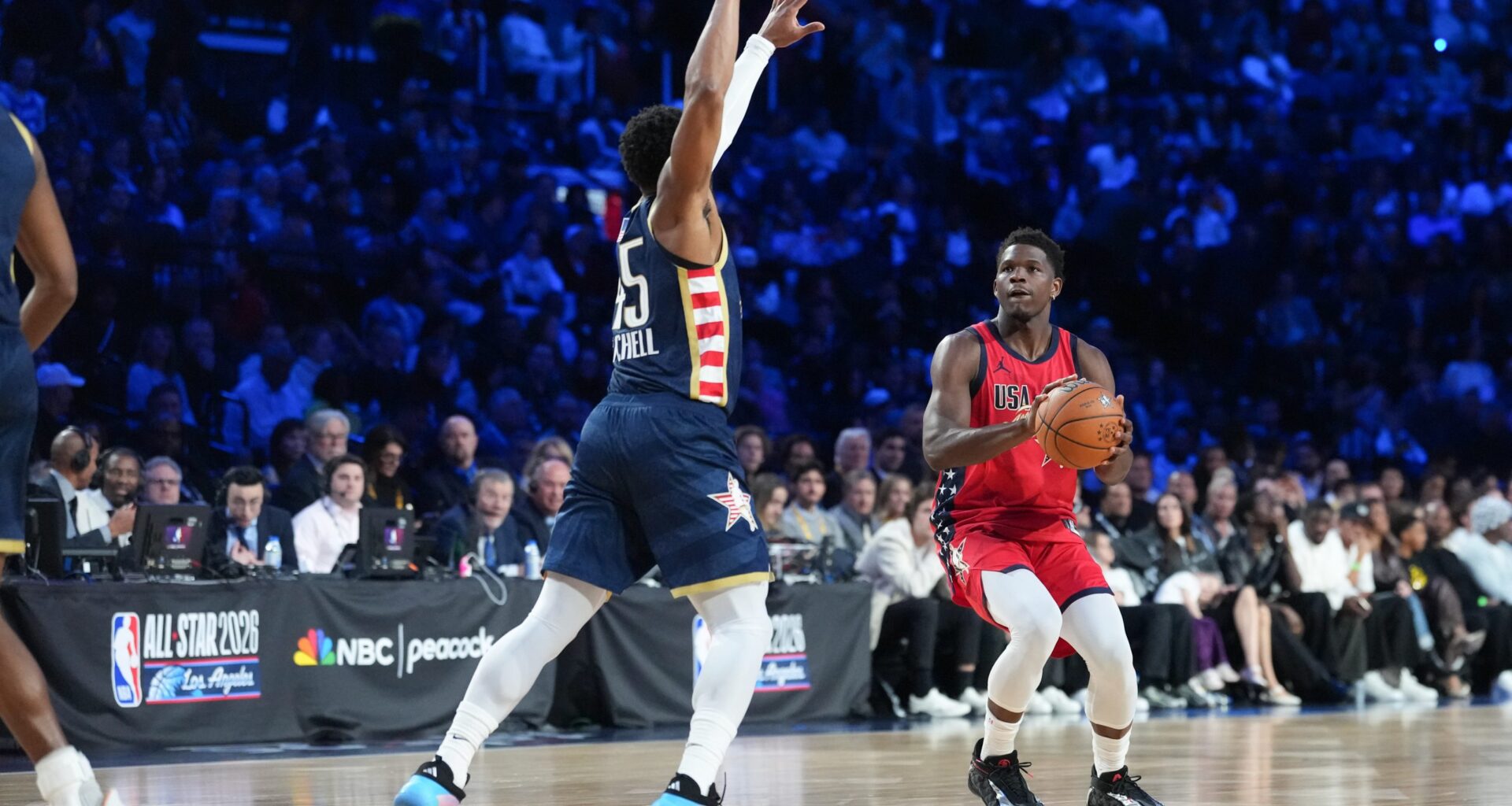
In its return to broadcast television on NBC, the revamped NBA All-Star Game bounced back both on the court and off.
Sunday’s NBA All-Star Game averaged 8.8 million viewers across NBC, Peacock and Telemundo, per a combination of preliminary Nielsen data and Adobe Analytics — nearly doubling last year’s Nielsen-only audience of 4.7 million on TNT Sports and marking the largest audience for the annual exhibition since 2011 (9.1M). (NBC’s position is that because Nielsen does not track its streaming viewership, its combined Nielsen + Adobe audience figures are comparable to the Nielsen-only figures of other networks.)
Final figures will not be available until Wednesday due to the Monday holiday.
The USA vs. the World round-robin, which peaked with 9.8 million in the 7 PM ET quarter-hour, delivered the largest audience for any traditional All-Star Game since the Major League Baseball edition drew 9.3 million in 2017. (If one counts last year’s NHL “Four Nations Face-Off” as an All-Star event, the final of that tournament drew 9.3 million.)
Keep in mind that Nielsen did not track out-of-home viewing in its estimates until 2020 and did not do so in 100 percent of markets until last year. In addition, Nielsen in September shifted to a new metric that combines “Big Data” from smart TVs and set-top boxes to its traditional panel. Those changes would not explain a year-over-year increase of such size, but will generally skew comparisons to prior years.
This year’s All-Star Game was the first to air on broadcast television since 2002, also on NBC. And just as in 2002, this year’s game was sandwiched between Winter Olympics telecasts in a 5 PM ET Sunday window. (The 2002 game also saw a pronounced viewership bump, benefiting not just from the Winter Olympics but also the presence of Wizards G Michael Jordan.)
While there were no shortage of complaints on social media about the earlier start time — and it likely affected in-person attendance in Los Angeles, where the festivities began at 2 PM local time — 5 PM is generally a better start time on Sundays than primetime. (One need only look at the NFL, whose largest audiences in a given week are during the 4:25 PM ET “national window” rather than “Sunday Night Football.”)
Between the return to broadcast television, the Winter Olympics lead-ins and lead-outs, and the improved timeslot, it is likely the case that literally any version of the NBA All-Star Game — even a reprise of East 211, West 186 in 2024 — would have hit a multi-year high.
But this year’s game likely benefited further from the new “USA vs. the World” format and the apparent increase in intensity that ensued. The first three quarters — each of which was a ‘mini-game’ with a winner and loser — were tightly contested. That was a far cry from the laid back efforts of recent years, which have been the subject of increasingly overwrought criticism.