
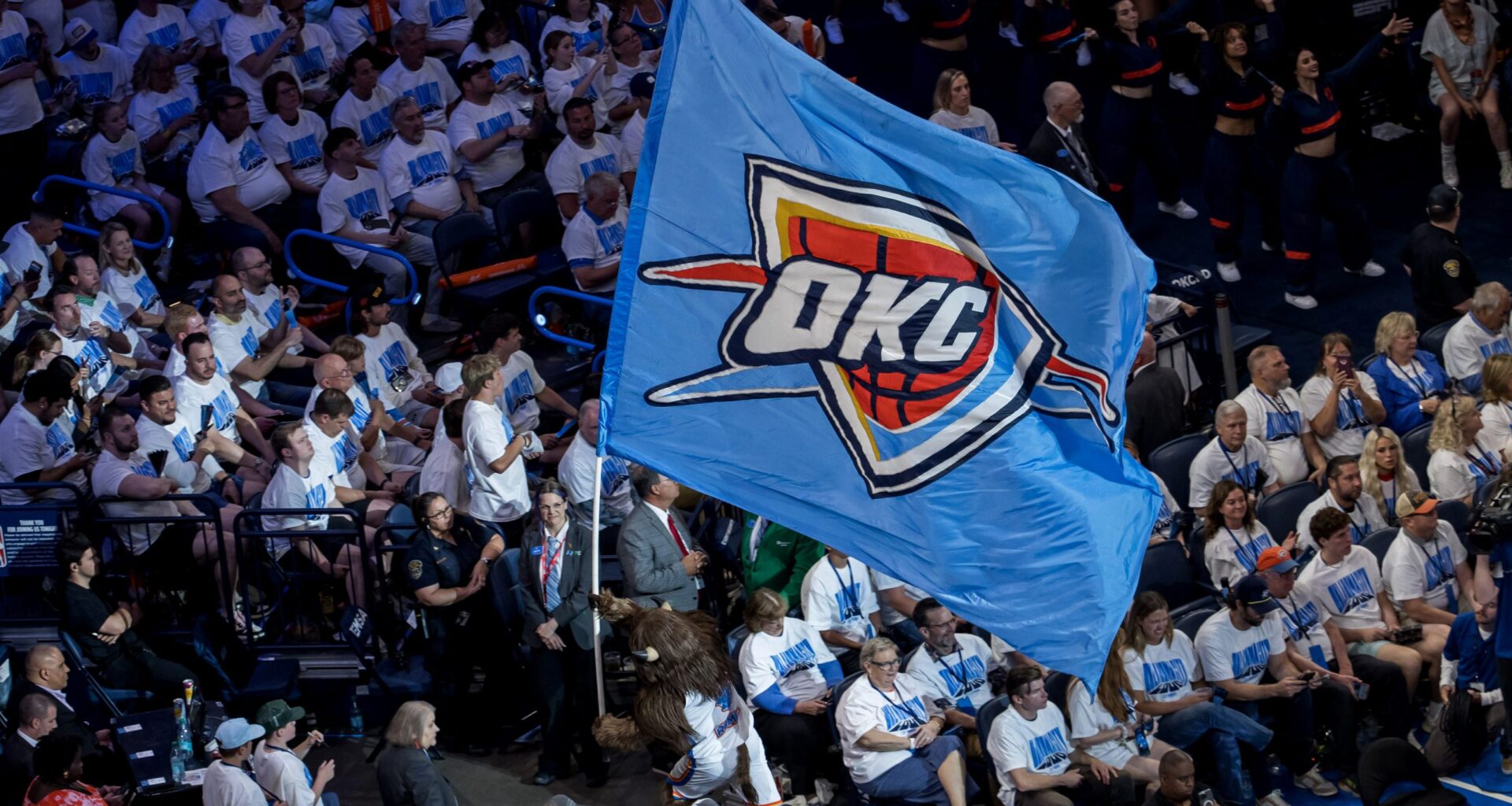
On a special edition of “The Needle,” SMW contributor and Oklahoma City resident Ben Huddleston takes a look at the Thunder’s NBA finals berth and concerns about a potential small market championship series.
Oklahoma City, the nation’s 47th-largest media market and home to this writer, will host the NBA Finals next week as the Thunder closed out the series against the Timberwolves with another dominant performance Wednesday night. Barring a comeback from the Knicks, OKC’s opponent in the league’s championship series appears to be the Indiana Pacers, who hail from the 25th-largest market.
The location and population of the two cities means one thing is nearly guaranteed: television viewership for the NBA Finals will be down from last year, probably to a multi-year low. This trend as already been observed this postseason — Oklahoma City’s Western Conference Finals run posted multi-year lows. As much as online conspiracists suggest, the league cannot rig its games to favor certain teams. It can only provide the platforms to feature its best teams in the best windows and let the games play out.
At times this postseason, the Pacers were seemingly hidden in unfavorable windows, even playing a game on ESPNU. If they win Saturday or Monday, the Pacers will be the first team since the 2003 San Antonio Spurs (a team with similarly difficult marketability) to play multiple playoff games on NBA TV.
Evidence suggests that more than market size, lengthy, compelling series are the primary driver for television ratings. The Toronto Raptors title-clinching Game 6 in 2019 averaged 18.3 million viewers, despite essentially having only one home market in the US for ratings purposes. That game outdraws every subsequent Finals game by nearly six million viewers. The most recent Game 7 (Cavaliers-Warriors in 2016) nearly doubles that figure.
But the NBA is not guaranteed to see a long series either. The Thunder concluded the regular season with an average point differential of 12.87 points, the highest average in league history. If that trend continues against the Pacers’ shaky defense, expect this series to wrap in four or five games at the most.
During the NBA’s early-season ratings slump, observers were quick to jump to conclusions about the cause of the decline. Among the reasons given was a claim that today’s players don’t play with defensive intensity, and that the three-point shot has ruined the quality of the game. The Thunder have played with a historically strong defense this season, and on Wednesday limited the Timberwolves to just 94 points, among their lowest of this postseason, and 12 successful 3-point shots. If defense really is the cure for the NBA, Thunder games would be must-see TV.
Market size is not often a concern for other sports properties. Prior to the release of this year’s schedule, the NFL’s television partners were clamoring for more games featuring the Kansas City Chiefs, from the #34 market, well below Indianapolis. Even further down the list at #69 is Green Bay, whose Packers are often a reliable draw for the NFL. Large markets are not always an indicator of success in the ratings. The 2023 World Series, which drew the worst average viewership on record, matched teams from the nation’s #5 market (Dallas) and #11 market (Phoenix).
There are so many storylines and personalities to make this an attractive series, if the league and its partners are willing to market it as such. An often-circulated photograph from the Thunder’s last appearance in the Finals shows Kevin Durant, Russell Westbrook, and James Harden sitting defeated at the end of a blowout loss in Game 5 to the Heat in 2012, with the expectation that those three would be back to the Finals stage soon and often. Instead, those three would all depart the city without a title, and a new “Big Three” has risen in its place: league MVP Shai Gilgeous-Alexander, All-Star Jalen Williams, and second-year sensation Chet Holmgren. In Indiana, Tyrese Haliburton has captured the spotlight during the Eastern Conference Finals run, demonstrating a combination of offensive skill and personality the league would be wise to promote in the future.
If one will allow this writer to defend his city: As Oklahoma’s only major-league professional sports team, the Thunder hold a special place in the hearts of Oklahomans.
When nearly 20,000 fans pack Paycom Center next Thursday night, with thousands more spilling out on Reno Avenue, not one of them will be concerned about the marketability of their favorite NBA franchise. But the NBA is not the city’s only sports attraction. Thursday also marked the start of the Women’s College World Series, held annually in OKC since 1990. The event has become an annual showcase for the city, with its popularity boosted locally by the recent success of the eight-time national champion Oklahoma Sooners. The city’s investment in a world-class softball venue will provide world-class exposure for the city in 2028, when the stadium will host the softball tournament as part of the Los Angeles Summer Olympics.
The small markets and the potential for blowouts will result in lower television ratings, which will result in less advertising revenue for ABC during the Finals. It seems odd that NBA fans would feel concern for the financials of The Walt Disney Company, a conglomerate with a $200 billion market cap. But does the league itself feel any heartache over the matchup? Probably not. In fact, one could argue that television ratings for the NBA Finals matter less now than at any point in recent history. The league successfully negotiated $76 billion in new, 11-year media rights agreements to begin next season, mostly by extracting value from the declining RSN model to create more exclusivity for its national partners. This year’s Finals allow the league to fully move beyond the LeBron and Steph era, and into its next generation of stars.
Since the “bubble” finals of 2020, the Heat and Celtics are the only teams to appear in the Finals more than once, with Boston’s 2024 championship the only title among them. What the league needs most for its future growth is a repeat champion with the expectation of contending year after year. This version of the Oklahoma City Thunder appears to be constructed to take that position. Their young championship core are all under contract for several more years, with a bevy of draft picks and developing talent to keep that high-level play going. The rest of the league will adjust to Oklahoma City’s strategies, which theoretically will provide more competitive matchups in the future. If the NBA on NBC of the 1990s was marked by the Jordan era, SGA and the Thunder may come to define the new era of NBA television coverage.