
Sports Media Watch presents thoughts on recent events in the industry, starting with the question of mystique and aura in the NBA Finals.
Asked about the New York Yankees’ mystique and aura on the eve of the 2001 World Series, then-Arizona Diamondbacks P Curt Schilling gave one of the most memorable answers in postseason history. “When you use the words ‘mystique’ and ‘aura,’ those are dancers in a nightclub.”
Whether or not the Yankees proved him wrong — New York authored two of the greatest World Series comebacks ever in Games 4 and 5, but ultimately lost to Schilling both that year and again in 2004 — the quote lives on as a thumb in the proverbial eye of superstition.
There are no curses (“Wake up the damn Bambino and have me face him!” Pedro Martinez once said in a fit of youthful impertinence. “Maybe I’ll drill him in the [backside].”) There are no little green leprechauns, as Kyrie Irving made clear when he stomped on “Lucky’s” face at midcourt. There is simply the action between the lines. Mystique and aura “are not things we concern ourselves with on the ball field,” Schilling concluded.
But there is more to sports than what the players concern themselves with on the ball field.
One of the main topics of conversation in the NBA Finals has been the lack of ‘aura’ in the presentation. In person at Gainbridge Fieldhouse for Games 3 and 4, one honestly could not notice. The crowd is so loud that it creates its own ‘aura,’ the gold shirts so plentiful that it seems to tint the court itself. Yes, a keen eye might notice that the YouTube TV logos are more noticeable than any for the Finals, but it is less of an issue in-person than on TV.
As for the TV presentation, a common criticism in this Finals has been that it feels like a regular season game. The atmosphere that is so all-encompassing in person rarely comes through in TV — particularly the raucous crowd noise, reduced to a more muted hum. The Finals TV presentation has rarely been so stripped down.
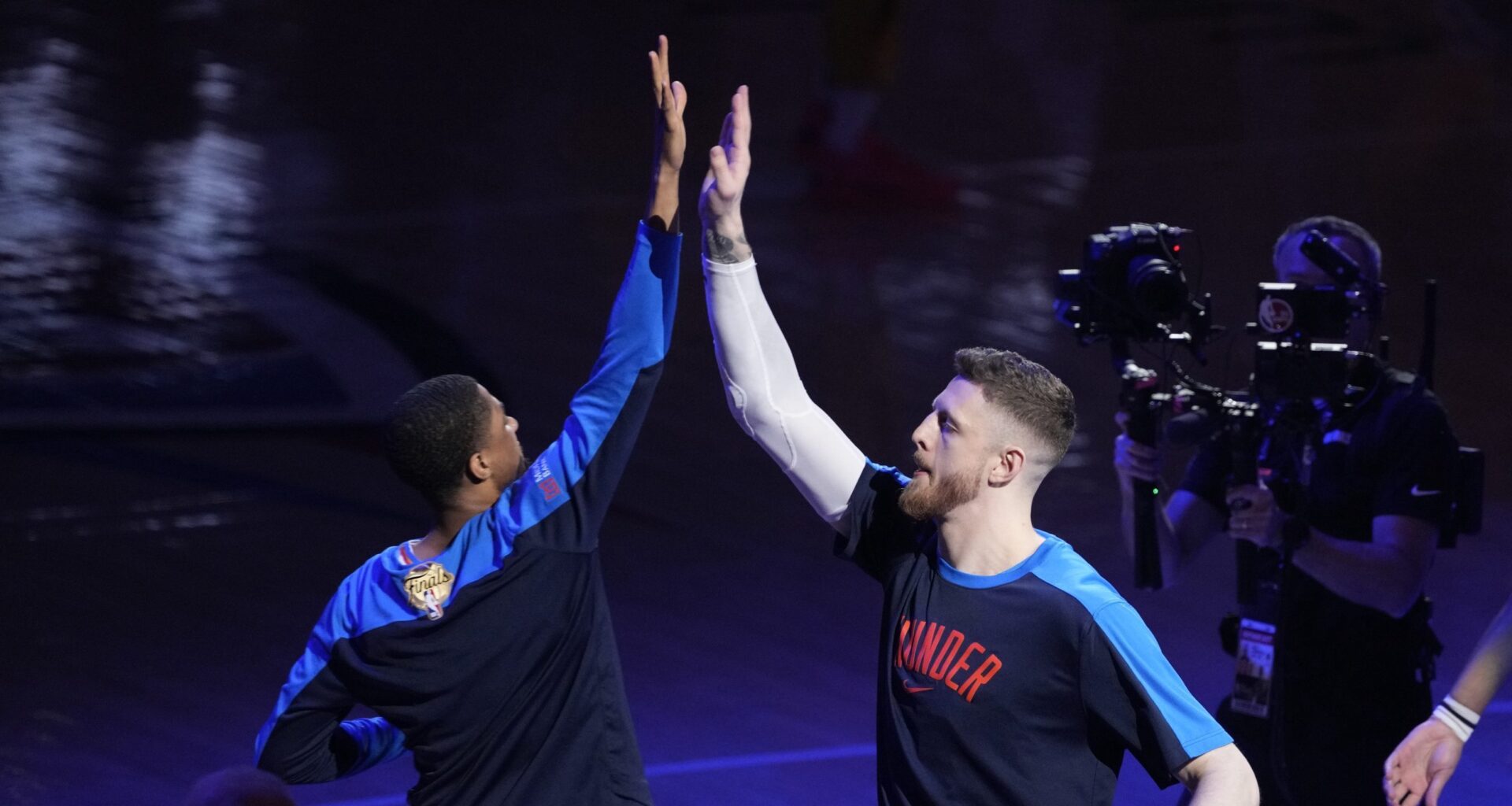
Thus, ABC on Monday carried the pregame introductions prior to Game 5 of the Finals. According to ESPN’s Shams Charania, who was first to report the news about his employer, it was the first such occurrence on a Finals broadcast since 2013. It is hard to believe 12 years have passed since ABC last carried the pregame intros, which were a staple — though not a constant — of predecessor NBC’s coverage.
Airing the pregame introductions is not something ABC has to do. It does not affect viewers’ ability to watch the game. The 12 years between televised pregame intros encompasses all four meetings of LeBron James’ Cavaliers and Stephen Curry’s Warriors, and it is difficult to recall any complaints about its absence. (Though it seems odd — even shocking — that the average fan has no idea what it sounds like in the Bay Area when Curry is introduced to the crowd.)
But the magic of sports TV is adding in those extra things that have nothing to do with the game.
What has happened in the past two — maybe even three — decades in sports television, particularly in the NBA, is that the little extras have taken a backseat to that which keeps the lights on: sponsored segments, advertising breaks, cross-promotion, synergy. Sports TV has become very efficient, and items like the pregame intros and opening tease either cost money or prevent the networks from maximally monetizing of the broadcast.
To be clear, this is not a condition that solely afflicts sports TV. As mentioned previously, even in person the YouTube TV logos in and around the court are more visible than those of the NBA Finals. The NBA long ago moved its logo (and as a result, the NBA Finals patch) to the back of jerseys in order to make room for uniform manufacturer Nike’s logo and an advertising patch.
Yes, it is true that neither the NBA Finals logo on the court nor the NBA Finals patch on the front of the jersey add anything tangible. There was no Finals logo on the court or on the front of the jersey during the classic Cavaliers-Warriors Game 7 in 2016. The game can speak for itself, can it not?
But on those occasions when the game itself is not enough — and those occasions are more frequent than purists may want to admit — it helps to have a signpost or two connoting significance. One would not expect to watch the Super Bowl without seeing the logo patch on the front of the jersey, or the World Series without the logo stenciled on foul ground. Player introductions are so commonplace in sports TV that it is borderline malpractice that ESPN/ABC skipped them altogether for more than a decade (again, NBC did not air them for every game, but did so at least once in each Finals).
The little things matter. There is a reason why Pacers fans line up to have the NBA Finals logo patch pressed onto their jerseys. There is a reason why theme songs from “Roundball Rock” to the NFL on FOX to the NHL on ESPN remain in circulation. A championship event that is simply the game in between some promos is perfunctory. Imagine the Masters without its pageantry, the Olympics without its fanfare, March Madness without One Shining Moment. It is hard to think of another event on the scale of an NBA Finals so lacking in those extra elements.
People tune in for the game, but they tune in for more than the game. If mystique and aura are just dancers at a nightclub, they are part of the reason why people keep coming back night after night.
Plus: Tiger, Salters, Ward, MLB
Speaking of mystique and aura, NBC on Sunday re-aired portions of Tiger Woods’ 2008 U.S. Open victory during a rain-delay in this year’s final round. It was a reminder of what the Tiger era meant to the game of golf — and the impact of his absence. It was also a reminder of the absence of another golf great, the NBC analyst Johnny Miller, also a tough act to follow.
It would certainly be something if NBC could remedy those two absences in one fell swoop.
In a world where Tom Brady calls NFL games on FOX every week and Michael Jordan is set for some unspecified role on NBC’s new NBA package, is there any chance at all that NBC (or CBS) could lure Woods to the broadcast booth?
No analyst has ever had a meaningful impact on the ratings, and it is unlikely that any ever will. Nonetheless, the PGA Tour was defined for two decades by Tiger Woods on Saturdays and Sundays. It would at least be worth a try to see if he might be as receptive to a TV role as Brady and Jordan, two icons of equivalent or even greater fame.
— Even though the circumstances were not good, it was nice to see Jorge Sedano get the opportunity to work NBA Finals games last week. Even so, Lisa Salters’ return to the sidelines Monday was welcome, as she has long been at the top of her field.
— With Ryan Ruocco becoming a father on Saturday, Pam Ward got the assignment to work the Fever-Liberty game on ABC. Ward took so many slings and arrows earlier in her career that it is easy to forget that she is one of the pioneers among women in play-by-play. While she was far from perfect on college football, the criticism she got in those days probably veered into the gratuitous, and ended up impacting her career arc.
— Major League Baseball has real momentum coming off of last year’s World Series, armed with superstar players in the biggest markets in the country. Few will want to admit it, but having superstars in New York and Los Angeles is good for one’s national television ratings. While national TV ratings are not the be-all and end-all, they tend to form the broader perception of a league’s health.
Perhaps those perceptions are way off, and one could argue that having Texas-Arizona (or Oklahoma City-Indiana as in the NBA) is a better marker of health than being dependent on New York and Los Angeles. But realistically, the vibes surrounding MLB on TV are much more positive this year than at any point in recent years, and with all due respect to teams like Detroit, it’s not because the Tigers are leading the AL Central.