
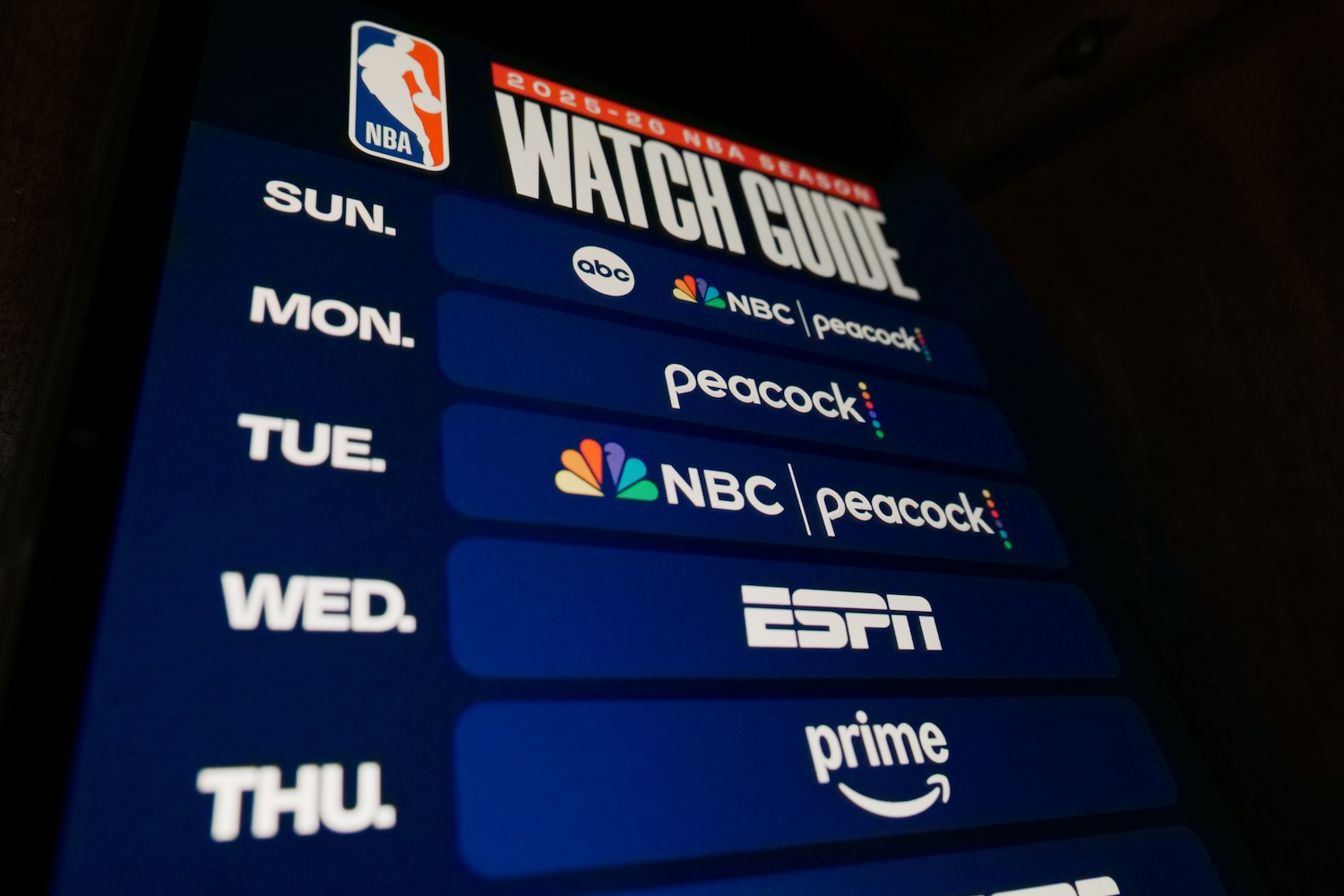
“I think the NBA’s got a big problem,” TNT NBA analyst Charles Barkley said on Bill Simmons’ The Ringer podcast this week. “How are they going to tell people what night the games are on?”
After more than two decades of TNT Tuesdays and Thursdays, ESPN Wednesdays and Fridays and ABC Saturdays and Sundays, how will fans become accustomed to a schedule where different networks can sometimes claim the same night of the week? With two new partners and their three new networks, plus the returning ESPN/ABC and NBA TV, navigating the NBA’s national schedule this season will be a taller than usual task.
Characteristically blunt, Barkley summed up what he believes is the league’s approach to its fanbase. “If y’all find the games fine, just make sure the check clears.”
The NBA and its VP of broadcast scheduling Gene Li are aware that the new media rights deal will be an adjustment for the fans. “I think it’ll be a learning curve for everyone to get used to these new cadences, and especially the new networks,” Li said in a conversation with Sports Media Watch Tuesday. To assist in that effort, the league plans to launch a feature through the NBA app, NBA.com and team websites that will take viewers directly to the respective apps carrying national games — Peacock (NBC/Peacock), the new ESPN DTC app (ESPN/ABC), and Prime Video. “Hopefully that will reduce some of the friction.”
The new media rights deal, which goes into effect when the season starts next month, marks the biggest transformation of the NBA on television since the 2002-03 season. That year, the league largely left broadcast television for a cable-heavy deal with ESPN and Turner Sports. The new deal sees the league dramatically increase its presence on over-the-air broadcast television and make a first-time shift to direct-to-subscriber streaming, largely at the expense of cable. As a result, there are some fundamental changes to the rhythm of the league’s national TV presence.
Perhaps the biggest is the addition of something unprecedented in the history of the NBA on television, a season-long weeknight window on broadcast television.
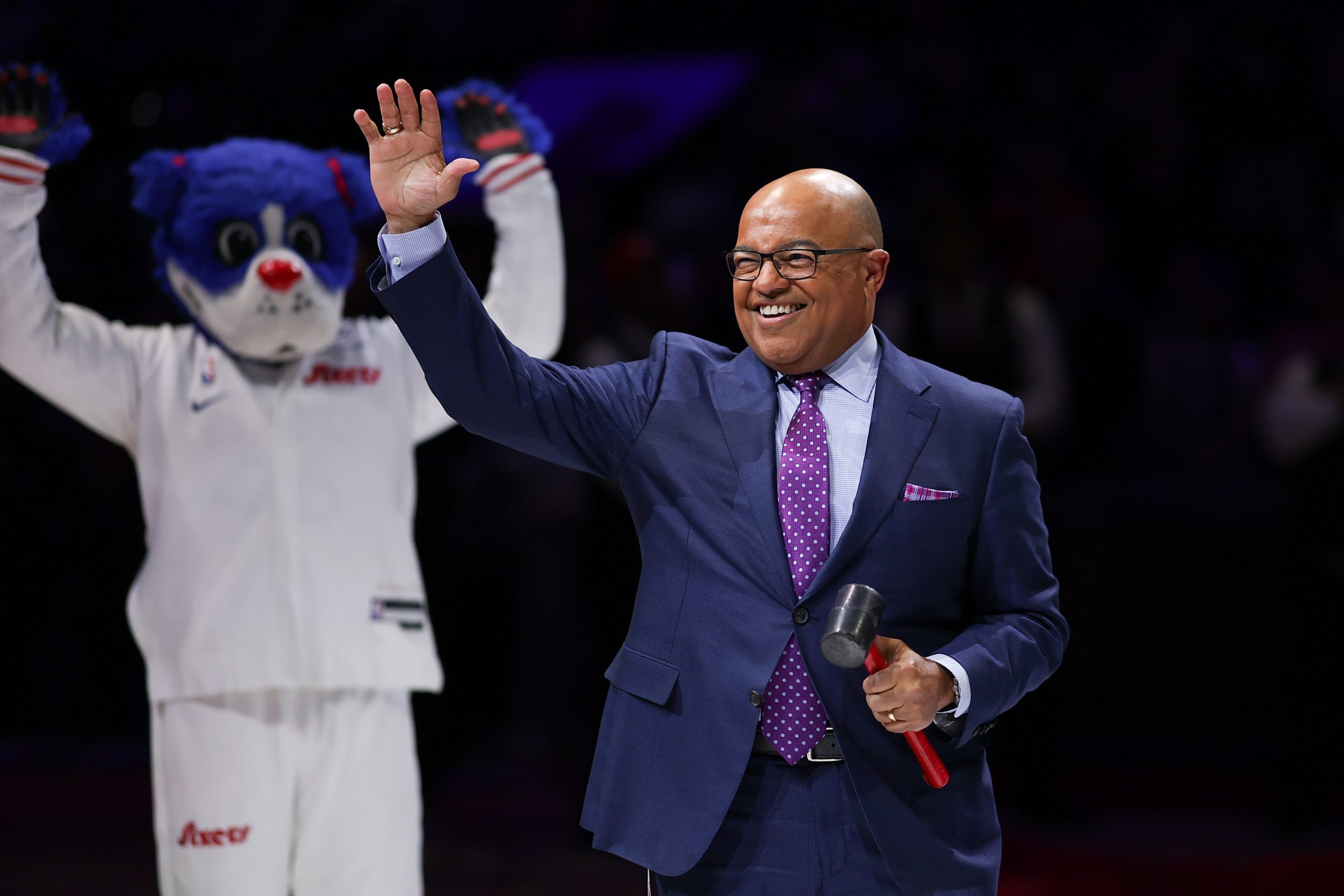 Mar 3, 2025; Philadelphia, Pennsylvania, USA; NBC Sportscaster Mike Tirico waves to fans before a game between the Philadelphia 76ers and the Portland Trail Blazers at Wells Fargo Center. Mandatory Credit: Bill Streicher-Imagn Images
The NBA has never previously “had a consistent broadcast window on a weeknight,” Li said. “That’s pretty rare right now. ‘Monday Night Football’ has some of that, Fox has college football on Fridays, but outside of those, it’s actually pretty rare for any broadcast station to have sports on a weeknight.”
Part of the reason is that live sports does not easily map onto the primetime schedule. Primetime on weeknights is 8-11 PM local time in the Eastern and Pacific time zones and 7-10 PM in the Central and Mountain. A live event that runs from 8-11 PM ET is necessarily disruptive in the Western time zones, where it preempts the newscasts and game shows that are the bread and butter of local affiliates.
Thus, for the Tuesday night NBC windows, the league has scheduled games for 8 PM Eastern and Pacific, with NBC affiliates generally getting only one game that will not meaningfully impact any daypart earmarked for local or syndicated programming (save for the Central time zone affiliates that will occasionally have to preempt the late local news for a West Coast game that starts at 10 PM local time). “It just so happens that with us having these over the air broadcast windows on Tuesdays, this is a way for us to have those while still being sensitive to the NBC local affiliates and their programming,” Li said.
While the 11 PM ET start times generated no shortage of reaction on social media when the NBA schedule was announced last month, the NBA’s position is that the Tuesday games are not a traditional doubleheader. “I would say for the fans on the East Coast that they should think of these [11 PM ET] games as Peacock games — not as a traditional double header, but really as one primetime broadcast window that is aggregated from two separate games, right? So one game that goes to NBC on the East Coast and then one that goes on the West Coast.”
For those East Coast fans watching an 11 PM ET game on Peacock, there is at least one consolation. Because the Tuesday games are not true doubleheaders, there is no need for the league to push back the start of the late game if the early game runs long. In general, Li said, the league is planning to “make the tip times more consistent across all networks,” including local RSNs.
In addition, the NBA — which several years ago moved up its national doubleheaders from 8/10:30 PM ET to 7:30/10 — has not otherwise changed its approach to national TV start times. “The actual true doubleheaders that we have on ESPN, Prime Video, Peacock, etc., the bulk of those will still be 7:30 and 10. We also have quite a few 7:00 and 9:30s as well.”
The 11 PM ET starts will not extend into the NBA playoff schedule, which the league is still finalizing, but that does not necessarily mean NBC will skip those Tuesday nights. Li said the league plans to “maintain some level of consistency in terms of days of week carrying through from regular season to playoffs.” Will that mean Sunday night games on NBC in the playoffs? That is still to be determined, but the answer will be impactful beyond the NBA — as it is increasingly likely that “Sunday Night Baseball” will be airing on NBCUniversal starting next season as well.
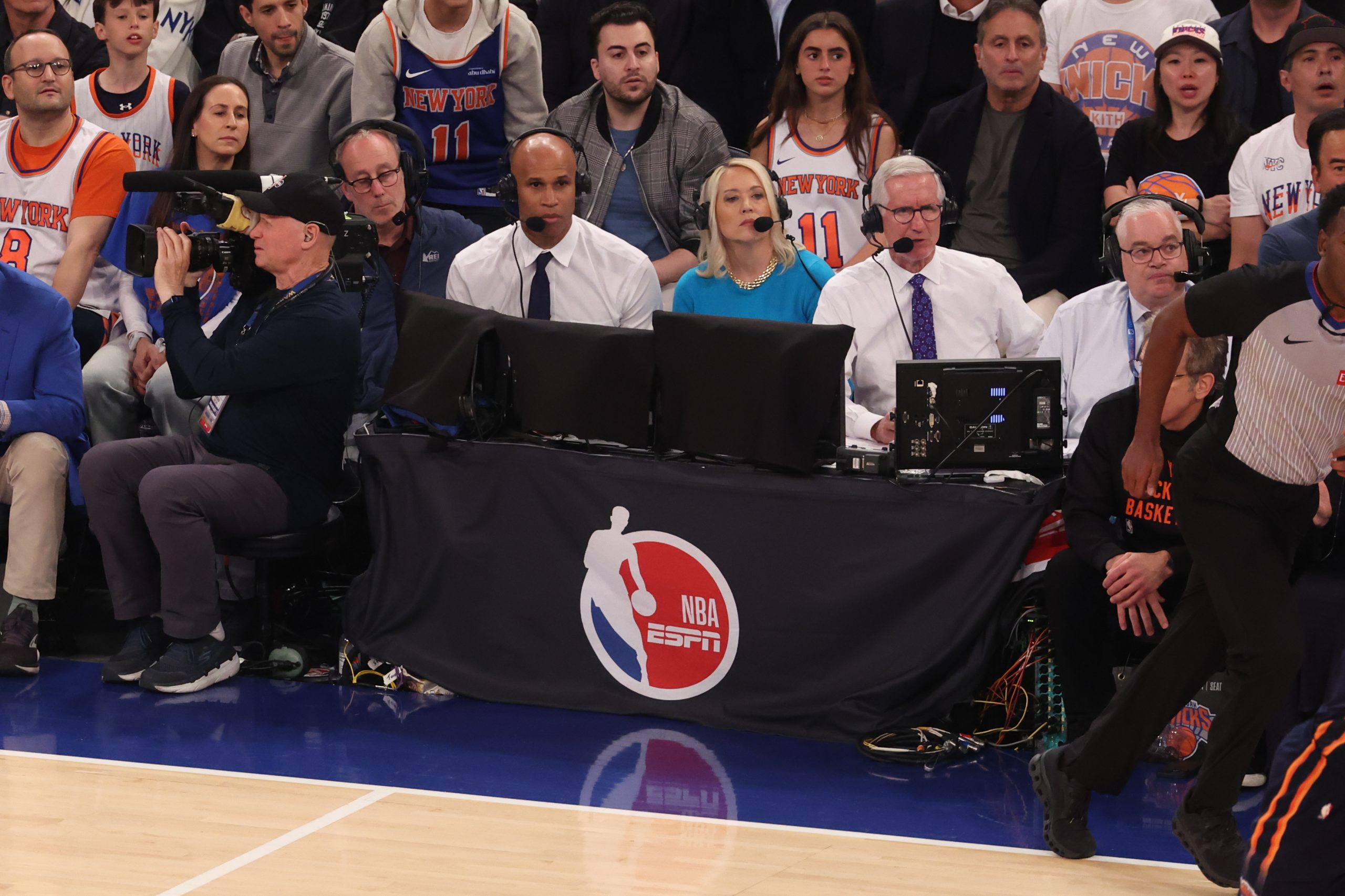 New York, NY – May 12, 2025 – Madison Square Garden: Richard Jefferson, Doris Burke and Mike Breen during game 4 of the 2025 Eastern Conference Semifinals.
(Photo by Ed Mulholland / ESPN Images)
The return of the “NBA on NBC” is one of the top headlines heading into the season, but it should be noted that NBCUniversal is still the “B” partner. ESPN/ABC is still the “A” partner, and ESPN has in the past year has begun referring to ABC’s “NBA Saturday Primetime” as the “marquee, national NBA game of the week.” For the first time in league history, the NBA has two primetime over-the-air packages to choose between for its biggest games, and while NBC is the “B” partner, Sundays are a far better night for television ratings than Saturdays.
Li was diplomatic when asked about how the league will balance the two windows. “I think that we did a relatively good job of trying to balance all of our marquee windows across not just ABC and NBC, but also, across all three partners [including Amazon].” He touted the league’s parity as creating an embarrassment of riches allowing it to spread the wealth. “When we have the luxury of just having so many strong, attractive teams and players that fans are interested in, it actually ended up being a relatively smooth process in trying to allocate all these marquee matchups into these marquee windows.”
ESPN/ABC still has the very biggest windows of the regular season, the league’s annual Christmas Day quintupleheader. The NFL has committed to scheduling a Christmas tripleheader every year going forward, leaving the NBA without any windows free of competition on the holiday. While Li said the league is “always exploring ways to optimize our broadcast windows for Christmas,” it does not have a ton of flexibility to avoid the NFL. An earlier late morning start is out of the question in consideration of the players. “I think what we’ve done has been relatively successful. Just the five windows that we have, starting from Noon Eastern and going all the way to 10:30.”
Even with all of the new mouths to feed, there will not be games on the league’s national media partners every night. As a result, there will still be inventory set aside for NBA TV, the league-owned channel whose operations will revert from TNT Sports to the league as of October 1. Details on the future of NBA TV, including its schedule for next season, will be available “very soon,” Li said.
 MSG broadcasters prior to Game 6 of the NBA Eastern Conference Finals (Jon Lewis/SMW)
With so much national TV tonnage, there has been understandable concern about the future of the NBA on RSNs. Knicks owner Jim Dolan, who owns the MSG RSN, wrote in a letter to the league last year that its new rights deal would give national TV so many games that it would risk “rendering the entire RSN model unviable.” Li conceded that the increase in national TV games — about a 45 percent jump — will “by default” result in “a slight reduction in the number of games that are available for local broadcast.”
But there are some limits. While all five platforms carrying the NBA will have the ability to air exclusive games, the same holds true of non-exclusive games — even on the broadcast television networks, whose games have traditionally been fully exclusive. Yes, ABC’s games will continue to air exclusively, as will NBC’s Opening Night doubleheader and Sunday night package. But NBC’s weekly Tuesday “Coast to Coast” games and Martin Luther King Day slate can be non-exclusive, a rarity for the NBA on broadcast TV.
Beyond the NBA, the new media rights deal also covers WNBA games. But unlike the NBA, the WNBA’s deal with NBC included games on the USA Network — which is being spun off from NBCU parent company Comcast into a new venture called Versant. Li said the league is “freshening up the deal terms,” an ongoing process that is hoped to be completed by the start of next season.
Also unlike the NBA deal, the WNBA deal rotates control of the WNBA Finals. Next year’s WNBA Finals was awarded to NBCU, and Li said that the setup for the now best-of-seven series is “also still being finalized in terms of the split between NBCU and Versant.”
In a changing industry, spreading the wealth has become the rule. The NBA is going from two partners and three networks to three and five. Major League Baseball could have as many as five partners and seven networks next season. Even the mighty NFL will spread its game inventory across FOX, NBC, CBS, ESPN, ABC, Netflix, YouTube and NFL Network this season. Given that, the act of making the schedule has become more complicated.
“It was much more challenging,” Li said, “probably two or three times harder, just because when you’re managing three partners, five networks, [that’s] just way more national TV games.”
For Li, putting the schedule together means more than just feeding the various network TV partners. “We have to consider the team schedules, right? We can’t make team travel and the team schedule cadences too onerous, just to hit this increase in national TV games. And so just having that balance of making sure that we are creating what we think is the best possible schedule, both from a national TV perspective, but also from a team schedule perspective, that certainly was made very challenging — but I think we somehow did it.”
“It wasn’t perfect, and so we’ll definitely learn from this first season, and then I’m sure we’ll try to improve for future seasons as well.”