
Welcome back to “The Needle,” a new ratings-focused column on Sports Media Watch that will break down the numbers, attempt to put some context behind the data, and discuss broader trends in measurement and television viewing.
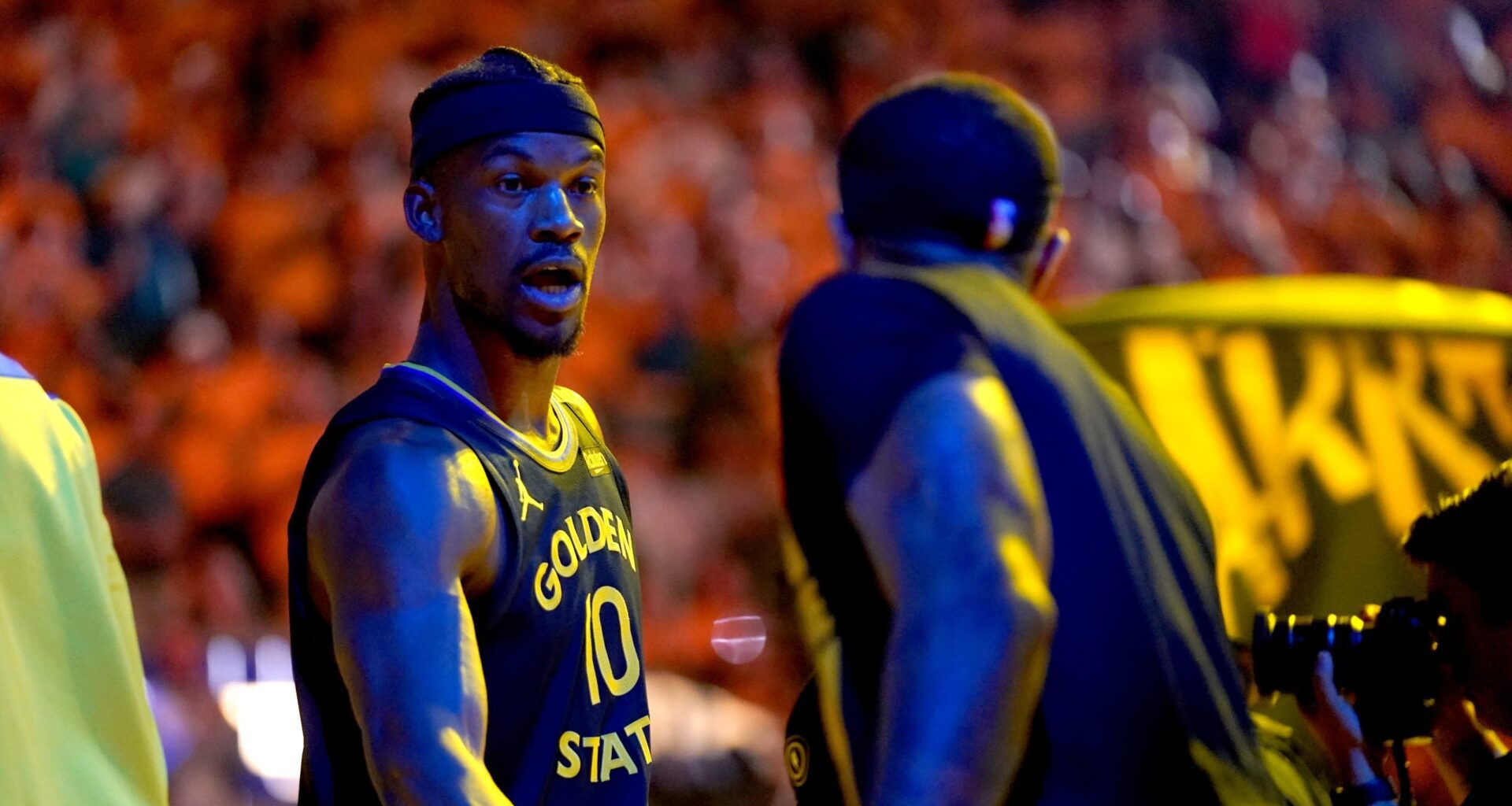
When the Golden State Warriors last played an NBA playoff Game 7 two years ago, an ABC audience of nearly ten million viewers tuned in to watch Stephen Curry score 50 points in a 20-point win over Sacramento — still the largest first round NBA playoff audience since 1999 (oddly enough also involving the Kings). Two years later, Golden State is back in another opening round Game 7, but instead of carrying the winner-take-all contest, ABC will be airing Formula 1.
ABC’s commitment to airing the F1 Miami Grand Prix over the NBA Playoffs has never made much sense, especially given the relative importance of those properties to the network. The same Disney that agreed to a $2.6 billion/year contract extension with the NBA is uninterested in meeting the F1 asking price of $150-180 million, and yet ABC is going fully dark on an NBA playoff weekend because of its F1 commitment. It is not as if the games are airing on ESPN instead, as TNT has both Sunday contests (Pacers-Cavaliers Game 1 leading into Game 7).
There is of course no ratings argument for carrying F1 in the timeslot that usually belongs to NBA playoff games. Last year’s F1 Miami Grand Prix was the most-watched yet with an audience of 3.1 million viewers — boosted by a direct lead-in from an NBA playoff Game 7 between Orlando and Cleveland (4.3M). That record F1 audience trails every NBA playoff game ABC has ever aired in its primary Sunday afternoon timeslot, including a Clippers-Mavericks game in the “bubble” that aired on the final Sunday of August opposite the Indy 500 (3.3M).
Already this postseason, ABC’s main playoff window has drawn audiences of 6.69 million (Magic-Celtics Game 1 on Easter) and 7.35 million (Lakers-Timberwolves Game 4), and even those figures are likely to pale in comparison to what a Warriors Game 7 could draw.
There is of course nothing stopping ABC from airing an NBA game after F1, other than the network’s steadfast commitment to its Sunday night line-up. (It should be noted that ABC’s insistence on wrapping up its sports programming by 6 PM on Sundays largely prevents “Idol” from drafting off of the sports-fueled lead-ins that other primetime shows enjoy.)
For the NBA, the scheduling is another reminder of ABC’s insufficiencies as a broadcast partner. The nearly two-week gap between ABC’s games last Sunday and its games next Saturday will be the longest the NBA has gone between playoff windows on broadcast television. The idea of NBC, or even CBS, skipping a playoff weekend is unheard of.
The new media rights deal will remedy much of this, as NBC is set to carry at least 14 early round playoff games per year — more than ABC has ever carried prior to the Finals. It would seem fairly likely that the TNT windows this weekend will be NBC windows a year from now, including a likely Kentucky Derby lead-in on the first Saturday in May.
In the meantime, the NBA for the second time in three weeks this postseason will fail to maximize its audience. Until the new deal kicks in, the league’s most-watched timeslot is Sunday at 3:30 PM ET on ABC. The only chance of the Warriors playing in that window this postseason is in two weeks — either a Game 7 against Minnesota or a Western Conference Finals Game 1.
In the first round, the difference between 3:30 on ABC and primetime on TNT is not simply between broadcast and cable, but also between exclusive and non-exclusive. TNT’s Game 7 broadcast will have to co-exist with the Warriors on NBC Sports Bay Area and the Rockets on Space City Home Network, the final NBA playoff telecasts ever on an RSN (all first round games are exclusive to national TV in the new deal).
In addition, primetime is generally not as strong a window on Sundays as the late afternoon, as anyone who has observed the NFL’s ratings can attest. (The 4:25 PM ET “national window” consistently outperforms “Sunday Night Football.”)
The difference between an exclusive Sunday afternoon window on broadcast and a non-exclusive Sunday night window on cable is unlikely to be negligible. Game 7 should still perform well, but it would be a surprise if viewership got anywhere close to the 9.8 million Warriors-Kings drew two years ago.
When it comes to the ratings, the stakes may never be lower than in the lame duck year of an expiring rights deal. Viewership is up so far this postseason, and just having two first round game sevens — regardless of network or timeslot — should help extend the lead over last season. Nevertheless, for a league whose ratings are endlessly scrutinized, the NBA continues to leave viewership on the table in this postseason.
It is not as if ABC will benefit from the decision. Last year’s Miami GP only set a record because of its NBA lead-in. Assuming an audience in line with 2023 — when the race had 2.1 million — ABC could end up falling five or six million viewers short of what it could have drawn airing the NBA, and that may be conservative. That shortfall could impact the primetime line-up the network so strenuously protects.
Last week’s “American Idol” had a season-high 5.31 million viewers, and while much of that was due to the show’s first ‘live coast-to-coast’ airing of the season, surely one factor was the residual impact of ABC’s Lakers-Timberwolves game — which swelled to more than 10 million viewers in the 6:30 PM ET quarter-hour. Last year’s F1 race, by comparison, peaked with 3.6 million.
Plus: Lakers’ exit, Kentucky Derby, Caitlin Clark
The Lakers’ swift elimination from the playoffs was no doubt a downer for the NBA and its media partners. LeBron James, Luka Doncic and company were the league’s biggest draw throughout the regular season, even moreso than the Warriors, and that continued into the playoffs. The five-game Timberwolves-Lakers series accounts for four of the nine largest playoff audiences through Wednesday.
After their Game 4 loss to the Timberwolves delivered the largest audience of the playoffs thus far — and the third-largest first round playoff audience overall since 2002 — the Lakers’ series-ending Game 5 loss was the most-watched game of the playoffs on cable with 4.71 million on TNT. A Game 6 Friday night and certainly a Game 7 on Sunday would have been welcomed. Anthony Edwards and company had other plans.
Horse racing’s Kentucky Derby flies under the radar, but there are few sporting events that rival the fastest two minutes in sports in terms of viewership. Among non-football sporting events over the past year, last year’s audience of 16.7 million — 15.9 million per Nielsen, plus 714,000 per Adobe Analytics — is exceeded only by the Olympics, Game 5 of the Dodgers-Yankees World Series (18.15M) and the NCAA men’s basketball national championship (18.1M).
It should be noted that the main Kentucky Derby telecast window — typically referred to as the “race portion” or “race segment” — does not solely consist of the race. The purpose of television ratings is to sell ads, so the “race portion” is the final hour or so preceding the race. In other words, an average of about 16-17 million viewers per minute consumed an hour of horse racing last year, not bad for a sport that is perceived as terminally outdated.
There is a reason why the Kentucky Derby is such a powerful lead-in. NBC has used the race to juice viewership for events from the NBA Playoffs more than 20 years ago to — more recently — the NHL, golf and even USFL football. Expect the NBA to get that post-Derby slot again starting next year.
One interesting sports viewership item to keep an eye on this weekend is the audience for Sunday’s WNBA preseason game between Caitlin Clark’s Indiana Fever and the Brazilian national team. Taking place at Clark’s alma mater in Iowa, the game will air in a cushy 4 PM ET timeslot on ESPN. WNBA preseason games have rarely aired on any form of television, much less the ESPN flagship network, but the Clark effect needs no recapping here.
It seems doubtful that even Clark could draw a seven-figure audience for a preseason game, but given the stark lack of competition — there are no afternoon NBA or NHL playoff games on Sunday (or all weekend) — it would be foolish to rule it out.