
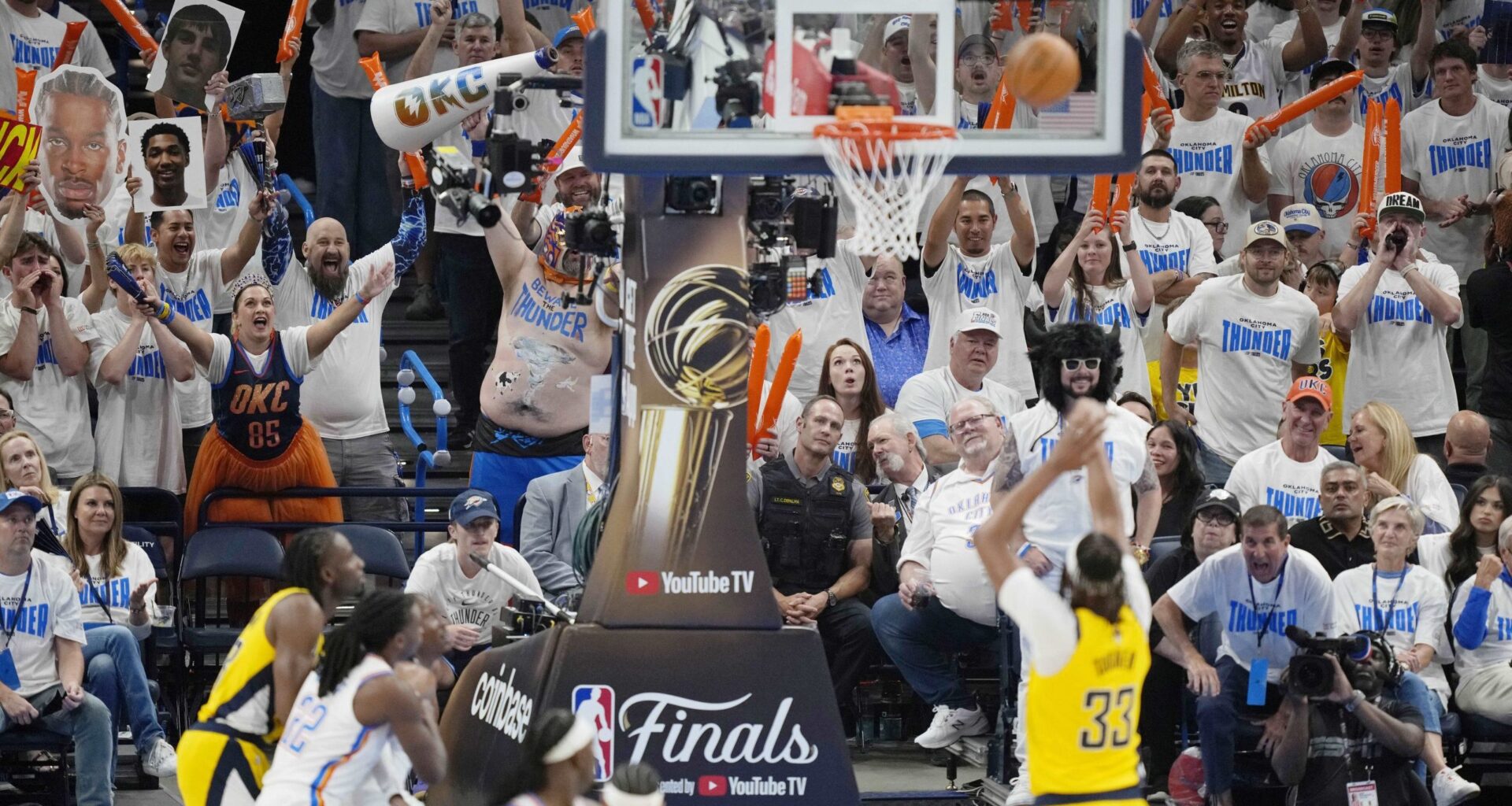
A championship event like the NBA Finals requires a championship presentation. Not to get too philosophical, but this is fundamentally just a basketball game. It’s the same game that was played hundreds of times in the regular season, and the same game that will be played casually thousands of times every day at courts around the world. But humans have chosen to intentionally elevate the significance of these seven games to mean something more than the rest, to determine which team will go down in history as the champion of this season, alongside the great teams of the past.
That elevated significance does not come automatically. Just having NBA teams play games in June on ABC does not make them the NBA Finals. A certain amount of pageantry, decoration, atmosphere is required to turn a playground game into a do-or-die championship event. Much has already been written about the quality of the TV presentation, with some suggesting the games don’t “feel big” enough on TV. In person, however, the league has gone all-out to create a big environment in the first games in Oklahoma City this week.
Just to the west of Paycom Center sits Scissortail Park, a recent product of the city’s 1993 urban development sales tax initiative, which also produced the arena itself. On this sunny evening the park is alive with Thunder fans enjoying musical entertainment as kids play in the grass and the smell of food trucks fills the air. The Thunder has created this gathering place to elevate the event experience beyond the walls of the arena and into the heart of the city.
NBA branding is omnipresent in the city, even on billboards miles away from the game. As one approaches the arena, the streetlights are adorned with portraits of OKC’s roster, providing one final refresher to casual fans who may be here to engage with the event, rather than the basketball. The classic script “Finals” logo is plastered all over the arena. Several stations are set up for photo opportunities inside and outside the arena, giving fans a chance to commemorate this moment in the city’s history.
But all the presentation and decoration means nothing if those that engage with it don’t buy in. While basketball fans know that the outcome will not fundamentally effect their life in a significant way, they’ve chosen to collectively suspend reality and participate on Sunday night as if it is the most important game in history. Fans have entered into a mutual agreement with the NBA: the league will produce a high-quality basketball event, and the fans will treat it as such. In Oklahoma City, the fans have certainly held up their end of the deal.
Starting with the obvious: it’s very loud inside the arena. As the clock ticked down approaching the start of the game, the unison clapping of 18,000 fans was amplified by cardboard clappers, taking the volume to a deafening roar. Visually, the sea of matching t-shirts (white for Game 1, Thunder blue on Sunday) helps create a unified body of fans. The t-shirt is a prime example of the contract fans make with the league: by putting on this shirt, the fan chooses to engage passionately with the game in front of them, setting aside what they know to be true about the relative insignificance of a single basketball game.
The energy from the fans inside never stopped, but reached new heights in the fourth quarter. Sunday’s performance from the Thunder was one OKC fans have come to expect this season, defying the specter of another magical comeback from the Pacers. The Thunder carried a thirteen-point lead into the final intermission, as AC/DC’s “Thunderstruck” rallied the crowd once more. With just over three minutes remaining, Alex Caruso‘s three-pointer pushes the lead up to 21, and OKC fans start to relax. The final seconds tick down and as the buzzer sounds, streamers and confetti punctuate the story: the Oklahoma City Thunder have just won their first NBA Finals game since 2012. As fans exit to the concourse and out onto the streets, chants of “OKC!” ring out everywhere.
The Thunder’s history in OKC has been tremendously successful. They’ve appeared in the Western Conference Finals five times in their 17 years in the city. For Thunder fans, an appearance in the NBA Finals is about more than a dominant basketball program. It’s a chance to showcase the city on an international stage, to welcome hundreds of media from around the world, and celebrate the growth of the city that’s taken place in the thirteen years since OKC’s last appearance in the Finals.
Those feelings, positive as they may be, have evidently not resonated on a national level. Sunday’s game was the least-watched Game 2 in June in more than twenty years. Some of that may be due to correctable issues by the league and ESPN, some of that is simply the result of the small markets involved. But in Oklahoma City, it certainly doesn’t feel like a record-low Finals. As this community gathers together to rally around their team — in the largest event locally in more than a decade — there is palpable NBA Finals-level energy throughout the city.